Roku Labs Goes Live: Experimental Apps Come to the Big Screen
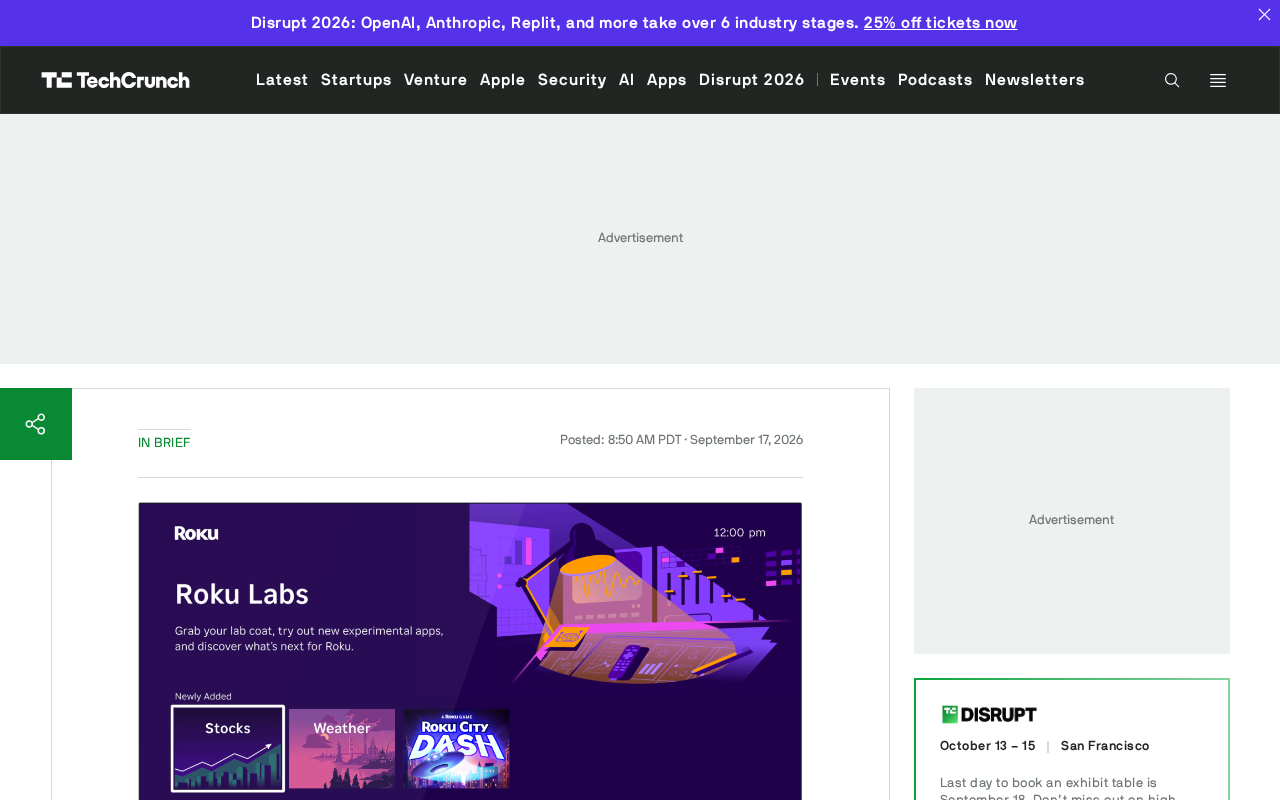
Roku's new OS update debuts Roku Labs, personalized home screens, and subscription bundles to reinforce its living room platform role.
Roku's latest OS update delivers three key features: Roku Labs, a hub for experimental features; personalized home screens expanding to more markets; and streaming subscription bundles to simplify multi-service management. Roku Labs borrows the "labs" model from products like Google Chrome to bring early adopters into the feedback loop and lower iteration costs. Personalized home screens improve retention by dynamically adjusting layouts based on viewing habits, while subscription bundles follow the industry's aggregation trend to position Roku as users' central billing hub. Together, these features reflect a unified product strategy: use software innovation to secure Roku's role as the core gateway in the smart TV ecosystem and grow its advertising and subscription revenue.
Roku Labs: Bringing Experimental Features to the Living Room
Roku's latest operating system update introduces a new hub called Roku Labs, dedicated to hosting experimental apps and features. For users who love trying things early, this means getting hands-on with features still in testing — on the big screen — without waiting for an official release.
This "labs" approach to product development is nothing new in the software world. Google, Chrome, and countless internet products have used similar mechanisms to open up unfinished features to early adopters. Roku bringing this model to the smart TV ecosystem signals a clear intent to further differentiate its streaming device software experience.
Other Highlights From This OS Update
Beyond Roku Labs, this OS update also delivers several improvements for everyday users:
Personalized Home Screens Expand to More Markets
Roku is rolling out personalized home screens to more markets. These dynamically adjust the homepage layout based on a user's viewing habits and preferences, surfacing frequently used apps and recommended content more quickly. On a platform with vast amounts of content, a smarter home screen can meaningfully improve how efficiently users find what they want.
Streaming Subscription Bundles
The update also introduces streaming subscription bundles. Packaging multiple subscription services together simplifies billing and management for users, while also aligning with the broader industry trend toward aggregated distribution. In an era of increasingly fragmented streaming subscriptions, whoever can offer the most convenient single entry point is well-positioned to become users' default platform.
The aggregation trend in streaming has grown steadily more prominent in recent years. Apple bundles Apple TV+, Music, Arcade, and more through Apple One; Amazon embeds Prime Video within the broader Prime membership. Roku pushing into subscription bundles is fundamentally a play to become the "bill aggregator" — once users are accustomed to managing and renewing multiple services through Roku, the platform gains both stronger user retention and greater negotiating leverage. For content providers, joining Roku's bundle ecosystem means access to a more stable distribution channel, but it also requires sharing a portion of subscription revenue as a platform commission — creating some tension with the direct-to-consumer sales strategies streaming services had previously favored to cut out the middleman.
Why This Matters
Roku's update may look like routine iteration, but the combination of features reveals a coherent product strategy: use Labs to capture early adopters, use personalized home screens to improve retention, and use subscription bundles to strengthen monetization and stickiness.
As a streaming OS whose primary revenue model is built on advertising and platform services, Roku increasingly relies on software-layer innovation to cement its position as the gateway to the living room. Roku Labs is effectively pulling user feedback earlier into the product development loop, letting the platform experiment with new directions at lower cost.
For everyday users, the most immediate benefits are straightforward: access to new TV features sooner, a more personalized interface, and simpler subscription management.
Roku's business model differs fundamentally from traditional hardware manufacturers. Its revenue is driven primarily by platform services — including ad revenue sharing, subscription commissions, and data licensing — rather than device margins. This is precisely why Roku has long sold streaming sticks and TVs at near-cost, prioritizing the expansion of its activated account base so it can monetize through software over time. Under this logic, every system update isn't just a feature release — it's a business decision that directly impacts the platform's ARPU (average revenue per user). The launches of Roku Labs and subscription bundles are, at their core, further efforts to extract more value from user lifetime within this same framework.
Wrap-Up
With this OS update, Roku weaves together three threads: experimental apps, personalized experiences, and subscription aggregation. Roku Labs is the most headline-grabbing of the new additions — offering the platform a flexible testing ground for new features while giving curious users an early window into what's coming. As these features roll out to more markets, Roku's competitive position within the smart TV software ecosystem is well worth keeping an eye on.
Related articles
AI Plays Pokémon Red: Jev Clears Two Gyms for Under $2
A Reddit user had AI model Jev play Pokémon Red in real time while Opus 5 built the harness on the fly — clearing two gyms for under $2, showcasing low-cost AI agents.
How Should a 20–30 Person Team Choose the Right Multi-Agent AI Platform?
How should a 20–30 person startup choose a multi-agent AI platform? Based on real Reddit discussions, this article analyzes the selection challenges for small teams and offers practical advice.
One Year of Sponsored Servo Development: The Revival of an Independent Browser Engine
A look at Servo browser engine's first year of sponsored development: how Rust-based open-source engine revival advances Web diversity and sustainability.