ROS2 for Beginners: Hands-On Embodied AI with Python and C++
Bilibili creator Edward releases a zero-foundation ROS2 course with dual-language hands-on teaching.
This article introduces a zero-foundation ROS2 introductory course on Bilibili by software engineer Edward. Based on his experience developing ROS programs for a six-axis robotic arm from scratch, it addresses beginners' lack of a structured learning path. Starting with ROS2 installation on Ubuntu, it covers nodes, topics, services, messages, parameters, and launch files, with all code in Python and C++. The final project is completed in Turtlesim, and prerequisites are minimal.
The barrier to robotics development is being lowered by a single course. On Bilibili, a software engineer and entrepreneur who goes by Edward has released a zero-foundation ROS2 introductory course, claiming it can take beginners from environment installation all the way to complete hands-on practice with nodes, topics, and services—with all code written in both Python and C++.
The core selling point of this course is straightforward: beyond explaining "how to do it," it also explains "why."
Course Background: Experience from a Six-Axis Robotic Arm to Tens of Thousands of Students
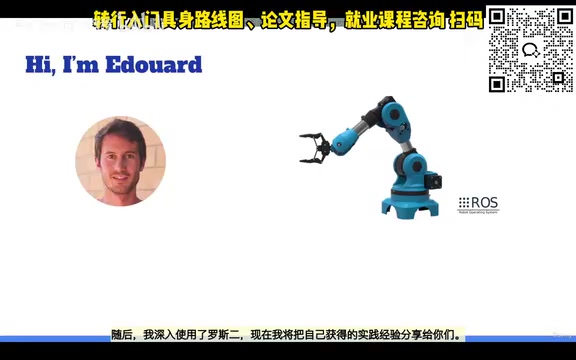
In the course introduction, Edward lays out his engineering credentials: he once wrote programs for an entire six-axis robotic arm using ROS from scratch, then went on to use ROS2 extensively, turning that practical experience into teaching content. He mentions that he has taught ROS2 to tens of thousands of students from around the world.
This background explains why he created the course: when he first learned ROS, he struggled to find well-structured courses and tutorials that told him what mattered most in the early stages, where to start, what to focus on, and which path to follow. This course is the version he "wishes he had when he was first learning." For learners, a course structure reverse-engineered by a frontline developer is usually closer to the actual rhythm of development than pure theoretical textbooks.
Course Structure: A Gradual Path from Installation to Practice
The course is designed as a step-by-step route. It starts with installing and configuring ROS2 on the Ubuntu operating system, then moves into ROS2's core concepts: nodes, topics, services, messages, parameters, launch files, and more. Edward states clearly that these points are the key concepts one must master to use ROS2 efficiently.
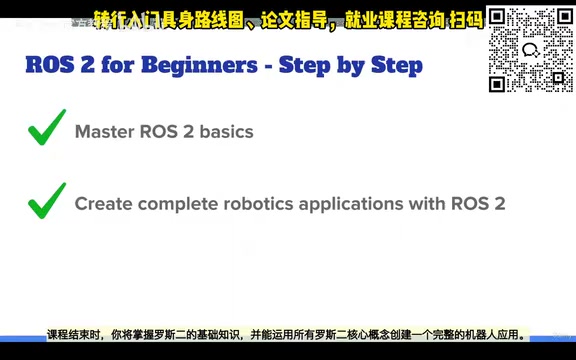
In addition to concept explanations, the course also covers ROS2's most important toolchain, with the goal of helping learners save development time. This combination of "concepts + tools" is relatively friendly to beginners: concepts solve cognitive problems, tools solve efficiency problems, and missing either one will cause stumbling blocks in real projects.
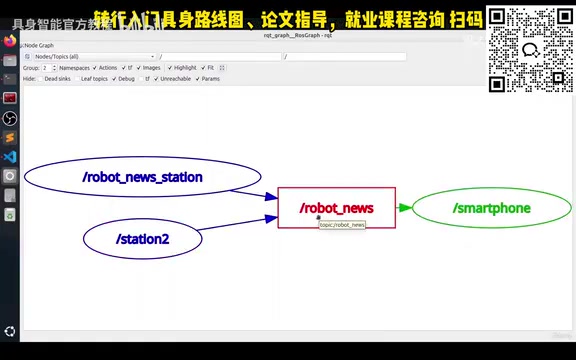
ROS2 Nodes and Topics: A node is the basic execution unit in ROS2, and each node typically handles one independent function (such as reading sensors or controlling motors). Nodes communicate asynchronously through topics: publishers send messages to a topic, and subscribers receive messages from the topic, with neither side needing to know the other exists. This publish-subscribe model is the foundation of ROS2's loosely coupled, distributed architecture—only by understanding it can you understand mechanisms such as services and parameters later.
Services and Messages: A service is a synchronous request-response communication method, where the client sends a request and waits for the server to return a result. It is suitable for operations that need immediate feedback (such as querying status or triggering actions). Messages are the data structures transmitted in topics and services. ROS2 predefines a large number of standard message types and also allows user-defined ones. Together, nodes, topics, services, and messages form the skeleton of ROS2 communication.
Dual Languages and Hands-On Exercises: You Have to Write the Code Yourself
The course uses both Python and C++ to write code throughout. According to Edward, learners can, if they wish, fully master ROS2 with these two languages. For developers in the embodied intelligence field, this setup has practical significance: Python is suitable for quickly validating algorithm logic, while C++ is suitable for robot low-level modules that require performance and real-time capability—neither path can be avoided.
The course emphasizes extensive hands-on practice. Edward writes code together with learners, explains every step, and assigns challenges to help learners improve on key concepts. This "follow along + be challenged" model makes it easier to build muscle memory than simply watching video demonstrations, and it also exposes blind spots in learners' understanding.
The Division of Labor Between Python and C++ in ROS2: ROS2 officially supports both Python (rclpy) and C++ (rclcpp) client libraries. Python code is concise and iterates quickly, making it suitable for algorithm prototype validation and upper-layer logic; C++ offers high performance and controllable memory, making it suitable for low-level modules such as real-time control and sensor drivers. The two communicate through the same ROS2 interfaces and can be mixed within the same system. Therefore, the course's requirement to write in both languages is not redundant—it equips learners with the ability to choose tools according to the scenario.
Final Project: Comprehensive Practice in the Turtle Simulation Environment
At the end of the course, an exercise is completed using the Turtle simulation environment (described in the original text as the "Turt" simulation environment). Learners need to complete a full ROS2 project in this environment, thereby comprehensively applying everything learned in the course.
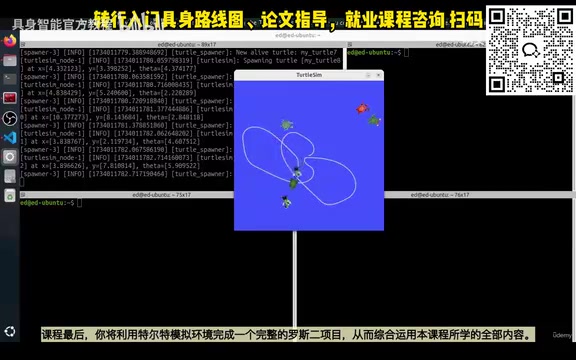
The value of a simulation environment lies in reducing the cost of trial and error. Real robot hardware is expensive and has long debugging cycles. Running through links such as node communication, topic subscription and publishing, and service calls in a simulated environment before migrating to a physical robot is a more pragmatic engineering path. Placing the final project in simulation also shows that the course focuses more on core software-level capabilities rather than hardware operation.
Turtle Simulation Environment: Turtlesim is a lightweight 2D simulation tool officially provided by ROS2 for teaching and introductory demonstrations. It simulates a turtle moving on a canvas. Learners can write nodes to publish velocity commands and subscribe to pose information, intuitively observing the effects of topic communication and service calls. Although Turtlesim itself does not involve complex physics simulation, it is enough to cover ROS2's core communication mechanisms and is an ideal sandbox for validating concepts such as nodes, topics, services, and parameters.
Who It Is For: Prerequisites and Expectations
Edward's prerequisites are clear: you only need the ability to operate a terminal and some basic programming knowledge to start learning. The course does not require you to already have robot hardware, nor does it require you to already be a C++ or Python expert.
The course also promises to share some best practices that Edward has personally summarized while developing ROS2 applications. The goal is not just for learners to "develop decent robot applications," but to "build excellent and scalable robot applications." This positioning is worth noting: scalability is precisely what many introductory tutorials lack. Beginners can often get demos running, but then fall into structural chaos once the project grows.
It should be noted that this course comes from a single-source course introduction. Its actual teaching quality, update and maintenance status, and statements such as "tens of thousands of students" all come from the instructor's self-description. Learners can judge for themselves by combining this with trial chapters before enrolling. Zero-foundation learners who are interested in embodied intelligent robot development and do not want to be discouraged by a steep learning curve can evaluate it as a structured starting point.
One-line Summary
Bilibili creator Edward releases a zero-foundation ROS2 introductory course with dual-language hands-on teaching.
Paragraph Summary
This article introduces a zero-foundation ROS2 introductory course released on Bilibili by software engineer Edward. Based on his practical experience developing ROS programs for a six-axis robotic arm from scratch, the course aims to solve the pain point of beginners lacking a structured learning path. It starts with installing and configuring ROS2 on Ubuntu, then gradually explains core concepts and the toolchain such as nodes, topics, services, messages, parameters, and launch files. All code is written in both Python and C++, with an emphasis on hands-on practice and challenges. The final project completes a full ROS2 application in the Turtle simulation environment, comprehensively applying what was learned. The prerequisites are low—only terminal operation and basic programming knowledge are needed—and the course also promises to share scalability best practices, making it suitable for zero-foundation learners in the embodied intelligence field as a structured starting point.
Related articles

VP ≠ VNP: A Major Breakthrough in Computational Complexity Theory
A study claiming to prove VP ≠ VNP over every field sparks heated discussion on Hacker News. This article analyzes the algebraic complexity background of VP and VNP, the proof approach, community controversy, and its potential impact on computational complexity theory.

Developer Naming Woes: The Technical Names That Drive Us Crazy
Why is technical naming so maddening? From Nginx and Vite to Qt and Sudo, a YouTube creator rants about the chaos of developer naming and pronunciation, revealing the tug-of-war between creators' intentions and community habits, and the cultural roots behind spelling traps like PyPI and GNOME.

Figma Workplace Scandal: Employee Sues CEO for Forcing Confrontation with Harasser
Figma and its CEO are sued by a current employee alleging sexual harassment and discrimination, and forcing the victim to confront her harasser. This article outlines the background, potential impact, and industry reflection.