Row-Bot Memory Mechanism Explained: How Knowledge Graphs and Hybrid Search Enable Cross-Conversation Memory
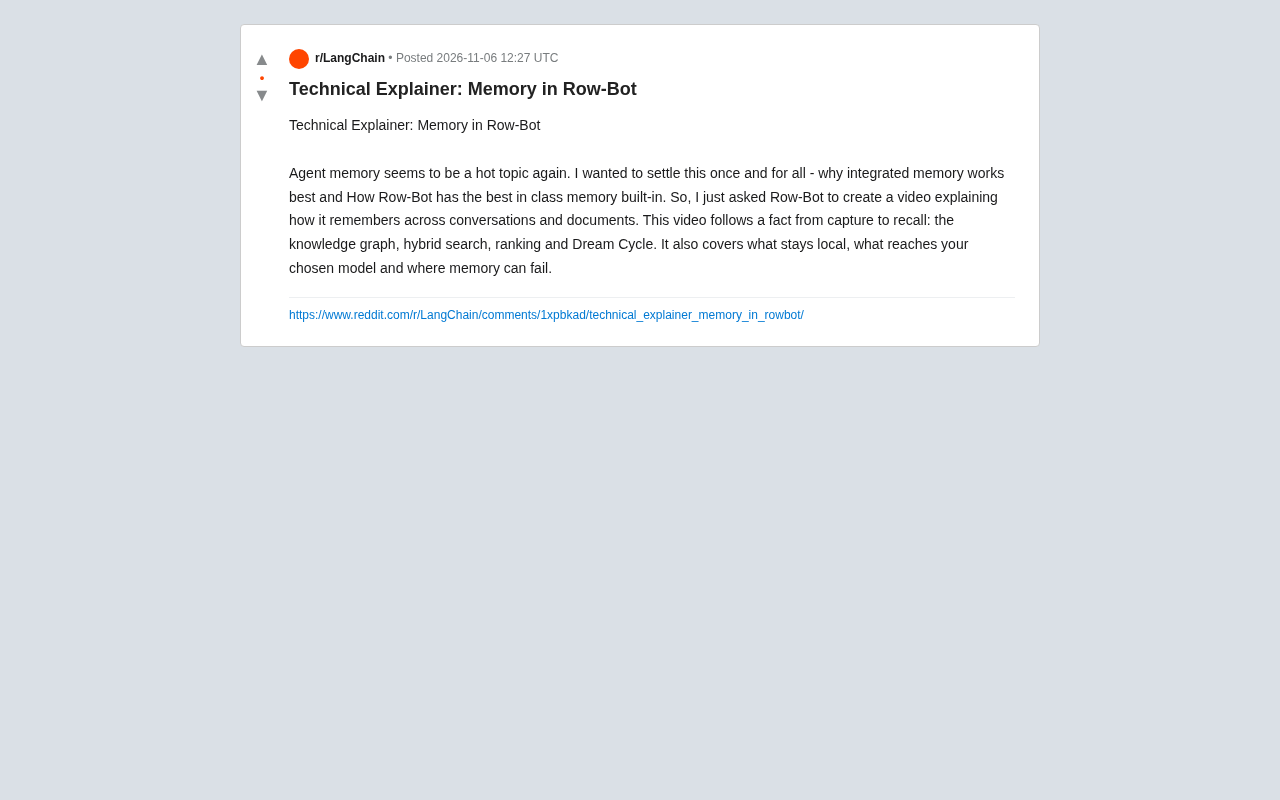
Row-Bot integrates memory as a core component, using knowledge graphs, hybrid search, and the Dream Cycle for full-pipeline capture to recall.
The article covers Row-Bot's technical explainer on agent memory, arguing integrated memory beats bolt-on approaches. Bolt-on vector retrieval stitched into prompts separates capture, organization, retrieval, and updating, causing inaccurate recall and context bloat; integration unifies memory operations for consistency and control. Row-Bot's pipeline has four stages: capture, storage, retrieval/ranking, and updating. Information becomes knowledge graph nodes and edges for multi-hop reasoning; hybrid semantic and keyword search ranks by recency and credibility; the Dream Cycle merges duplicates, strengthens connections, and decays low-value memories when idle. Some memories stay local, with only filtered content sent to the user's chosen model. The article also candidly lists failure points like graph omissions, wrong recall, and over-decay.
Agent memory is once again a hot topic. The Row-Bot team released a technical explainer that attempts to answer a question: why integrated memory works best, and how Row-Bot builds in top-tier memory capabilities. They had Row-Bot generate the video itself, showing the entire process from information capture to recall—knowledge graphs, hybrid search, ranking, and the Dream Cycle—and covering local storage, what the model receives, and where memory can fail.
Why integrated memory is better
Most agent memory today is bolted on: a vector database plus retrieval, stitched into the prompt. This approach is simple to implement, but memory capture, organization, retrieval, and updating are all disconnected from one another, leading to inaccurate recall and context bloat. Row-Bot chose to integrate memory as a core component, letting information flow naturally within the system rather than patching it on afterward. The advantage of integrated memory lies in consistency and controllability: all memory operations follow the same logic, and retrieval results better align with the current conversation goal.
The full memory pipeline: from capture to recall
The Row-Bot memory pipeline revolves around the journey of a single fact, divided into four stages: capture, storage, retrieval and ranking, and updating (the Dream Cycle). Each stage involves clear design trade-offs.
Knowledge graph: the structured skeleton of memory
Captured information is not simply stored as text snippets; it is built into a knowledge graph. Entities, relationships, and temporal cues are extracted as nodes and edges, giving memory structure. The knowledge graph enables Row-Bot to perform multi-hop reasoning—for example, associating a project mentioned in a conversation with related documents and past discussions. Structured memory also facilitates subsequent ranking and conflict resolution.
A knowledge graph is a knowledge representation method that organizes information in a graph structure. It represents real-world entities (such as people, projects, and documents) as nodes, semantic relationships between entities (such as "participates in," "references," or "belongs to") as labeled edges, and can attach attributes such as time and source to both nodes and edges. Unlike splitting text into chunks and storing them in a vector database, a knowledge graph explicitly preserves the connections between entities, so the system can expand a query step by step along multiple edges—what is known as multi-hop reasoning. For example, starting from "a certain project," it first finds the people involved in that project, then finds the documents written by those people, thereby recalling information indirectly related to the current question. Another advantage of knowledge graphs is that they make it easy to detect and resolve conflicts: the same entity usually clusters into the same node in the graph, making duplicate or contradictory information easier to spot and merge. The cost is that the construction phase requires entity recognition, relationship extraction, and other processing, and may miss implicit relationships.
Hybrid search and ranking: finding the most relevant memories
The retrieval stage uses hybrid search, combining semantic similarity and keyword matching, and then scores candidate memories through a ranking model. Ranking considers not only relevance but also recency, source credibility, and the degree of match with the current context. Hybrid search compensates for the shortcomings of pure vector retrieval in exact matching, while ranking ensures that high-value memories enter the model context first.
Hybrid Search refers to using two types of retrieval signals simultaneously: one is dense vector retrieval, which maps queries and memory snippets into semantic vectors and judges semantic similarity by vector distance; the other is sparse keyword retrieval (such as BM25), which scores based on the degree of term matching. The former excels at understanding synonymous expressions and fuzzy semantics, but is prone to inaccuracy in exact-match scenarios such as proper nouns, numbers, and code; the latter is precise but lacks semantic generalization ability. Hybrid search usually fuses the two result sets after score normalization, thereby balancing recall and precision. The ranking stage then introduces more features on top of the candidate set for re-ranking—such as recency (newer memories are more likely to be relevant), source credibility, and the degree of match with the current conversation intent—ultimately deciding which memories enter the model's limited context window.
Dream Cycle: offline memory consolidation
The Dream Cycle is a distinctive part of Row-Bot's memory system. When idle, the system reviews and organizes memories: merging duplicate information, strengthening important connections, and decaying low-value memories. This process is similar to memory consolidation during biological sleep, keeping the memory store lean and consistent and avoiding information overload and accumulated contradictions after long-term operation.
The name Dream Cycle borrows the analogy of sleep and memory consolidation in neuroscience. During biological sleep, the hippocampus is believed to replay the day's experiences, gradually transferring important information to long-term storage in the cortex while weakening unimportant connections. Offline consolidation in agent memory systems borrows this idea: reviewing the memory store in batches during idle periods, performing operations such as deduplication and merging, association strengthening, and importance decay. The value of this kind of offline processing lies in moving computational cost off the online conversation path, avoiding full-scale consolidation on every request; at the same time, through continuous maintenance, it keeps the memory store at lower redundancy and with fewer contradictions after long-term operation. Related engineering concepts include memory decay strategies and forgetting curves—setting different retention priorities for different memories so that low-value information naturally fades over time, thereby controlling storage size and retrieval noise.
The data boundary between local and cloud
Row-Bot clearly defines the data flow: some memories remain local, and only filtered, relevant memories are sent to the model chosen by the user. This design strikes a balance between privacy and performance—sensitive information can stay off the local device, while the model still receives the necessary context. Users have control over which memories can be accessed by external models.
Where memory can fail
The explainer video also candidly discusses the limitations of memory. Knowledge graph construction may miss implicit relationships; hybrid search may recall incorrect memories when semantics are ambiguous; if the Dream Cycle's decay strategy is too aggressive, it can lose useful information; and the model's degree of memory utilization is also affected by prompt design. Understanding these failure points helps users use memory features more sensibly.
Row-Bot's integrated memory approach demonstrates a systematic way of thinking about agent memory: rather than simply stacking retrieval components, it designs capture, organization, retrieval, and updating as a whole. As agents take on longer-cycle tasks, this built-in memory capability will become a core competitive advantage.
One-line Summary
Row-Bot integrates memory as a core component, using knowledge graphs, hybrid search, and the Dream Cycle to achieve a full pipeline from capture to recall.
Paragraph Summary
The article introduces the Row-Bot team's technical explainer on agent memory, with the core point that integrated memory is superior to bolt-on memory. The bolt-on approach stitches vector retrieval results into the prompt, with capture, organization, retrieval, and updating disconnected from one another, leading to inaccurate recall and context bloat; the integrated approach makes all memory operations follow a unified logic, improving consistency and controllability. Row-Bot's memory pipeline is divided into four stages: capture, storage, retrieval and ranking, and updating. Information is extracted into nodes and edges of a knowledge graph to support multi-hop reasoning; retrieval uses hybrid search combining semantics and keywords and ranks by recency and source credibility; the Dream Cycle merges duplicates, strengthens important connections, and decays low-value memories when idle. On the data side, some memories remain local, and only filtered content is sent to the model chosen by the user. The article also candidly lists failure points such as omissions in knowledge graph construction, incorrect retrieval recall, and excessive decay.
Related articles
 Tech Frontiers
Stylome Bot Slammed as Useless Junk: Why Do AI Detection Tools Keep Failing?
Reddit users test the Stylome AI detection bot: Gemini-rewritten text judged human-written, consistently low confidence. An analysis of AI text detection's technical dilemmas, privacy concerns, and credibility crisis in community governance.
 Tech Frontiers
When AI Becomes a Productivity Divide: Clarity or "AI Psychosis"?
A civil engineer's deep use of agentic AI boosted efficiency but bred contempt for peers who refuse to learn. Is this clarity or AI psychosis? An analysis of the cognitive and psychological challenges behind the AI productivity divide.
 Tech Frontiers
Opus 5.5 Benchmark Scores Climb, Community Says Its "Weights Are Blessed"
Reddit community discusses Opus 5.5's rising scores on the Benchmaxxing Bench, with users describing its performance as "weights are blessed." This article interprets the community reaction and cautions against conflating benchmark scores with real capability.