RSS Feed Databases and the AI Era: The Scarcity Value of Human-Original Content

RSS databases gain new relevance as human-original content becomes scarce in the AI era.
A developer's Reddit post about building the world's largest RSS feed database sparks a crucial discussion about the value of human-original content in an era of AI-generated content overload. As AIGC floods the internet, RSS — a decentralized, algorithm-free technology from Web 1.0 — is finding renewed relevance for AI training, content authenticity, and information quality preservation.
A Deceptively Simple Question
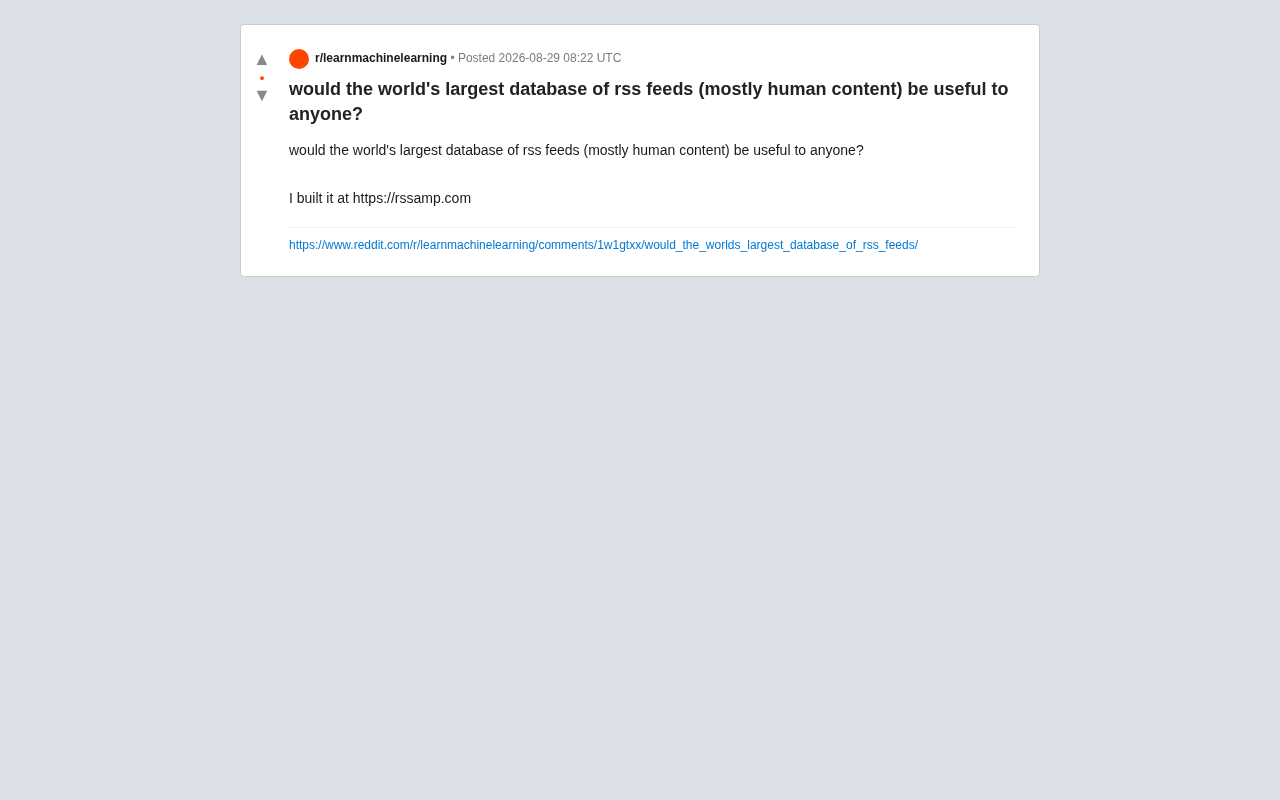
Recently, a developer posed a thought-provoking question on Reddit: "If there were a world's largest RSS feed database (mostly human-created content), would it be useful to anyone?" He then shared his creation — rssamp.com.
This seemingly simple question actually touches on a core issue of the AI explosion era: In a world flooded with AI-generated content (AIGC), how much value does purely human-original content still hold? And could RSS — a technology born in the Web 1.0 era — find new life amid the AI wave?
RSS: An Underrated Retro Technology
What Exactly Is RSS
RSS (Really Simple Syndication) is a standard format for aggregating and distributing website content updates. Instead of visiting websites one by one, users can centrally access the latest content from blogs, news sites, podcasts, and other sources through an RSS reader.
In the days before social media and algorithmic recommendations ruled the internet, RSS was a mainstream way to consume information. However, after Google Reader shut down in 2013 and platforms like Facebook and Twitter rose to dominance, RSS gradually faded from public view.
Why RSS Is Getting Renewed Attention
Interestingly, it's precisely the "filter bubbles" created by algorithmic recommendations, content homogenization, and the explosive growth of AI-generated content that are making more and more users nostalgic for what RSS represents: proactive, transparent, decentralized information consumption. RSS has no algorithmic black box — you see exactly what you subscribe to, content is presented in chronological order, and it's completely free from commercial recommendation logic.
Why Human Content Is Becoming Scarce and Precious in the AI Era
AIGC Is Diluting the Quality of Internet Information
With the widespread adoption of large language models like ChatGPT and Claude, AI-generated articles, comments, and images are flooding the internet at an exponential rate. Research predicts that within the next few years, AI-generated content could account for the majority of internet content. This raises a critical question: How do we distinguish genuine human experience from mass-produced machine content?
The developer's emphasis that his database contains "mostly human content" hits squarely on today's pain point. RSS feeds that have been manually curated and continuously maintained by real creators represent a scarce resource in terms of credibility and originality.
The Dual Significance for AI Training
For the AI industry, high-quality human-original training data is becoming increasingly scarce and expensive. A large-scale, structured, primarily human-content RSS database could theoretically serve multiple purposes:
- As a high-quality corpus source for AI model training, avoiding the "model autophagy" problem (quality degradation caused by repeatedly training on AI-generated content)
- Providing reliable benchmark data for content detection and provenance tracking
- Supporting the construction of AI-contamination-free information retrieval systems
Who Would Benefit from the World's Largest RSS Database
Potential Use Cases
From a product perspective, the world's largest RSS feed database could serve multiple user groups:
Developers and Researchers: Build next-generation RSS readers and content aggregation tools via API, or use the data for academic research, public opinion analysis, trend monitoring, and other applications.
AI Companies: Use it as a high-quality, traceable human content data source for model training or performance evaluation.
Content Creators: Help creators discover quality content sources in their field for competitive analysis or creative inspiration.
General Information Consumers: Through better content discovery mechanisms, find truly worthwhile high-quality information sources and break free from the constraints of algorithmic recommendations.
The Business Model Potential
Data itself is value. This type of RSS feed database could be monetized through API subscriptions, data licensing, value-added analytics services, and more. Especially as compliance around AI training data receives increasing scrutiny, a database with clear provenance and primarily human-original content holds unique commercial appeal.
Challenges and Sobering Realities
However, while the vision is compelling, several challenges remain.
Scale Verification: The claim of being the "world's largest" needs objective data to back it up. Based on a promotional statement alone, it's hard to assess the true breadth of coverage and content update quality.
Content Authenticity Verification: How can you ensure the database truly contains "mostly human content"? In an era where AI-generated content is increasingly indistinguishable from human writing, this is itself a technical challenge.
Copyright and Compliance Risks: Aggregating others' RSS feeds involves content copyright, robots protocol compliance, data usage authorization, and other legal issues — especially when the data is used for AI model training, where compliance pressure is even greater.
Monetization Path Unproven: The RSS user base is relatively niche. How to turn a comprehensive database into a sustainably operated product with stable revenue remains a key test.
A New Mission for an Old Technology
At its core, this developer's question explores a direction: As machines become increasingly adept at producing content, the value of human creation actually needs to be redefined and protected. RSS, as a decentralized, human-centric content distribution protocol, may be precisely the bulwark we need against the flood of AI content.
Regardless of whether rssamp.com ultimately becomes the "world's largest RSS feed database," the proposition it raises deserves serious consideration from the entire industry: In the AI era, how should we cherish, organize, and make good use of genuine human intellectual output? This is not just a product-level question — it's a long-term issue concerning the health of our information ecosystem.
Related articles

Amphibious Transforming Drone: Beyond 100x Power Savings, What Are the Real Needs?
Is the amphibious transforming drone just a gimmick? Starting from the 100x power difference of the M4 Morphobot, explore real application scenarios and thesis topic ideas, analyzing boundary conditions where pure drones and pure ground robots both fail.

Warhound Raises $200 Million: Genetically Engineered "War Dogs" Paired with Anduril Gear
Warhound raises $200M, backed by Ben Lamm and Palmer Luckey, to genetically engineer dogs for military and law enforcement use and equip them with Anduril gear. This article analyzes its technology direction, funding logic, and ethical controversy.

Claude API Comes to Google Cloud: IAM Integration and SDK Access Guide
Anthropic hosts the full Claude API on Google Cloud with IAM-controlled permissions and unified billing. This guide covers the Vertex AI and Anthropic-hosted entry points, IAM role configuration, and SDK access.