RTX Spark for Local LLMs: Can It Power a Coding Agent?

RTX Spark's 128 GB unified memory clears the capacity barrier for local LLMs, but bandwidth is the key to coding agent experience.
NVIDIA's upcoming RTX Spark laptop offers up to 128 GB of unified memory, attempting to break the "won't fit" deadlock for local large models. Unified memory lets the CPU and GPU share one memory pool, eliminating the weight-copy step and providing enough capacity for 70B-class 4-bit quantized models—a realistic range for local coding agents. However, the article notes that the advertised 600 GB/s figure is not memory bandwidth, and bandwidth is precisely what determines token generation speed under a unified memory architecture. Capacity determines feasibility; bandwidth determines usability. Coding agents need multi-round inference and tool calls, making them especially speed-sensitive. Hardware is only one of three barriers, and final experience still needs real-world verification.
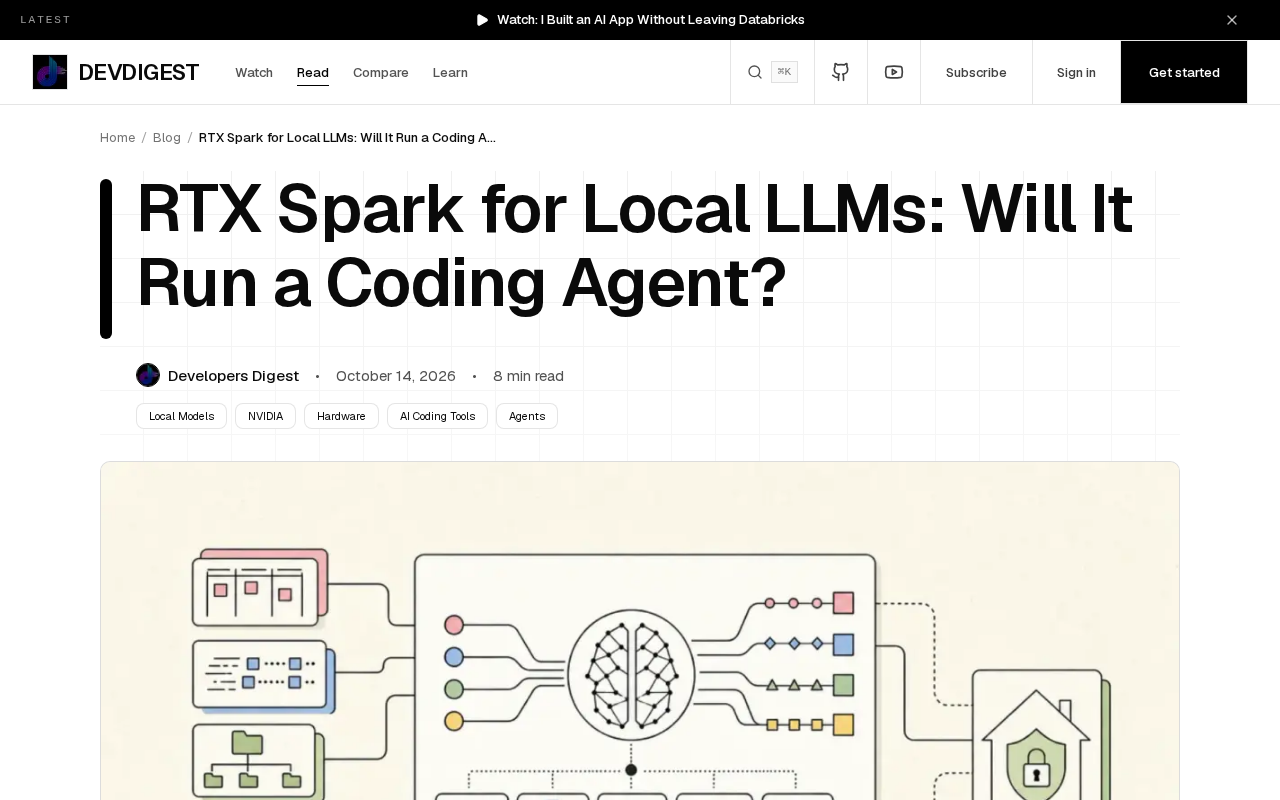
Running large models locally has been stuck on a fundamental contradiction for the past year or two: consumer GPUs don't have enough VRAM, and the models that do fit aren't smart enough. Models that are smart enough either degrade in quality after quantization or simply won't fit. NVIDIA's upcoming RTX Spark laptop is trying to break this deadlock with a "unified memory" approach—up to 128 GB of unified memory, which sounds like enough to make local coding agents genuinely viable.
But there's a layer of technical detail between the numbers on a spec sheet and how things actually perform in practice. This article breaks down the known key specs of RTX Spark and the real-world feasibility of running local coding models on this hardware.
What RTX Spark's Hardware Specs Actually Say
According to official information, the RTX Spark laptop goes on sale on October 16, with the top configuration offering 128 GB of unified memory. This number is the most talked-about point across the entire product line, because it directly determines how large a model you can fit.
The core value of unified memory is this: the CPU and GPU share the same memory pool, so you don't need to manually move model weights from system memory into VRAM like you do with traditional discrete GPUs. For large language models that routinely weigh tens of gigabytes, this eliminates the most troublesome step.
However, there's a spot that's easy to misread. A figure of 600 GB/s appears in RTX Spark's marketing, but this number is not memory bandwidth. It more likely corresponds to the throughput of some internal GPU subsystem (such as cache or a specific compute path), rather than the actual bandwidth for CPU-GPU access to unified memory. Under a unified memory architecture, what truly determines large model inference speed is memory bandwidth—and the official specs don't make any clear high-bandwidth promise on this front. In other words, 128 GB solves the "can it fit" problem, but not necessarily the "does it run fast" problem.
What Is Unified Memory
Unified memory is an architecture in which the CPU and GPU share the same physical memory pool. In traditional discrete GPU setups, system memory (DDR) and VRAM (GDDR/HBM) are two separate physical media. Model weights must first be loaded from disk into system memory, then copied over the PCIe bus into VRAM before the GPU's compute units can read them. This copy process is not only time-consuming but also limited by PCIe bandwidth.
Unified memory (such as Apple Silicon's Unified Memory or NVIDIA's Grace Hopper NVLink-C2C architecture) eliminates this copy step. The CPU and GPU access data through the same address space, which in theory allows large model weights to be "loaded once, shared by both." The trade-off is that memory in this architecture often uses LPDDR, which typically has lower bandwidth than the HBM or high-frequency GDDR used in high-end discrete GPUs. This is the fundamental reason why unified memory devices can "fit" a model but may not "run it fast."
Why Bandwidth Matters More Than Capacity for Inference Experience
Large language model inference is a classic memory-bandwidth-bound task. For every token generated, the model needs to read the corresponding weights from memory once. The larger the weight size, the more data must be read per pass, and the higher the bandwidth requirement.
This explains a common phenomenon: two devices that can both fit a 70B-class model may differ in token generation speed by several times, depending on bandwidth. Capacity determines feasibility; bandwidth determines usability.
For coding agents, this distinction is especially critical. Coding tasks aren't simple one-question-one-answer exchanges. An agent needs multi-round planning, tool calls, file reads and writes, and repeated iteration. Every round of interaction involves model inference, and token generation speed compounds directly into overall wait time. If bandwidth is insufficient, even if the model fits, the agent's actual experience may be so slow it's unacceptable. So 128 GB of unified memory is a necessary starting point, but far from the whole answer.
The Relationship Between Memory Bandwidth and Token Generation Speed
In the autoregressive generation process of a large language model, producing each token requires reading all model weights from memory once (or at least reading the current layer's weights). Take a 70B model quantized to 4-bit with roughly 40 GB of weights: if memory bandwidth is 100 GB/s, the theoretical ceiling is about 2.5 tokens per second; if bandwidth reaches 400 GB/s, the theoretical ceiling rises to 10 tokens per second. This is why bandwidth directly determines inference speed.
It's worth noting that this is a theoretical peak. Actual speed is also affected by compute unit scheduling, KV cache reads and writes, and quantization/dequantization overhead, and typically only reaches 50%–70% of the theoretical value. Therefore, the bandwidth figure is the single most important metric for evaluating local inference experience—far more predictive of actual user perception than memory capacity.
Which Local Coding Models Can Actually Run
Based on the 128 GB unified memory ceiling, we can roughly define the range of models that can fit.
Tier 1: Mid-sized models under 30B. These models typically occupy 20 GB to 40 GB of memory after quantization. A 128 GB configuration can accommodate them easily, and may even load multiple instances simultaneously or retain a longer context window. They're suitable for everyday code completion, single-file edits, and explanation tasks.
Tier 2: 70B-class models. After 4-bit quantization, a 70B model occupies roughly 35 GB to 45 GB. 128 GB of memory is more than enough capacity-wise, with plenty of room left for KV cache and context. This is the most valuable range for local coding agents—the model is capable enough to handle complex cross-file tasks, and capacity isn't tight.
Tier 3: Large models above 100B. Even after quantization, these models often exceed 60 GB. As they approach the 128 GB ceiling, the space left for KV cache gets severely compressed, and long-context scenarios become strained. They can fit, but actual runtime context length and concurrency will be limited.
It's important to emphasize that the above is a capacity-level assessment. Whether a coding agent can actually run smoothly also depends on the bandwidth factor mentioned earlier, as well as how well the software stack is optimized for the unified memory architecture.
Model Quantization and Memory Footprint Conversion
Quantization is the technique of compressing model weights from high precision (e.g., FP16 at 2 bytes per parameter) to low precision (e.g., 4-bit at about 0.5 bytes per parameter). A 70B-parameter model requires about 140 GB of memory at FP16 precision, but only about 35 GB after 4-bit quantization. This explains why 128 GB of unified memory can accommodate a 70B-class model—quantization is the key prerequisite.
But quantization isn't free. 4-bit quantization introduces some degree of accuracy loss on most benchmarks, and in coding agent scenarios that require precise reasoning and long-chain tool calls, that loss can be amplified. In addition, the KV cache (the attention key-values stored during inference) grows linearly with context length and can consume an additional few GB to tens of GB in long-context scenarios. Therefore, when assessing "can it run," you must add up weight memory, KV cache, and runtime overhead together—not just look at the model's parameter count.
The Real Barriers to Running a Coding Agent Locally
Running a full coding agent locally depends on three conditions, and hardware is only one of them.
Model capability must be sufficient to support multi-step reasoning and tool calls. Mid-sized models often aren't stable enough in this regard and tend to drift off target on complex tasks. The 70B class is a fairly realistic minimum capability threshold for local scenarios.
Inference speed must match the agent's interaction rhythm. A coding agent may generate dozens or even hundreds of model calls in a single task. If each round requires a long wait, the overall experience degrades rapidly. This is heavily influenced by bandwidth and quantization method.
Software ecosystem must keep up. Unified memory architectures require targeted optimization from inference frameworks (such as the major local inference engines) to translate memory advantages into actual speed. Software maturity in the early days after a hardware launch usually takes time to polish.
RTX Spark's 128 GB of unified memory essentially solves the first barrier—model capacity. Whether the second barrier can be crossed depends on that bandwidth number that hasn't been clearly labeled. The third barrier depends on how quickly the software catches up after launch.
What It Changes, and What It Doesn't
The direction RTX Spark represents is clear: use unified memory to fit large models into consumer devices, freeing local inference from VRAM anxiety. The 128 GB capacity is a significant step forward in that direction, giving 70B-class coding models a capacity foundation in laptop form for the first time.
But what it hasn't changed is the fundamental bottleneck of inference. Large model speed is still determined by memory bandwidth and compute throughput; capacity is just the entry ticket. The fact that the 600 GB/s figure from the marketing materials is singled out actually shows the vendor knows bandwidth is what users care about most—it's just that what this number actually corresponds to requires careful scrutiny.
For anyone planning to use it to run a local coding agent, the rational expectation is this: it will most likely fit and run 70B-class models, making everyday coding assistance tasks feasible. But whether it can achieve smoothness close to a cloud agent will have to wait for real-world reviews and software optimization to land. The hardware specs give reason for optimism—and also leave blanks that need to be verified.
One-line Summary
RTX Spark's 128 GB unified memory clears the capacity barrier for local large models, but bandwidth is the key to the coding agent experience.
Paragraph Summary
NVIDIA's upcoming RTX Spark laptop offers up to 128 GB of unified memory, attempting to break the "won't fit" deadlock for local large models with a unified memory architecture. Unified memory lets the CPU and GPU share the same memory pool, eliminating the weight-copy step of traditional discrete GPUs, and offers enough capacity to hold 70B-class 4-bit quantized models—a realistic capability range for local coding agents. However, the article points out that the 600 GB/s figure in the official marketing is not memory bandwidth, and under a unified memory architecture, bandwidth is precisely what determines token generation speed. Capacity determines feasibility; bandwidth determines usability. Coding agents require multi-round inference and tool calls, making them especially speed-sensitive. Hardware is only one of three barriers—model capability and software ecosystem are equally critical, and the final experience still needs real-world review to verify.
Related articles

Random Pruning of the DPO Computation Graph: 1.4x Training Speedup and Lower Peak Memory
DPO training too slow and memory-hungry? This paper proposes a random pruning framework for the DPO computation graph, sampling independently across position, sequence, and branch dimensions; branch pruning achieves a 1.426x step-time speedup and cuts training time by about 30%, with in-depth attribution of memory and time gains.

Why Does JEPA Underperform MLM in Longitudinal EHR Representation Learning?
New study compares JEPA and MLM for longitudinal EHR representation learning on MIMIC-IV: three JEPA variants train stably without collapse but underperform MLM; target size, not heterogeneity, drives prediction error.

Transfer Learning + Visible Light Communication: A New Approach to Energy-Efficient Indoor Positioning
A study proposes a transfer learning-based visible light communication indoor positioning method, achieving 47% accuracy improvement on the BOSCH factory dataset, 67.5% model efficiency under high noise, and introducing the ME composite metric for energy-efficient positioning in energy-constrained industrial IoT scenarios.