Ruff: A Blazing-Fast Practice of Rewriting Python Code Checking in Rust
A Rust-rewritten Python linter/formatter that challenges traditional toolchains with speed and unified configuration.
Ruff is a Python static analysis and formatting tool implemented in Rust that integrates Flake8 and its plugins, isort, pyupgrade, and some pylint rules into a single binary, and provides a Black-compatible formatter. Its core advantage is speed: Rust's zero-cost abstractions and native parsing avoid Python interpreter startup and cross-process overhead, enabling full checks to complete in an instant so it can be embedded in pre-commit and editor save actions. Ruff supports large-scale auto-fix and incremental adoption via rule-level and line-level noqa, lowering the migration barrier for existing projects. Its ~50k GitHub stars reflect community demand for tool performance. When migrating, verify third-party Flake8 plugin rule coverage—Ruff is not fully equivalent.
Ruff: A New Rust-Powered Choice for Python Static Analysis
In the Python ecosystem, linters and formatters have long been dominated by tools like Flake8, Pylint, and Black. Most of these tools are written in Python itself—mature in features, but slow on large projects and cumbersome to configure. A project on GitHub called astral-sh/ruff took a different approach: rewriting the entire static analysis pipeline in Rust, making speed its core competitive advantage. As of now, the project has garnered over 50,000 stars, becoming one of the fastest-growing projects in the Python toolchain.
The Speed Advantage of Rust
Ruff's core selling point is stated in the first sentence of its project description: "An extremely fast Python linter and code formatter, written in Rust." Rust's ownership model and zero-cost abstractions allow it to approach C/C++ performance without sacrificing safety, whereas Python-interpreter-based linters often need to parse ASTs file by file, repeatedly import modules, and incur significant cold-start overhead. Ruff integrates parsing, rule matching, and fix generation into a single binary, eliminating cross-process calls and interpreter startup costs.
The direct experiential difference: on medium-sized repositories, Ruff typically completes a full check before the developer even switches windows. Speed itself isn't the goal, but it changes workflows—linting can be placed in pre-commit hooks or editor save actions without worrying about slowing down daily operations. For CI pipelines, reduced check-step time also means shorter feedback cycles.
Zero-cost abstraction is one of the core design principles of the Rust language. It refers to the fact that high-level language features (such as generics, iterators, and traits) compile to machine code with performance comparable to hand-written low-level code, without introducing runtime overhead. This allows developers to write code with expressive abstractions without worrying about performance loss. In Ruff, zero-cost abstractions let logic such as rule matching and AST traversal remain readable while compiling into efficient native instructions—this is the language-level foundation of its speed advantage.
AST (Abstract Syntax Tree) is a tree-like representation of the syntactic structure of source code, where each node corresponds to a syntactic construct (such as a function definition or expression). Linters typically first parse source code to generate an AST, then traverse nodes to match rules. Python's ast module builds ASTs within the interpreter with additional overhead, whereas a Rust-implemented parser (Ruff uses its own ruff_python_parser) can directly generate a compact AST and traverse it efficiently, avoiding the Python interpreter's object allocation and GC pressure.
One Tool Covering Multiple Toolchains
Another design orientation of Ruff is "aggregation." It includes hundreds of built-in rules, covering Flake8 and its many plugins, isort's import sorting, pyupgrade's syntax modernization, and some pylint rules. Teams no longer need to maintain a configuration matrix assembled from multiple tools, nor deal with rule conflicts and execution-order issues between different tools.
For code formatting, Ruff provides a formatter highly compatible with Black. This means projects already using Black can migrate while keeping code style largely unchanged, reducing diff noise from large-scale reformatting. Configuration files are unified in pyproject.toml, where rule selection, ignore lists, and target Python version are all managed in one section.
The Flake8 plugin ecosystem is an important reason for Flake8's popularity: Flake8 itself provides only basic checks, extending rules through a plugin mechanism (such as flake8-bugbear and flake8-comprehensions). Each plugin is an independently distributed Python package, and both installation and loading increase startup time. Ruff builds the rules of many common plugins into a single binary, distinguishing their origins by rule code prefixes (e.g., B for bugbear, C4 for comprehensions), thereby eliminating plugin-loading overhead while preserving rule coverage. When migrating, note that Ruff does not implement all plugins—check its rule list against your project's dependencies.
Auto-Fix and Incremental Adoption
Ruff's --fix capability deserves separate discussion. It provides automatic fixes for a large number of rules, including import sorting, unused variable cleanup, and outdated syntax replacement. Such fixes can be triggered on save in editors or run in batch as a pre-commit step. Auto-fix reduces the migration burden of introducing new rules: teams can first enable checks, observe the warning distribution, and then gradually enable fixes.
Incremental adoption is a key strategy for Ruff to lower the migration barrier. The project supports fine-grained control of the enabled scope by rule code, as well as line-level exemptions via noqa comments. For codebases with heavy legacy baggage, you can first run with a loose configuration, then gradually tighten by directory or module, avoiding a flood of warnings that causes the team to give up.
noqa comments originate from Flake8 and are a line-level exemption mechanism: adding # noqa at the end of a code line tells the linter to ignore warnings on that line, while # noqa: E501 ignores only the specified rule. Ruff is compatible with this syntax and supports finer-grained control. For existing projects, noqa provides a progressive governance approach—first suppress warnings that are difficult to fix immediately to avoid blocking CI, then clean them up gradually. However, overuse of noqa can mask real issues; it's recommended to combine it with rule grouping and directory-level configuration, limiting exemptions to the necessary scope.
Community Popularity and Ecosystem Position
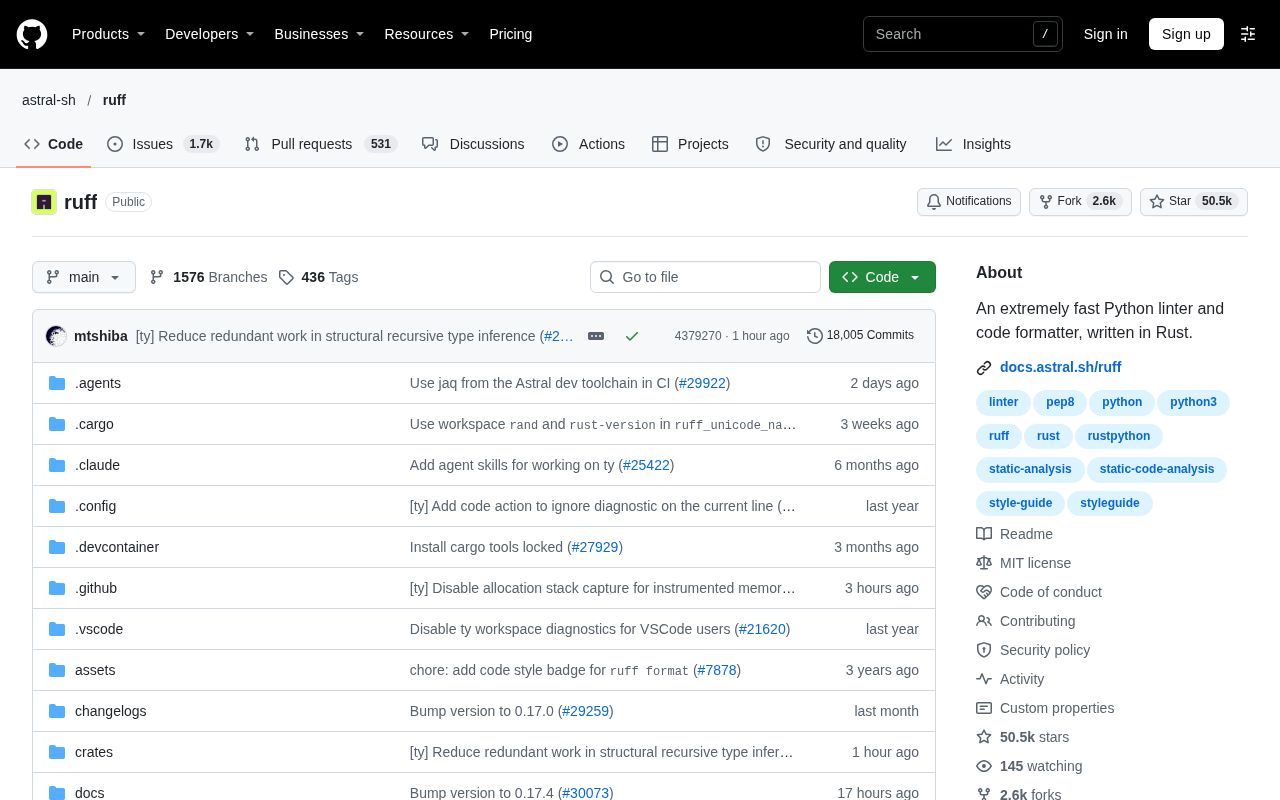
Looking at GitHub data, Ruff has approximately 50,000 stars, 2,596 forks, and gains about 107 stars per day. This popularity reflects the Python community's general dissatisfaction with tool performance and the ongoing penetration of the Rust rewrite wave into the developer tools space. Similar phenomena are also appearing in areas such as packaging and dependency management—rewriting Python infrastructure in systems-level languages is becoming an accepted engineering choice.
Ruff is maintained by the Astral team, which also advances other Python tool projects with some synergy in configuration and philosophy. For users, this means Ruff is not just a point tool but may become part of the infrastructure of Python project development environments.
Adoption Recommendations
New projects can use Ruff directly as the sole linter and formatter with low configuration cost. For existing projects, a two-step approach is recommended: first integrate into CI in check-only mode to understand the warning baseline; then enable auto-fix and gradually expand using the rule grouping capabilities of pyproject.toml. A boundary to note is that although Ruff covers many Flake8 plugin rules, it is not fully equivalent to all third-party plugins—before migrating, verify whether the rule sets your project depends on are covered.
Overall, Ruff's value lies not only in being "fast" but also in unifying previously fragmented checking and formatting workflows with a single tool. For Python teams troubled by multi-tool configurations and slow CI, it offers a low-friction replacement path.
One-line Summary
A Rust-rewritten Python linter/formatter that challenges traditional toolchains with speed and unified configuration.
Paragraph Summary
Ruff is a Python static analysis and formatting tool implemented in Rust that integrates Flake8 and its plugins, isort, pyupgrade, and some pylint rules into a single binary, and provides a Black-compatible formatter. Its core advantage is speed: Rust's zero-cost abstractions and native parsing avoid Python interpreter startup and cross-process overhead, enabling full checks to complete in an instant, so it can be embedded in pre-commit and editor save actions. Ruff supports large-scale auto-fix and incremental adoption via rule-level and line-level noqa, lowering the migration barrier for existing projects. With about 50,000 GitHub stars, it reflects the community's demand for tool performance. When migrating, verify the coverage of third-party Flake8 plugin rules—Ruff is not fully equivalent.
Related articles
 Tech Frontiers
Stylome Bot Slammed as Useless Junk: Why Do AI Detection Tools Keep Failing?
Reddit users test the Stylome AI detection bot: Gemini-rewritten text judged human-written, consistently low confidence. An analysis of AI text detection's technical dilemmas, privacy concerns, and credibility crisis in community governance.
 Tech Frontiers
When AI Becomes a Productivity Divide: Clarity or "AI Psychosis"?
A civil engineer's deep use of agentic AI boosted efficiency but bred contempt for peers who refuse to learn. Is this clarity or AI psychosis? An analysis of the cognitive and psychological challenges behind the AI productivity divide.
 Tech Frontiers
Opus 5.5 Benchmark Scores Climb, Community Says Its "Weights Are Blessed"
Reddit community discusses Opus 5.5's rising scores on the Benchmaxxing Bench, with users describing its performance as "weights are blessed." This article interprets the community reaction and cautions against conflating benchmark scores with real capability.