Rumor: GPT-6 Astra Can Drive a Car? Breaking Down an Unverified AI Claim
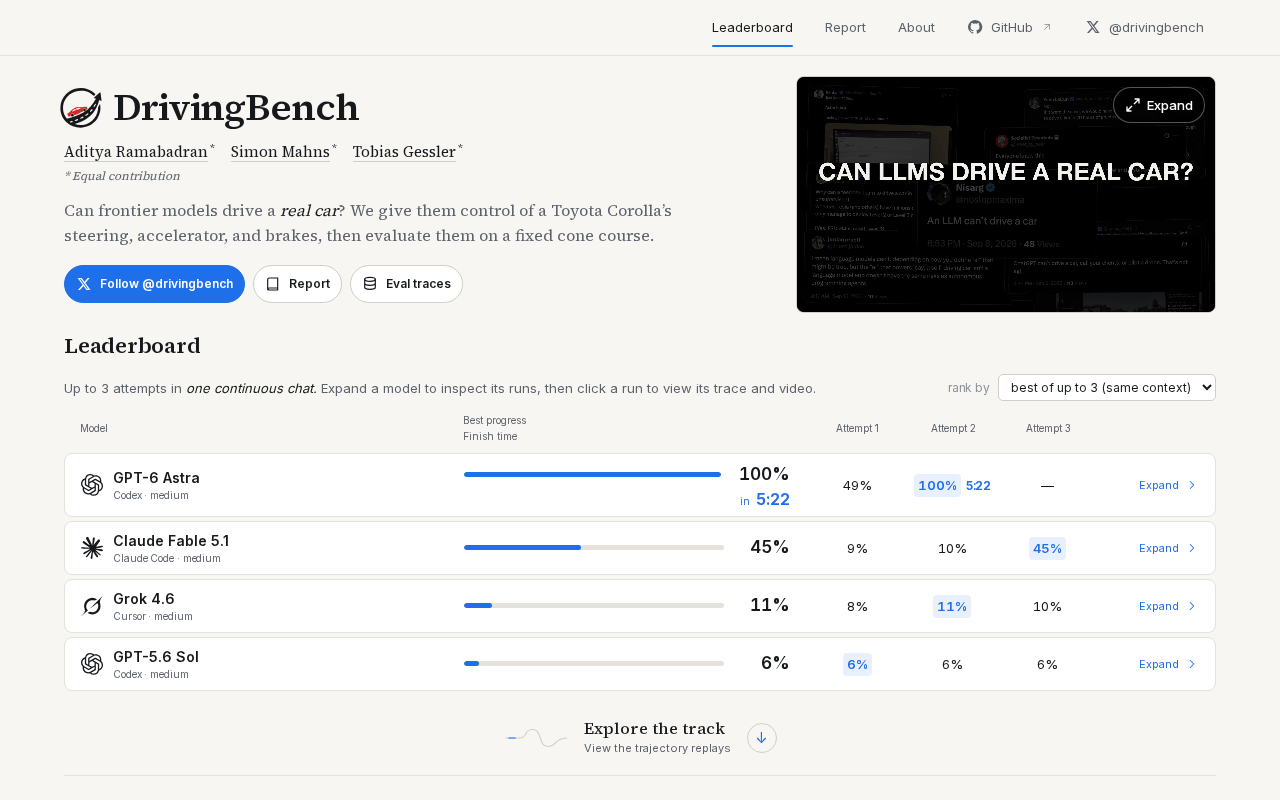
A viral Hacker News rumor about GPT-6 Astra driving cars — unpacking the hype and the real technical challenges.
A Hacker News post claiming "GPT-6 Astra can drive a car" went viral, but lacks any official source or verifiable details. The article uses it as a springboard to examine how multimodal LLMs could power autonomous driving via end-to-end architectures, while highlighting the hard gaps — inference latency, hallucinations, and long-tail edge cases — that separate research demos from production-ready systems. Readers are advised to look for official channels, verifiable technical details, and independent replication before drawing strong conclusions.
A Viral AI Rumor
Recently, a strikingly titled post appeared on Hacker News: "GPT-6 Astra has gained the ability to drive a car." It quickly accumulated 71 upvotes and 54 comments, sparking lively community discussion.
To be upfront: this claim currently consists of nothing more than a headline — there are no verifiable technical details, official announcements, or authoritative sources to back it up. This article is therefore not a report on an established fact. Instead, it uses the topic as a lens to examine the technical logic and real-world limitations behind the idea of "large language models driving cars."
Why "LLMs Driving Cars" Is Such a Hot Topic
Over the past two years, the capabilities of multimodal large models have expanded dramatically — from text and images to video and audio — and models are increasingly evolving toward a closed loop of "perception → reasoning → action." The notion that GPT-6 Astra could "drive a car" points to a direction the industry has been actively exploring: using a general-purpose large model as the decision-making brain for Embodied AI.
This idea isn't baseless. Autonomous driving has traditionally relied on a pipeline of specialized perception, planning, and control modules. Multimodal large models offer an alternative: a single end-to-end model that maps directly from sensor inputs to driving actions, potentially offering stronger scene generalization and commonsense reasoning.
The Gap Between "Perception" and "Action"
Getting a large model to "understand" road conditions is no longer the hard part — vision-language models (VLMs) already perform impressively on scene comprehension. The real challenge is translating that understanding into safe, real-time, and reliable vehicle control. Driving is extremely latency-sensitive; millisecond-level differences in response time can be a matter of safety. The inference latency of current large models, their hallucination issues, and their handling of long-tail edge cases represent a very real gap between a "demo" and a production-ready system.
Embodied AI refers to AI systems with a physical embodiment that can perceive, reason, and act in real or simulated environments — rather than merely processing language or images. Unlike the modular architecture of traditional autonomous driving, end-to-end approaches attempt to use a single unified neural network to map raw sensor inputs (cameras, LiDAR, etc.) directly to control outputs like steering angle, throttle, and braking — eliminating hand-engineered intermediate modules. The potential advantage is that the model can learn implicit driving knowledge that human experts struggle to encode explicitly, and leverage the large model's commonsense reasoning to handle novel scenarios not covered by training data. Google DeepMind's Gemini series, OpenAI's multimodal research roadmap, and Tesla FSD v12's shift to an end-to-end architecture are all representative examples of this trend.
Hallucination in the context of large models refers to outputs that are factually incorrect or entirely fabricated. In text-based Q&A, the cost of hallucination is typically misinformation. In autonomous driving, however, if a model misidentifies an obstacle, traffic sign, or pedestrian, the result could be a direct traffic accident. Long-tail scenarios are rare road conditions that appear infrequently in training data — such as a wrong-way electric scooter, unusually shaped construction signs, or near-zero visibility in severe weather. The safety of autonomous driving is ultimately determined by worst-case performance, not average performance, making long-tail problem-solving a core threshold for commercial deployment. Current large models still lack systematic engineering validation on both fronts, making this one of the hardest gaps to bridge between academic demos and real-world products.
What the Community Discussion Reveals
The volume of comments the post generated reflects two emotions that often coexist in the AI community: excitement about a potential capability leap, and skepticism toward hype. Without a technical paper, a demo video, or independent replication, a catchy headline is hard to treat as reliable fact.
For readers tracking the frontier, a few key questions can help assess claims like this: Is there an official release channel? Are verifiable technical details provided? Have independent parties reproduced the results? A headline and discussion heat alone are not sufficient grounds for a strong conclusion like "GPT-6 can now drive autonomously."
Keeping a Grounded View of AI Capabilities
Regardless of whether the GPT-6 Astra rumor is true, "general-purpose large models driving robots and vehicles" is genuinely one of the most closely watched research directions in AI today. Practical work from Tesla, Waymo, and others on end-to-end autonomous driving, along with major lab investments in Embodied AI, all signal that this path is being taken seriously.
But the road from a research prototype to a deployable product is long — paved with safety validation, regulatory compliance, and large-scale road testing. Staying curious about these developments while remaining appropriately skeptical may be the most practical stance to take as AI continues to iterate rapidly.
The source material for this article is limited. Should official or authoritative sources release specific technical details in the future, the conclusions presented here would need to be revisited.
Related articles

WorkBuddy Full Tutorial: Build an AI Office Automation Agent from Scratch
A complete WorkBuddy tutorial: installation, three working modes, multimodal picture book video practice, expert team agent building, and workflow configuration for low-cost AI office automation.

WorkBuddy Agent Complete Guide: From Beginner to Automation in 7 Days
Based on Bilibili's 256-episode WorkBuddy masterclass, this systematically breaks down Tencent's AI office workbench core capabilities: Agent principles, Skill encapsulation, cross-platform connectors, scheduled automation, knowledge bases, and zero-code development, with learning path recommendations.

8 AI Accounts, 7 Failed: An Honest Review of Using AI to Get Work Done
Only 1 of 8 AI-run Bilibili accounts succeeded. We break down the real difference between "performing AI" and "using AI to get work done."