Run a 125B Model on a 12GB GPU? Google Pauses Open Source Bug Bounty Program

125B local inference, Google's speech model, AI coding tools, and a paused bug bounty program.
This AI roundup covers four open source developments. StraightA claims quantization and offloading can run a 125B Qwen model on a 12GB GPU with 35–55GB of RAM, though real-world performance requires testing. Google open sourced an ~8B Gemma-series model for speaker diarization, deployable locally on 8GB VRAM. On the tooling side, Impactable uses deterministic rules (no LLM required) for front-end design in AI coding workflows, while OpenMount House open sources an agentic video system under AGPL 3.0. Finally, Google is pausing its open source bug bounty program from October 1 due to a flood of AI-generated invalid submissions — highlighting new governance challenges in the AI era.
This edition of the AI news roundup highlights several open source developments worth following for developers: an inference engine claiming to run a 125B model on a 12GB GPU, a lightweight Google model for speech processing, a few updates to AI coding and agent-based video tools, and Google's decision to pause its open source bug bounty program due to a surge in automated submissions.
Running a 125B Model on a 12GB GPU? A New Approach to Local LLM Inference
The open source project StraightA makes a fairly bold claim in its README: it can run a 125B-parameter Qwen 3.8 Flash Next model on a consumer PC with at least 12GB of VRAM — provided the system also has 35 to 55GB of system RAM. The project is released under the MIT license.
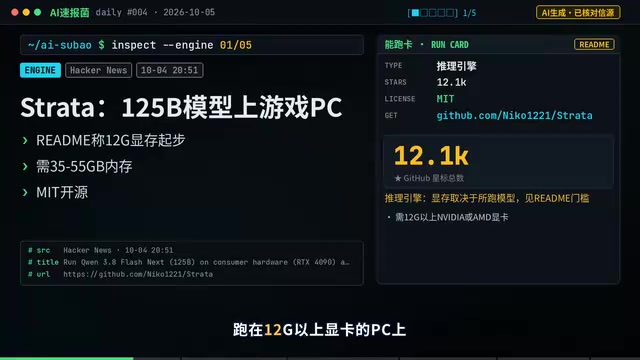
The core idea behind approaches like this is to use techniques such as quantization and memory offloading to keep most of the model weights in system RAM (or even on disk), loading them into VRAM only when needed for computation. The tradeoff is inference speed — you're substituting large amounts of RAM and memory bandwidth for VRAM capacity. For developers with limited GPU budgets who still want to experiment with large models locally, this offers a path worth exploring, though real-world throughput and latency should always be validated through actual testing.
Quantization is one of the primary techniques for compressing models. It involves converting model weights from high-precision floating point (e.g., FP16/FP32) to low-bit integers (e.g., INT8, INT4), which can reduce memory footprint by a significant multiple. Q4 quantization means each weight is represented with just 4 bits — roughly a 4x reduction compared to FP16 — at the cost of some precision loss. Memory offloading adds another layer: when model weights exceed VRAM capacity, layers not currently in use are offloaded to system RAM or even disk and reloaded as needed. Using both techniques together theoretically allows models far larger than available VRAM to run, but each data transfer introduces additional latency, and real-world inference speed is often a fraction of what's achievable with everything resident in VRAM. The gap between "it runs" and "it's usable" remains significant, so latency-sensitive interactive use cases should be evaluated carefully.
Google Open Sources a Small Speech Processing Model
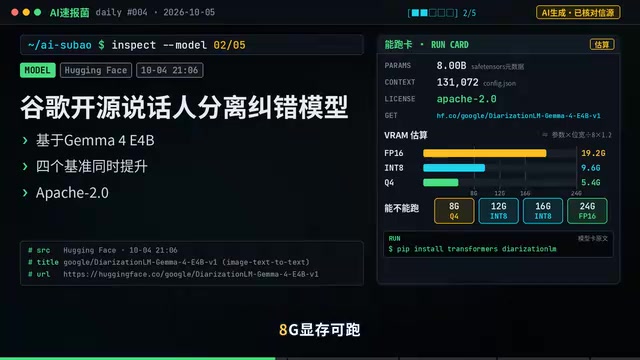
Google has released a lightweight Gemma-series model targeting speech transcription use cases (referred to in the README as Diarization Gemma 4 E4B), focused on speaker diarization and error correction, with a total size of approximately 8B parameters. Under Q4 quantization, the model weighs in at roughly 5.4GB and can run on 8GB of VRAM.
Speaker diarization — answering the question "who spoke when" — is a critical step in any speech transcription pipeline. Releasing this capability as a small, open source model means developers can integrate transcription and diarization directly into local or edge workflows without relying on cloud APIs. This is especially useful for privacy-sensitive scenarios like meeting notes and interview transcription.
Speaker diarization and automatic speech recognition (ASR) are two independent but highly complementary tasks in a speech processing pipeline. ASR handles "what was said" and outputs text; diarization handles "who said it" and outputs time-stamped speaker labels. Traditional diarization approaches are typically based on voice-print clustering algorithms (e.g., x-vector + PLDA), which have limited robustness in overlapping speech and noisy environments. Using a generative language model for this task means the system can leverage contextual semantics — such as name mentions and topic shifts — to help identify speakers, which should theoretically improve accuracy for multi-speaker scenarios like meetings and interviews. By integrating this into the Gemma family and releasing it at a lightweight ~8B parameter scale, Google aims to let developers deploy transcription and diarization together at a lower compute threshold, rather than stitching together two separate models.
Three Developer Tool Updates
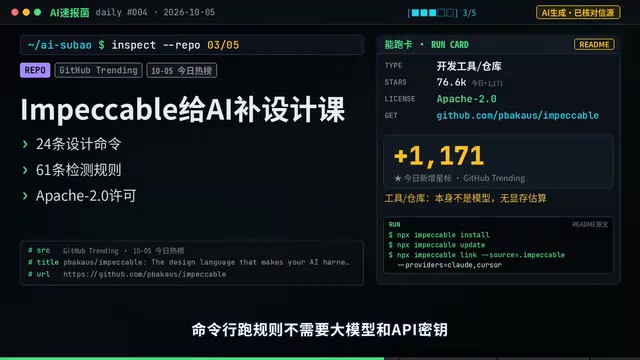
Impactable provides a front-end design language for AI coding agents. Its README states it includes 24 built-in commands and 61 deterministic detection rules. The key point: it runs entirely from the command line, the rule-based checks don't rely on an LLM, and no API key is required.
This "deterministic rules + CLI" approach stands in contrast to the prevailing "hand everything to an LLM" trend. For well-defined domains like front-end design standards, deterministic checks mean reproducible results, zero marginal cost, and easy integration into CI pipelines — a pragmatic complement to the broader AI coding toolchain.
OpenMount House claims to be the first open source agentic video production system, with its README listing 12 pipelines and over 100 tools. One important caveat: the project is released under the AGPL 3.0 license — a strict copyleft license with clear obligations for commercial integration. Anyone considering using it in a product should assess compliance requirements carefully.
Google Pauses Open Source Bug Bounty Program
According to TechCrunch, Google has decided to pause its open source bug bounty program starting October 1, citing a surge in automated submissions — most of which are low-quality or invalid. Google has promised a further update by Q1 2027.

This move reflects a new problem created by the proliferation of AI tools: automatically generated "vulnerability reports" are consuming security teams' review capacity. Bug bounties are designed to incentivize genuine security research, but when low-quality automated submissions flood the queue, the overhead of triaging them undermines the entire program. Google's pause isn't a termination — it's a signal that the mechanism needs to be redesigned. How to filter out noise while preserving valuable security contributions in the age of AI may be a challenge that bug bounty programs across the industry will all need to confront.
A Bug Bounty Program is a crowdsourced security mechanism in which companies pay external security researchers for disclosing vulnerabilities. Google's open source variant (the Open Source VRP) specifically targets open source projects it hosts or depends on. The widespread availability of AI code generation tools has made it extremely cheap to bulk-generate "potential vulnerability" submissions — researchers don't even need to understand the code; they can simply have a model scan it and output a formatted report. These submissions may look legitimate on the surface but are often false positives or already-known issues, requiring security teams to manually triage each one — with review costs scaling linearly with submission volume. Google's likely response will include some combination of machine-assisted pre-screening, raising the bar for submissions (e.g., requiring a proof-of-concept), or restructuring rewards to penalize low-quality reports — challenges the entire industry faces as it rebuilds trust mechanisms in the AI era.
Summary
From local large model inference to lightweight speech models, from deterministic AI coding rule engines to agentic video systems — these updates collectively reflect the open source community's sustained effort to lower the barrier to entry and achieve practical deployment. Meanwhile, Google's decision to pause its bug bounty program is a reminder that AI brings not just productivity gains, but also governance mechanisms that need to be redesigned from the ground up. The data and claims cited here largely come from project READMEs and self-descriptions — actual results should always be validated against your own use case.
Related articles

AI Reverse-Engineers Monitor Firmware in 15 Minutes — Has the Hacking Barrier Been Flattened?
A security researcher used AI to reverse-engineer Dell monitor firmware in 15 minutes—entropy analysis, key extraction, MD5 verification—revealing encryption design flaws.

Mistral Voxtral 3: Real-Time Voice at 4 Cents per Minute, Challenging OpenAI
Mistral Voxtral 3 cuts real-time voice agent costs to 4 cents per minute, bundling three speech recognition models, a speech generation model, and a real-time voice toolkit, supporting 50+ languages and self-hosting. This article analyzes its pricing structure, sub-second response performance, and its strategic divergence from OpenAI and Gemini on data privacy versus out-of-the-box convenience.

WebMCP: Every Website as Its Own MCP Server, So AI Agents No Longer Rely on Screenshots
WebMCP lets websites expose tools via the document.modelcontext API, becoming directly callable MCP servers. This article explains its architecture, the Claude Code remote-debugging demo, Chrome's current support stage, and its impact on the agent ecosystem.