RunInfra: An Open-Source Model Flat-Rate Plan Built for AI Agents

RunInfra offers open-source model plans starting at $10/month, pushing cache hit rates to 99.5% via session-aware routing for coding agents.
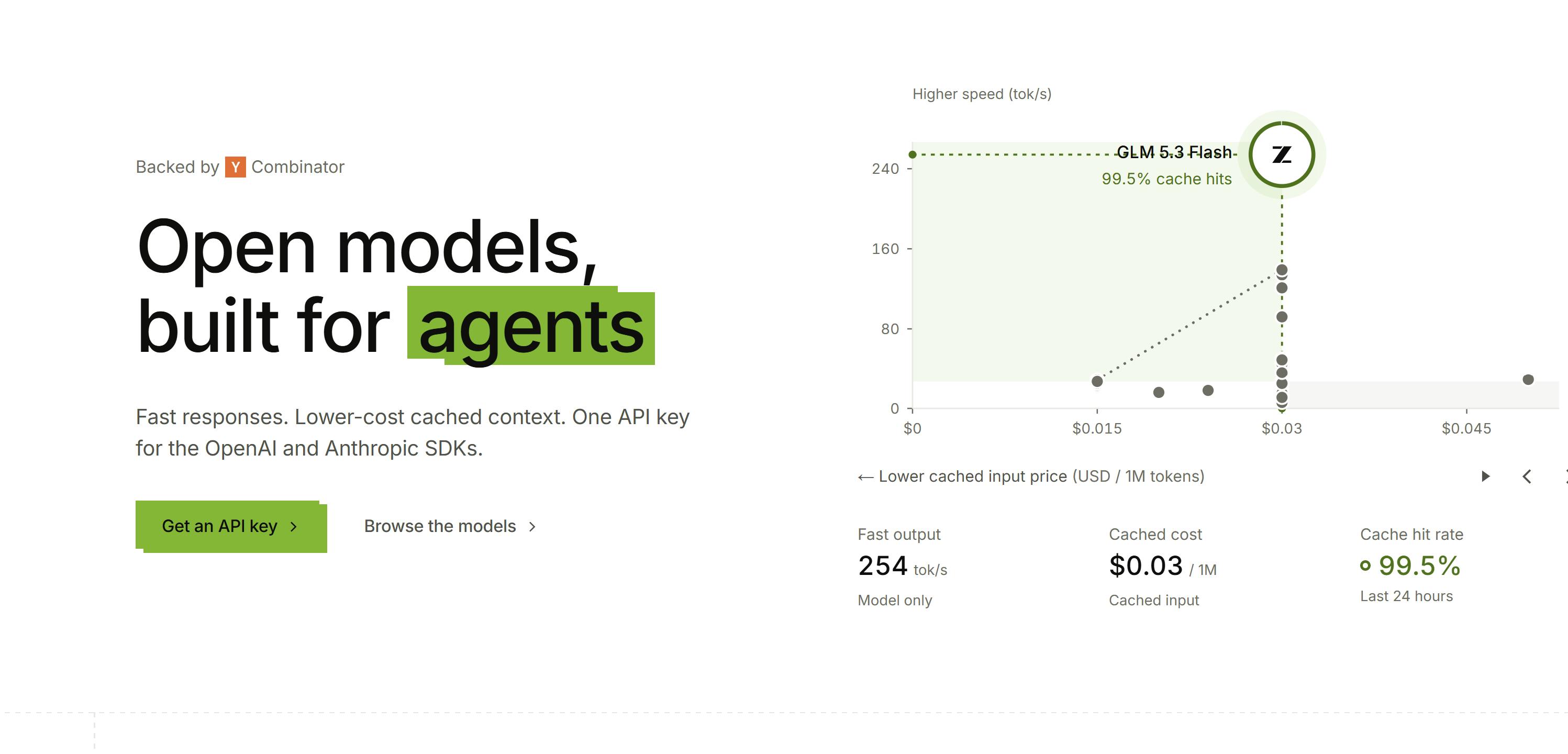
RunInfra is an open-source model subscription service for AI coding agents, starting at $10/month. It integrates GLM 5.3, DeepSeek V4.1 Flash, Qwen3.8 27B and more, integrating with Claude Code, Cline, Droid and other tools via a single prompt at near-zero migration cost. Its core is session-aware routing, binding consecutive requests from the same session to the same cache node with a claimed 99.5% cache hit rate, converting per-token billing into predictable flat monthly costs. It commits to zero data retention, no training use, and SOC 2 Type II certification.
The developer tools space is undergoing a quiet transformation: AI coding agents are no longer just concept demos—they're starting to genuinely enter everyday development workflows. But a question follows: how do you make these agents run fast and cheap? RunInfra's answer: an open-source model pool on a monthly subscription.
One Prompt to Integrate: The Barrier Is Pushed to the Minimum
The most appealing thing about RunInfra is its minimalist integration flow. The official description is "Setup takes one prompt"—you paste a prompt into your agent tool, complete a single login authorization, and configuration is done. No cumbersome API key management, no fiddling with environment variables. For developers already using Claude Code, Codex, OpenCode, Cline, Droid, or Grok Build, this zero-friction onboarding essentially means no migration cost.
From a product positioning standpoint, RunInfra doesn't train models itself; instead, it packages open-source models like GLM 5.3, DeepSeekAd V4.1 Flash, and Qwen3.8 27B into plans designed for coding agents, starting at $10 per month. This essentially bundles "model selection + inference cost + cache optimization" into a predictable fixed expense, so developers no longer have to worry about per-token billing.
Session-Aware Routing: The Technical Edge Behind a 99.5% Cache Hit Rate
RunInfra claims its session-aware routing can achieve a cache hit rate of 99.5%. This figure is the key to the entire business logic. The working pattern of coding agents is highly repetitive: the same codebase context, similar questions, continuous multi-turn conversations. If the routing layer can recognize session continuity and direct requests to the same cache node, then the vast majority of inference can hit the cache directly, and marginal costs drop sharply.
This also explains why RunInfra dares to offer "unlimited monthly" style pricing. Traditional APIs charge per token because each request may trigger full inference; but when the cache hit rate approaches saturation, the plan's economic model works. One detail: 99.5% is the vendor's claimed upper limit—the actual hit rate depends on usage patterns, and scenarios with frequently changing context may not reach this level.
KV Cache and Prompt Caching
During large language model inference, the key-value pairs of processed tokens (Key-Value, or KV cache) are stored in GPU memory to avoid recomputing the same prefix. Prompt caching leverages this mechanism: when two requests share the same context prefix (such as the same system prompt or the same codebase snippet), subsequent requests can directly reuse the computed KV state and only process new tokens. For workloads like coding agents—"same codebase context + multiple follow-up questions"—prefix reuse is extremely high, so cache hits can compress effective inference volume to a very low level.
Session-Aware Routing
Conventional load balancing distributes requests randomly or round-robin, so requests from the same session may land on different nodes, causing caches on each node to be unshared and hit rates to drop to zero. Session-aware routing instead uses session identifiers (session ID, conversation history hash, etc.) to stably bind consecutive requests from the same session to the node holding the corresponding cache, thereby maximizing prefix reuse. This is also the engineering prerequisite that makes RunInfra's "99.5% cache hit rate" possible—at the cost of maintaining session-to-node mapping state and handling cache migration or rebuilding when nodes fail.
Open-Source Models + Coding Agents: Does This Combination Hold Up?
The core assumption RunInfra is betting on: coding scenarios have relatively focused model capability requirements, and open-source models are already good enough. The GLM, DeepSeek, and Qwen series have indeed been rapidly approaching closed-source models in code generation and tool calling, often at a fraction of the price. For teams seeking cost-effectiveness, this constitutes a genuine alternative.
But this combination also has clear boundaries. Open-source models still lag in complex reasoning, long-context consistency, and ecosystem tool integration, and tasks heavily dependent on advanced reasoning may still need closed-source flagship models as a fallback. RunInfra's value isn't in replacing top closed-source models, but in providing a cost-controllable execution layer for the "high-volume, everyday" coding tasks.
Coding Agents and Tool Calling
A coding agent isn't just code completion; it's an intelligent agent that can autonomously plan steps, read and write files, execute commands, run tests, and iterate based on errors. Its core capability is tool calling (Tool Calling / Function Calling): the model outputs structured call instructions, the agent framework executes them and feeds the results back to the model, forming a closed loop.
This working pattern imposes two types of requirements on models: first, instruction following and state retention under long contexts; second, stable structured output capability. The former determines whether the agent can avoid getting lost in large codebases, and the latter determines whether tool calls are reliable. Open-source models have made significant progress on both fronts over the past two years, but still lag behind closed-source flagships in multi-step complex planning, error self-recovery, and long-range consistency—this is the technical basis for the article's judgment that "open-source models are sufficient for everyday tasks, while complex reasoning still needs closed-source fallback."
Data Security Commitments: Zero Retention and SOC 2
For products targeting enterprise developers, compliance is an unavoidable threshold. RunInfra explicitly commits to zero data retention, not training models on user prompts, and holds SOC 2 Type II certification. For teams handing private codebases to agents, these terms are basic prerequisites for trust. However, like all such commitments, actual implementation depends on third-party audits and independent user verification; the vendor's unilateral claims are only a starting point.
What Is SOC 2 Type II?
SOC 2 is developed by the American Institute of Certified Public Accountants (AICPA) and evaluates a service provider's controls around five trust service criteria: security, availability, processing integrity, confidentiality, and privacy. Type I only assesses whether the control design is reasonable at a single point in time, while Type II requires sampling audits of the actual operation of controls over an observation period of 6–12 months, thus better reflecting sustained compliance capability. For enterprise customers, a Type II report is usually more convincing than a vendor's self-description, but it covers internal control processes and does not directly equate to verification of specific commitments like "data is never used for training"—the latter still needs to be judged in combination with zero-retention terms and independent technical audits.
Competitive Landscape and Points to Watch
Getting 90 votes and ranking 6th on its launch day on Product Hunt shows this direction has clear attention but hasn't yet exploded. RunInfra faces competition from two sides: model aggregation platforms like OpenRouter on one side, and the official model channels bundled with various coding agents on the other. Its differentiation lies in "deep optimization for agent scenarios"—session routing, caching strategy, and flat fixed pricing are things general aggregation platforms won't specifically do.
What's worth watching next: the plan's actual rate-limiting policy, cache hit rate performance under real workloads, and how quickly RunInfra follows up when open-source model versions update. If these three points deliver, the positioning of "an open-source model layer born for agents" has a chance to take hold.
This article is based on publicly available product information on Product Hunt; model capabilities and performance data are subject to vendor claims and subsequent real-world testing.
One-line Summary
RunInfra offers open-source model plans starting at $10/month, pushing cache hit rates to 99.5% via session-aware routing to provide a low-cost execution layer for coding agents.
Paragraph Summary
RunInfra is an open-source model subscription service for AI coding agents, starting at $10 per month. It integrates models like GLM 5.3, DeepSeek V4.1 Flash, and Qwen3.8 27B, and can be integrated into mainstream agent tools like Claude Code, Cline, and Droid with a single prompt—virtually zero migration cost. The core of its business logic is session-aware routing: binding consecutive requests from the same session to the same cache node, claiming cache hit rates of up to 99.5%, thereby converting per-token billing into a predictable flat monthly expense. The product isn't positioned to replace closed-source flagship models, but to handle "high-volume, everyday" coding tasks. On compliance, it commits to zero data retention, no training use, and holds SOC 2 Type II certification, though actual effectiveness still requires third-party audits and real-workload validation.
Related articles

Random Pruning of the DPO Computation Graph: 1.4x Training Speedup and Lower Peak Memory
DPO training too slow and memory-hungry? This paper proposes a random pruning framework for the DPO computation graph, sampling independently across position, sequence, and branch dimensions; branch pruning achieves a 1.426x step-time speedup and cuts training time by about 30%, with in-depth attribution of memory and time gains.

Why Does JEPA Underperform MLM in Longitudinal EHR Representation Learning?
New study compares JEPA and MLM for longitudinal EHR representation learning on MIMIC-IV: three JEPA variants train stably without collapse but underperform MLM; target size, not heterogeneity, drives prediction error.

Transfer Learning + Visible Light Communication: A New Approach to Energy-Efficient Indoor Positioning
A study proposes a transfer learning-based visible light communication indoor positioning method, achieving 47% accuracy improvement on the BOSCH factory dataset, 67.5% model efficiency under high noise, and introducing the ME composite metric for energy-efficient positioning in energy-constrained industrial IoT scenarios.