Running AI Locally at €0.12/Hour — Is Calling Frontier Model APIs Actually Cheaper?

Local AI inference costs far more than electricity alone — throughput, depreciation, and model quality all matter.
A user wondered whether running LLMs locally at €0.12/hour in electricity is cheaper than paying for frontier model APIs. The article reveals a fundamental unit mismatch: local costs are time-based while cloud APIs are token-based, requiring conversion to a common baseline. Beyond electricity, true TCO includes hardware depreciation (RX 7900 XTX depreciation alone can exceed the hourly electricity cost), inference speed as a time cost, and the capability gap between small local models and frontier LLMs. The conclusion: heavy, sustained users may benefit from local inference, but intermittent or quality-focused users will typically find pay-as-you-go cloud APIs more economical.
A Recurring Question About Local Inference Costs
A Reddit user raised a characteristically thought-provoking question: if running a large language model locally costs around €0.12 per hour in electricity, is it actually cheaper to just pay for API access to frontier models?
The user's setup consists of a Radeon RX 7900 XTX paired with a Ryzen 9 7800X3D (listed as 9800X3D in the original post), running models including Qwen Flash and Qwen 27B dense. Because the Flash variant runs faster, it's their primary choice. Local electricity costs roughly €0.25/kWh, fluctuating between €0.11 and €0.35. Using ChatGPT to estimate total system power draw, they arrived at an operating cost of approximately €0.12 per hour.
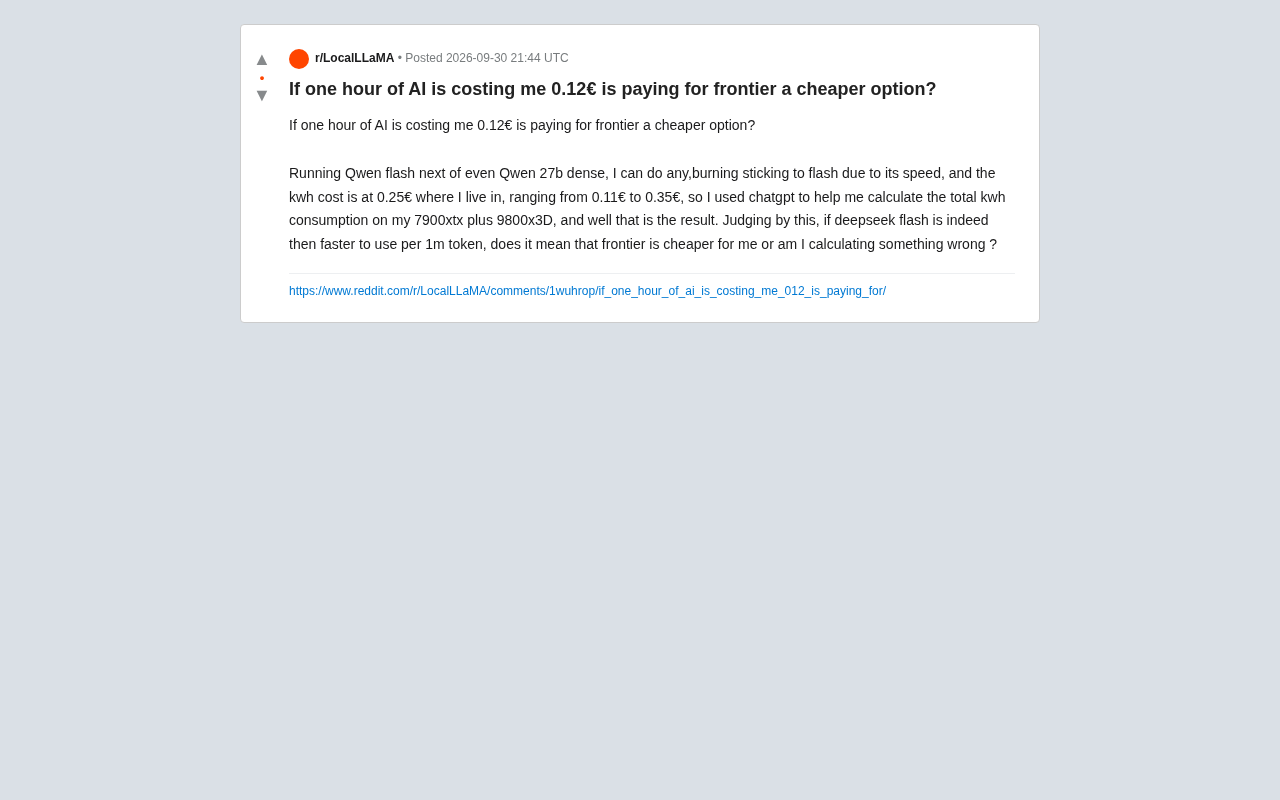
The core question: if models like DeepSeekAd Flash are faster and cheaper per million tokens when accessed via the cloud, does that mean calling frontier model APIs is actually more cost-effective than self-hosting local inference?
Why "Cost Per Hour" and "Cost Per Token" Can't Be Compared Directly
The crux of the issue is a fundamental mismatch between two billing dimensions. Local inference costs are measured in time (electricity per hour), while cloud API costs are measured in throughput (per million tokens). A fair comparison requires converting both to the same baseline.
€0.12 per hour sounds incredibly low — but what truly determines value is how many tokens you actually generate within that hour. If a consumer GPU only produces a few hundred thousand tokens per hour, the cost per million tokens may not be as attractive as it appears on the surface. Conversely, with a smaller model and high throughput, the marginal local cost becomes very thin.
The conversion formula is straightforward:
Local cost per million tokens = (hourly electricity cost) / (tokens generated per hour / 1,000,000)
Only after calculating this figure can you meaningfully compare it against cloud API pricing (typically quoted in USD per million tokens). The original poster calculated electricity costs but left throughput out of the denominator entirely — that's precisely where the confusion originates.
Understanding how throughput affects cost conversion requires a realistic sense of what consumer GPUs can actually do. Running a quantized Qwen 27B dense model on an RX 7900 XTX (24 GB VRAM), generation speed typically falls in the 20–40 tokens/second range; switching to a smaller Flash-series model (roughly 7B scale) can push this to 60–100 tokens/second. At an estimated 70 tokens/second, one hour yields approximately 252 million tokens, putting the electricity cost at around €0.48 per million tokens. Cloud services like DeepSeek typically price their Flash/lightweight models in the $0.10–$0.50 per million token range — remarkably close. This suggests that for high-throughput, smaller-model scenarios, local electricity costs aren't necessarily more expensive than the cloud. But once depreciation and other hidden costs enter the picture, that advantage narrows or disappears entirely.
The Hidden Costs That Get Ignored
Using electricity alone to represent the total cost of local inference is a significant underestimate. A complete Total Cost of Ownership (TCO) analysis should include at least the following:
Hardware Depreciation
The purchase price of an RX 7900 XTX is substantial. Amortized over its useful lifespan, the per-hour depreciation often exceeds the electricity cost itself. If the machine was bought primarily to run AI workloads, this component cannot be ignored.
Time and Speed
The original poster already noted that Flash is preferred "because it's faster." Speed is itself a cost — slower local inference means longer waits, while frontier model APIs typically have the edge in latency and throughput. For workflows that require rapid iteration, the time cost may far outweigh that €0.12.
Quality Gap
This is the factor most easily obscured by an electricity bill. The Qwen Flash or 27B dense models that run locally have a meaningful gap in reasoning ability and complex task performance compared to true frontier models (such as leading closed-source LLMs). For quality-sensitive tasks, cheaper local models may require many more conversation turns to reach a satisfactory result — paradoxically driving up actual costs.
Total Cost of Ownership (TCO) is the standard framework for evaluating the economics of a technical solution. It refers to the sum of all direct and indirect costs incurred over the entire lifecycle of a product or system. For local AI inference, TCO beyond electricity includes hardware purchase and depreciation, cooling and power supply losses, time spent on maintenance and troubleshooting, OS and driver version management, and the physical space and noise the machine occupies. Taking the RX 7900 XTX as an example: priced at roughly €900–1,000, with a 3-year lifespan and 4 hours of daily use, depreciation alone comes to approximately €0.23 per hour — already higher than the €0.12 electricity figure from the original post. This means that even when electricity seems negligible, the true per-hour cost of ownership may be more than double the electricity cost, directly altering the conclusion when comparing local deployment against cloud APIs.
Frontier Models refer specifically to large language models that represent the highest point of current technical capability at the time of release — typically hundreds of billions of parameters, trained with large-scale reinforcement learning from human feedback (RLHF). Canonical examples include GPT-4o, Claude 3.5 Sonnet, and Gemini 1.5 Pro. By contrast, models that run on consumer hardware locally (such as Qwen 7B Flash or 27B dense) are edge inference models, with a notable capability gap in multi-step reasoning, code generation, long-document comprehension, and other complex tasks. This gap cannot be ignored when assessing "value for money": if a task takes 5 conversation turns with a local model but only one with a frontier API, the actual token consumption and time cost of the former may be far higher — even if the per-token price appears lower.
When Local Wins, and When API Wins
Taken together, the answer isn't binary — it depends on usage patterns:
- High-frequency, long-duration, sustained load: If the GPU runs near-full capacity around the clock, the marginal electricity advantage of local inference becomes real, especially at off-peak electricity rates.
- Low-frequency, intermittent use: The machine depreciates while sitting idle most of the time. In this scenario, pay-as-you-go API access is almost always more cost-effective.
- Quality-sensitive tasks: The capability premium of frontier model APIs often justifies the price; small local models simply can't substitute.
- Privacy, offline access, or unlimited-call requirements: In these cases, the value of local deployment isn't about saving money — it's about control and data security.
For the original poster's specific situation, the recommendation is: first, benchmark the actual token output of the local model over one hour, calculate the per-million-token local cost, then add GPU depreciation and your own time cost, and finally compare that figure line-by-line against cloud service pricing from DeepSeek and similar providers. Only then does the question "is a frontier API actually cheaper?" have an honest answer.
Conclusion
What looks like a simple question actually touches on one of the most common misconceptions in local AI deployment: treating electricity as the total cost, and then comparing two solutions measured in completely different units. Electricity is only the tip of the iceberg. Throughput, hardware depreciation, speed, and model quality together determine real value. For most users with intermittent workloads and quality requirements, frontier model APIs are often genuinely the more economical choice. For heavy users with saturated workloads and a need for data sovereignty, local inference can have a chance of coming out ahead on the bill.
Related articles

WorkBuddy Full Tutorial: Build an AI Office Automation Agent from Scratch
A complete WorkBuddy tutorial: installation, three working modes, multimodal picture book video practice, expert team agent building, and workflow configuration for low-cost AI office automation.

WorkBuddy Agent Complete Guide: From Beginner to Automation in 7 Days
Based on Bilibili's 256-episode WorkBuddy masterclass, this systematically breaks down Tencent's AI office workbench core capabilities: Agent principles, Skill encapsulation, cross-platform connectors, scheduled automation, knowledge bases, and zero-code development, with learning path recommendations.

8 AI Accounts, 7 Failed: An Honest Review of Using AI to Get Work Done
Only 1 of 8 AI-run Bilibili accounts succeeded. We break down the real difference between "performing AI" and "using AI to get work done."