Running Out of Codex Quota? An In-Depth Review of HeyRoute's GPT-5.5 Integration

An objective review of HeyRoute's low-cost GPT-5.5 relay service for developers hitting Codex quota limits.
HeyRoute is a third-party API relay claiming to offer GPT-5.5 at ~3% of official prices, with a 1.08s first response and 99.95% success rate. This article analyzes its pricing, performance claims, and key risks—data security, model authenticity, and compliance—to help developers evaluate rationally.
For developers who rely heavily on AI coding assistants, an unavoidable pain point is the official usage quota limit. Whether you're writing code, refactoring projects, or running automated tasks, once you hit your quota ceiling, your workflow grinds to a halt. Recently, a third-party integration solution called HeyRoute surfaced on Bilibili, claiming that by integrating the GPT-5.5 model, it can deliver a stable, fast AI coding experience at prices far below official rates. Drawing on the original source material, this article offers a systematic and objective breakdown of its core selling points.
Why API Relay Services Like HeyRoute Exist
AI coding tools represented by Codex (and the GPT-series models behind it) often face two core problems under heavy-usage scenarios: first, quota gets consumed too quickly, especially when handling long contexts or large-scale project refactoring; second, the cost of official API calls is relatively high, and the expenses add up considerably over time.
These two pain points have given rise to a wave of API relay and aggregation services, and HeyRoute is one of them. Its positioning is quite clear—specifically targeting developers who find "Codex quota isn't enough," offering an alternative channel that's more cost-effective and tailored to coding-scenario needs.
The Technical Principles of API Relay Services: An API relay/proxy service essentially sets up a proxy layer between the user and the original model provider. Technically, it typically reduces latency through request forwarding, load balancing, and caching optimization, while leveraging bulk purchasing or specific access protocols to gain a price advantage. The sources of these services' cost advantages are complex, and may include regional pricing differences, bulk API key purchase discounts, or trimming and compressing model parameters. The core value of such services lies not in model innovation, but in lowering the barrier to entry and marginal call costs.
It's worth noting that API relay services have already formed a sizable gray-market ecosystem globally. From an architectural standpoint, such services usually adopt a multi-layer proxy design: the front end handles user requests, the middle layer manages authentication and rate limiting, and the back end connects to the original model API. From an engineering implementation perspective, the middle layer often introduces a Semantic Cache mechanism—storing vectorized historical responses to similar requests, and directly returning cached results when a new request's semantic similarity to a historical one exceeds a threshold, thereby drastically reducing the frequency and cost of actually calling upstream APIs. This mechanism is especially effective for generating highly repetitive boilerplate code in programming scenarios, but it may also result in personalized requirements not receiving precise responses.
The source of price advantages is often opaque. Some providers profit from regional price arbitrage, others rely on rotating large pools of bulk accounts, and a few even carry compliance risks from abusing academic or non-commercial agreements. Mainstream model vendors like OpenAI explicitly restrict unauthorized resale in their terms of service. Therefore, when choosing a relay service, whether the provider holds legitimate resale or distribution authorization is an easily overlooked yet crucial compliance consideration.

GPT-5.5: A New-Generation Tool for Coding Scenarios
GPT-5.5 is the new-generation language model OpenAI released after the GPT-4 series, offering significant improvements over its predecessor in code comprehension, long-context processing, and multi-step reasoning. Its core advantages in coding scenarios manifest in its ability to understand complex project structures and its context stability when handling ultra-long code files. For complex engineering tasks involving cross-file refactoring and architectural adjustments, the larger context window and stronger reasoning chains give it a clear edge over earlier models. HeyRoute's choice to integrate this model is precisely aimed at meeting heavy developers' core demand for high-quality programming assistance.
From the perspective of model evaluation, the core capability metrics for large language models in coding scenarios typically include: HumanEval code generation benchmark scores, SWE-bench real-world bug-fix success rates, and accuracy in resolving cross-file dependencies. Among these, SWE-bench is currently the industry's recognized benchmark that most closely mirrors real engineering scenarios, requiring models to locate and fix code defects within the context of real GitHub Issues—thus reflecting a model's actual engineering capability in complex projects better than pure code-completion benchmarks. Additionally, a model's context window size directly determines the upper limit of code it can process at once—GPT-5.5's improvement in this dimension gives it a clear advantage when handling large monorepos or performing cross-module dependency analysis.
It's worth noting that a model version number itself does not directly equate to a quality guarantee—whether the relay service actually calls the full model of the corresponding version, or a derivative version that has been distilled, quantized, or parameter-trimmed, is usually difficult for users to verify externally. It's advisable to evaluate the actual model capability using benchmark tasks of known difficulty, rather than judging solely by the version label.
Core Use Cases: Writing Code, Modifying Projects, Running Automation
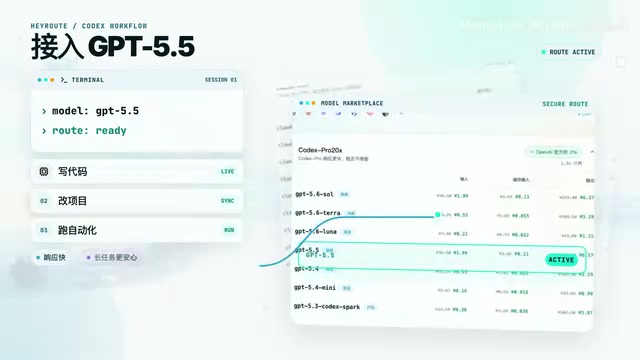
According to the UP master's actual demonstration, HeyRoute's GPT-5.5 integration primarily covers three high-frequency development scenarios: writing code, modifying existing projects, and executing automated tasks. These are precisely the most mainstream uses of AI-assisted programming today. The demonstration particularly emphasized stability in long-task scenarios—even when the task chain is lengthy, responses remain coherent and smooth, letting developers "run the full process with greater peace of mind."
In the actual workflow of AI programming, "automated tasks" typically refer to multi-step task execution driven by Agentic mode: the model not only generates code but also autonomously invokes tools, reads and writes files, executes terminal commands, and iteratively adjusts its strategy based on the output. Such scenarios place extremely high demands on the model's long-range reasoning stability—any context loss or logic break in an intermediate step could cause the entire task chain to fail. Therefore, in such scenarios, a relay service's context retention capability and streaming output stability are often more worth focusing on than single-response latency.
Performance and Stability: What Do the Official Numbers Say?
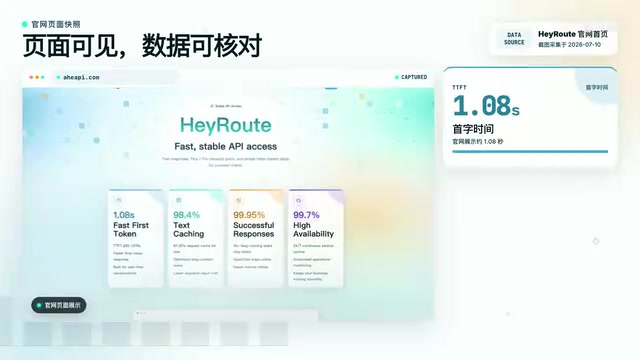
Performance is the key to whether such relay services can truly be adopted by developers. The original source material provides two specific metrics:
- First response of about 1.08 seconds: The time-to-first-byte response time displayed on the official site, which is a relatively smooth level for interactive programming scenarios.
- Success response rate of 99.95%: If this stability metric holds true, it means the service has made fairly thorough guarantees at the availability level.
Understanding the Technical Meaning of These Two Metrics: Time To First Byte (TTFB) reflects the latency between when a request is sent and when the model begins returning its first token, encompassing network transmission, request queue waiting, and model warm-up time. 1.08 seconds is acceptable in interactive scenarios, but may fluctuate significantly under high concurrency or poor network conditions. As for the 99.95% success rate, it corresponds to about 21.9 minutes of allowed downtime per month, which is a standard commercial service level in SLA systems—but note that this metric typically only counts successful returns at the HTTP layer, while "business failures" like model hallucinations and truncated outputs fall outside its scope.
When actually evaluating the availability of medium-sized services, another dimension warrants attention: P99 latency (99th-percentile response time). Excellent average or median latency does not mean the user experience will remain stable under extreme conditions. During peak concurrency, a relay service's queuing mechanism may cause the response time of a few requests to far exceed the average—for interactive programming scenarios that rely on real-time feedback, such long-tail latency often affects the actual user experience more than the average figures. It's advisable to simulate real concurrency scenarios during the testing phase, rather than relying solely on single-request response performance.
It must be objectively noted that all the above figures come from the official website's display, representing a single-source promotional claim. Actual experience will be affected by multiple factors such as network conditions, concurrent load, and task complexity. Developers interested in trying it out are advised to rely on small-scale hands-on testing rather than taking these claims entirely at face value.
Pricing Structure: 3% of the Official Price?
HeyRoute's core selling point is undoubtedly price. According to the description, its GPT-5.5 reference price is about 3% of the official price. If this ratio holds true, the cost savings would be considerable for developers who make frequent calls. Of course, the price advantage of third-party relays is often a trade-off against factors like stability guarantees and data compliance, so users need to evaluate based on their own circumstances.
In terms of plan design, HeyRoute offers three tiers to accommodate different usage rhythms:
- Pay-as-you-go quota: Suitable for users with variable usage who pay on demand;
- 7-day unlimited pack: Suitable for short-term concentrated effort on a specific project;
- 30-day monthly card: Suitable for long-term users with stable call demand.
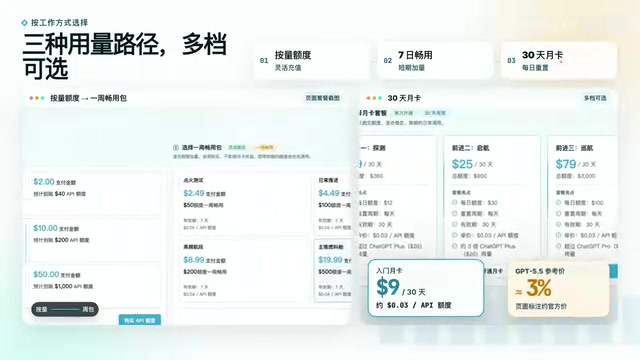
The "pay-as-you-go + short pack + monthly card" combination is a typical design for subscription services, and behind it is essentially a Price Discrimination strategy: pay-as-you-go covers low-frequency users, short-term packs lock in project-based developers, and the monthly card binds high-frequency users through prepayment while improving the provider's cash flow. For developers, when choosing a plan, key considerations include the validity period and rollover rules for quotas, concurrent request limits, and whether there is a hybrid pricing trap mixing per-Token billing with per-call billing.
To understand "3% of the official price" from an economics standpoint: large language model API pricing is usually denominated in per million Tokens, and OpenAI's official pricing for the GPT-5 series has differentiated billing for input/output Tokens. If a relay service's actual price is only 3% of the official rate, it either means an extremely low operating profit margin (raising sustainability concerns), or represents a fundamental difference in cost structure from the official offering—for example, actually deploying a distilled lightweight model, or trading real-time responsiveness for cost optimization through large-scale batch processing (Batch API). This figure warrants deeper scrutiny by developers, and verifying model quality through tasks of known difficulty during actual testing is the most direct way to avoid the risk of "selling dog meat under a lamb's-head sign" with version labels.
Technical Support: Real-Time Q&A via QQ Group
Beyond price and performance, after-sales support is also an important dimension for evaluating such services. The source material mentions that if you encounter configuration or usage issues, you can obtain technical support via a QQ group. Compared with purely self-service API offerings, having a community channel for real-time communication is more beginner-friendly for troubleshooting.
From the perspective of service sustainability, the level of community activity is often an important reference for judging the maturity of a relay service. Before formally paying, you can first join the community to observe: the response speed within the group, the quality of resolution for historical issues, developers' attitude toward feedback, and whether there is long-term usage feedback from real users. These "soft indicators" often reflect the service's true level better than the official promotional data.
Making a Rational Choice: Considerations for Third-Party AI Coding Relay Solutions
On the whole, HeyRoute addresses a genuine market need: finding a more economical AI coding call channel under the constraints of official quotas and costs. Low prices, fast responses, flexible plans, and community support all hit the core pain points of heavy developers.
However, when choosing such a third-party relay service, the following points deserve focused attention:
-
Data Security and Privacy: Sending code containing business logic to a third-party relay service carries non-negligible risks at the data security level. Core concerns include: the risk of man-in-the-middle attacks during transmission, whether the provider retains logs of request content, and whether it complies with data regulations such as GDPR and China's MLPS 2.0 (Cybersecurity Multi-Level Protection Scheme). From a technical protection standpoint, you can require the provider to furnish proof of transport-layer encryption (TLS 1.3) and written terms guaranteeing no data retention; for highly sensitive code, consider performing variable-name obfuscation or logic desensitization before submission to minimize the risk of data leakage. For code involving trade secrets, finance, or healthcare, it's advisable to carefully review the provider's privacy policy before use.
-
Credibility of Promotional Data: The 1.08-second response and 99.95% success rate are all one-sided official claims; it's advisable to verify through hands-on testing before making decisions. Combining the interpretation of TTFB and SLA metrics above, actual business availability may differ from the promotional figures.
-
Long-Term Service Availability: The stability of relay services depends on upstream supply and carries a degree of uncertainty, so it shouldn't be your sole production dependency. It's advisable to keep the official API as a backup channel in your toolchain, and configure error retry and fallback strategies for critical tasks. From an architectural design standpoint, you can encapsulate AI calls as replaceable components through an abstraction adapter layer (Adapter Pattern), minimizing the cost of switching between different providers.
-
Traceability of Compliance Authorization: As mentioned earlier, some relay providers may resell without formal authorization, and once users build production dependencies on such services, they face a high risk of the service suddenly shutting down. Before deciding to make a long-term investment, ask the provider for relevant authorization proof where possible.
For developers who are indeed short on quota and need to control AI coding costs, it's worth first conducting small-scale testing through pay-as-you-go or short-term plans, verifying actual results before deciding whether to invest long-term. The essence of technology selection is always finding the optimal balance among needs, cost, and risk.
Key Takeaways
- HeyRoute is a third-party API relay service targeting heavy AI coding users, achieving lower call costs than the official offering through a proxy-layer architecture
- It claims to integrate the GPT-5.5 model, with the official site showing a first-byte response of about 1.08 seconds and a 99.95% success rate—but these figures are all single-source promotional claims, and hands-on verification is advised
- The price is about 3% of the official rate, with three plans offered (pay-as-you-go, 7-day pack, 30-day card); pay attention to quota rollover rules and concurrency limits before choosing
- Using such services requires focused evaluation of: data privacy compliance, model version authenticity (whether it's a distilled/quantized derivative), long-term service availability, and whether the provider holds legitimate resale authorization
- It's advisable to position the relay service as a supplementary channel rather than the sole dependency, keeping the official API as a fallback in your toolchain
Related articles

Disaster and Glory of the Apollo Program: The History We Must Revisit Before Returning to the Moon
From the fatal Apollo 1 fire to Apollo 8's daring lunar orbit to Apollo 11's successful landing—revisiting the disasters, fears, and compromises of the Apollo program and their lessons for today's return to the Moon.

Netflix Trust Exercise Turns Into Firing Trap: Where Are the Boundaries of Corporate Trust?
A Netflix employee was fired after sharing private info in a trust exercise. We analyze the risks of corporate trust exercises and how employees can protect themselves.

AMD CDNA5 Architecture Deep Dive: Technical Evolution and the AI Computing Competition Landscape
Deep analysis of AMD's CDNA5 architecture covering Chiplet packaging upgrades, HBM memory evolution, and low-precision compute optimization, examining how AMD challenges NVIDIA's AI chip dominance.