Running Qwen 27B Locally on Mac Studio: Real-World Performance Tests & Deployment Guide

Real-world benchmarks and deployment guide for running Qwen 27B locally on Mac Studio.
A developer shared real-world performance data for running Qwen 27B on a Mac Studio, highlighting Apple Silicon's unified memory architecture as a key advantage for local LLM inference. The article covers quantization strategies (4-bit, 8-bit, FP16), actual tokens/s throughput, and practical considerations including cost comparisons with cloud APIs, data sovereignty benefits, and the maturing open-source inference ecosystem with tools like llama.cpp, MLX, and Ollama.
Introduction: Is Local LLM Deployment Actually Viable?
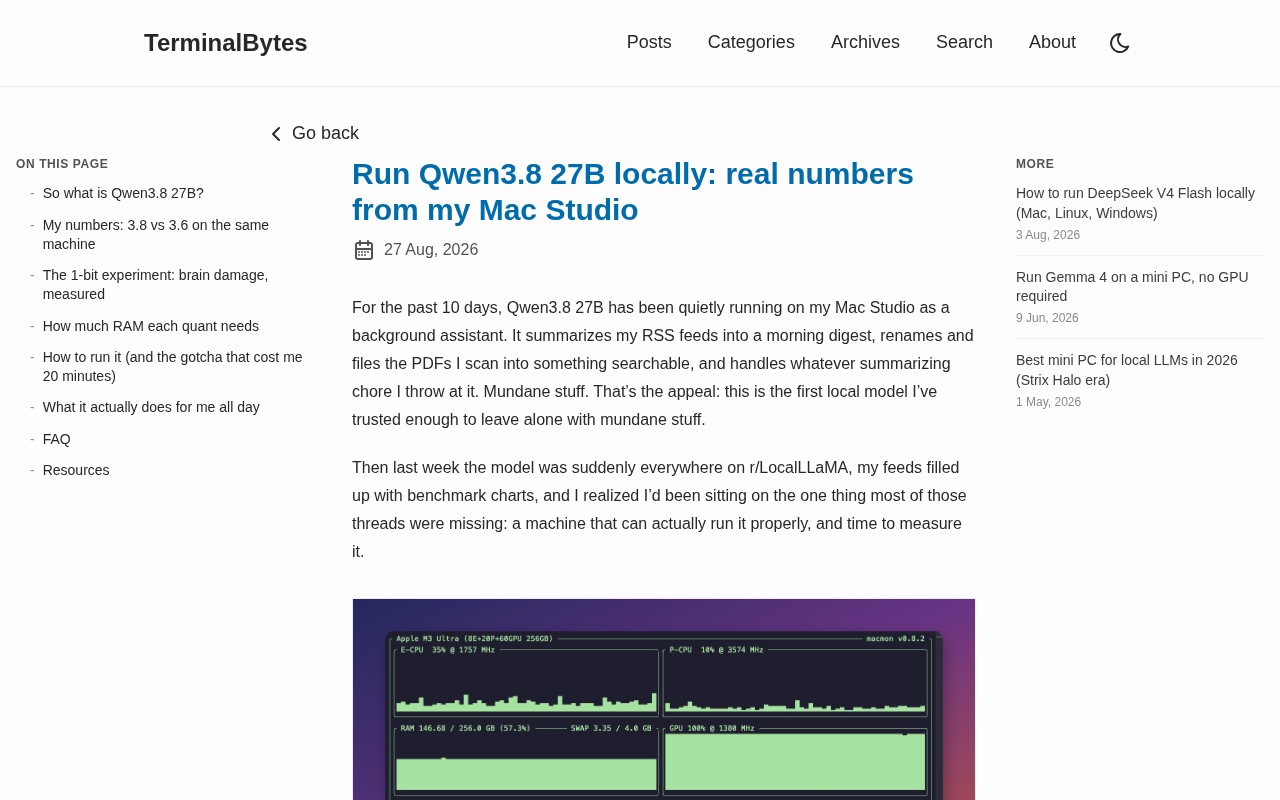
As open-source large language models continue to improve, more and more developers are exploring local deployment to break free from cloud API dependencies. Recently, a developer shared real-world benchmarks of running a Qwen 27B-class model on a Mac Studio on Hacker News, sparking a lively discussion (76 upvotes, 63 comments).
What made this post stand out was the "real numbers" it provided — not vendor marketing claims or theoretical peaks, but actual performance that an ordinary developer can expect on professional-grade hardware.
Why Choose Mac Studio for Running Large Models
The Unique Advantage of Unified Memory Architecture
The Apple Silicon Mac Studio has become a popular choice for local LLM deployment, primarily thanks to its Unified Memory Architecture. On traditional PC platforms, GPU VRAM and system memory are separate — even a high-end consumer GPU like the RTX 4090 only has 24GB of VRAM, making it difficult to fully load larger models.
To understand the technical roots of this advantage, you need to understand the design philosophy behind unified memory. On traditional x86 platforms, the CPU accesses DDR memory via the system bus, while the GPU has its own independent GDDR VRAM. Data transfer between the two must traverse the PCIe bus, which imposes bandwidth and latency constraints. When a model's parameters exceed GPU VRAM capacity, the system must frequently shuttle data between CPU memory and GPU VRAM (known as "offloading"), causing inference speed to plummet. Apple Silicon integrates the CPU, GPU, Neural Engine, and memory controller onto a single SoC (System on Chip), where all compute units share a single high-bandwidth LPDDR5 memory pool. Memory bandwidth can reach up to 400GB/s (M2 Ultra), eliminating the overhead of cross-bus copying.
This is why the Mac Studio, powered by M-series chips, can be configured with up to 192GB of unified memory shared between CPU and GPU. A 27B-parameter model (with reasonable quantization) can reside entirely in memory, avoiding the performance penalties of frequent data swapping. While this architecture can't match NVIDIA's professional compute cards in raw GPU throughput, its "large capacity + zero-copy" advantage becomes especially pronounced for memory-intensive inference tasks with very large models. For users pursuing local inference, this is the Mac platform's most compelling competitive edge over traditional approaches.
Power Consumption and Noise: The Overlooked UX Factors
Beyond the memory advantage, the Mac Studio's power efficiency and thermal management are important reasons many developers choose it. Compared to a workstation with multiple GPUs drawing hundreds of watts with audible fan noise, the Mac Studio can handle inference tasks in a relatively quiet, low-power state — making it far more suitable as a personal AI workstation sitting on your desk for long-term use.
Interpreting the Benchmarks: Is the Performance Actually Usable?
Quantization Strategies for a 27B Model
Running a Qwen 27B-class model at full FP16 precision requires roughly 54GB of memory. While a high-end Mac Studio can handle this, quantization (e.g., 4-bit, 8-bit) can significantly reduce memory usage and improve inference speed. In practice, the community commonly uses the GGUF format with llama.cpp or the MLX framework for inference.
GGUF (GPT-Generated Unified Format) is a model file format designed by Georgi Gerganov, the creator of the llama.cpp project. It replaced the earlier GGML format and has become the de facto standard for local inference. GGUF's key advantage is packaging model weights, tokenizer configuration, and metadata into a single file, with native support for various quantization schemes (e.g., Q4_K_M, Q5_K_S, Q8_0), allowing users to flexibly choose based on their hardware. llama.cpp is currently the most widely used C/C++ inference engine, supporting hybrid CPU/GPU inference with excellent cross-platform compatibility. MLX, on the other hand, is Apple's machine learning framework optimized specifically for its own chips, fully leveraging Apple Silicon's unified memory and Metal GPU acceleration — typically delivering better inference performance than llama.cpp on Mac platforms.
What you might not realize is that quantization sacrifices model output quality to some degree. The basic principle of quantization is representing neural network floating-point weights with lower-precision data types — standard FP16 uses 16 bits per parameter, while 4-bit quantization compresses each parameter to just 4 bits, theoretically reducing model size to one quarter. But quantization isn't simple truncation. Modern quantization algorithms like GPTQ, AWQ, and the k-quant series used in llama.cpp employ group quantization and importance-aware strategies, assigning different quantization precisions to different layers and channels to preserve inference capability while compressing size.
Developers need to make trade-offs between "speed" and "generation quality":
- 4-bit quantization: Lowest memory usage, fastest speed. Suitable for tasks with relatively relaxed precision requirements like code completion and text summarization. Tests show that well-quantized 4-bit models typically fall within 1-3 percentage points of the original FP16 model's performance.
- 8-bit quantization: Strikes a balance between speed and quality. Suitable for most everyday use cases.
- FP16 full precision: Best output quality, but demands more memory and slower inference speed. Suitable for scenarios requiring fine-grained reasoning. Notably, quality degradation from quantization can be more pronounced in tasks requiring precise mathematical reasoning or complex logical chains.
tokens/s: The Core Metric That Determines Real-World Experience
The key metric for evaluating the local LLM experience is tokens per second (tokens/s). Here's a quick explanation: a token is the basic unit of text processing for LLMs. One token doesn't equal one complete word — in English, one token corresponds to roughly 4 characters or 0.75 words; in Chinese, a single character is typically encoded as 1-2 tokens.
Measuring tokens/s actually involves two distinct phases: Time to First Token (TTFT) measures the latency from receiving input to producing the first output token, which depends on prompt length and prefill computation speed. Decode throughput measures the rate at which subsequent tokens are generated one by one. When generation speed drops below human reading speed (roughly 5-10 tokens per second), the interactive experience degrades noticeably. Specifically, normal English reading speed is about 250 words per minute, which translates to roughly 5-6 tokens per second. For scenarios like code generation where users review output line by line, 3-5 tokens/s can provide a smooth experience, while below 2 tokens/s users will feel an obvious "lag."
The actual throughput of Mac Studio running the Qwen 27B model directly determines whether it can handle real-time interactive scenarios like conversations and coding assistance.
Judging by the discussion activity on Hacker News, this kind of "real numbers" sharing fills an important information gap between official documentation and actual usage — many people desperately want to know what kind of speed they'll get from hardware costing thousands of dollars before making a purchase.
Practical Considerations for Local LLM Deployment
Cost Comparison: One-Time Investment vs. Ongoing Subscriptions
A high-end Mac Studio doesn't come cheap, but for heavy AI users, the one-time investment may be more cost-effective than paying for cloud API fees over time. This is especially true for scenarios involving sensitive data where privacy must be guaranteed (such as internal enterprise document processing or private conversations) — local deployment provides data sovereignty guarantees that cloud solutions simply cannot match.
Data sovereignty refers to the principle that data is subject to the laws of the country where it is generated or stored. As data protection regulations tighten worldwide — the EU's GDPR, China's Data Security Law and Personal Information Protection Law, and various U.S. state privacy acts — sending sensitive data to third-party cloud APIs for processing carries increasing compliance risks. When enterprises use cloud-based LLM APIs, user prompts and responses technically pass through third-party servers. Even if providers promise not to store or train on this data, there remain security concerns during transmission and auditing difficulties. Local deployment means all data processing stays on hardware under the user's physical control — data never leaves the machine, fundamentally eliminating risks of data breaches and cross-border transfer compliance issues. This is especially critical for data-sensitive industries like healthcare, finance, and legal.
The Open-Source Inference Ecosystem Is Maturing
Alibaba's Qwen (Tongyi Qianwen) series, as a leading Chinese open-source model, has become an important choice for local deployment thanks to its balanced performance across Chinese and English tasks and permissive open-source licensing. Since its initial release in 2023, the Qwen series has gone through multiple iterations, using a Transformer decoder-only architecture trained on large-scale corpora covering Chinese, English, and multiple programming languages. It particularly excels at bilingual Chinese-English understanding and code generation. The Qwen 2.5 series offers multiple parameter sizes from 0.5B to 72B, with the 27B tier widely considered a sweet spot for "model capability vs. hardware requirements" — it approaches or even surpasses 70B-class models on multiple benchmarks while remaining small enough to run smoothly on consumer hardware. The series uses the Apache 2.0 open-source license, permitting commercial use, making it especially popular for enterprise local deployment scenarios.
Combined with increasingly mature inference frameworks like MLX, Ollama, and llama.cpp, the barrier for ordinary developers to set up local LLM environments is dropping rapidly. Ollama in particular provides a friendlier user interface on top of these underlying engines — with simple command-line operations, you can pull a model and launch a local API service with one command, dramatically lowering the barrier to entry. The maturation of these toolchains has made the entire workflow — from model download, format conversion, to launching an inference service — increasingly straightforward, no longer requiring a deep machine learning engineering background.
Conclusion: Local AI Is Moving from Experiment to Everyday
The value of this real-world benchmark isn't about any specific performance number — it's about confirming a trend: running tens-of-billions-parameter models on professional consumer hardware is transitioning from a tech enthusiast's experiment to an ordinary developer's daily workflow.
As model quantization techniques advance, inference frameworks continue to be optimized, and hardware performance improves, the local LLM experience will keep getting better. For users who care about data privacy, want to break free from cloud dependencies, or have high-volume inference needs, devices like the Mac Studio with unified memory architecture are becoming a pragmatic choice for local AI infrastructure. Of course, before making a purchase decision, consulting more real-world benchmarks like this one remains the wisest approach.
Related articles

Chain of Thought Isn't Just for AI: How Humans Can Use CoT to Improve Thinking Quality
Chain of Thought isn't just a prompt trick for large models. Starting from a Hacker News discussion, this article analyzes why CoT works for human thinking too, breaks down actionable ways to transfer it, and highlights the key differences between human CoT and machine CoT.
Cloudflare Teams Up with OpenAI: Closi…
Cloudflare Teams Up with OpenAI: Closing the Loop from Vulnerability Discovery to Defense with AI
Cloudflare uses OpenAI Daybreak to investigate security vulnerabilities and generate reviewable remediation plans, while developers use Codex to boost coding efficiency and quality.

Orca Multi-Agent Orchestration in Practice: A Guide to Parallel Collaboration with Claude and Codex
Orca is Stable AI's free open-source agent workbench supporting 34 agents like Claude Code and Codex in parallel. Learn its Git worktree isolation, multi-model orchestration, and mobile management.