Running Qwen3 27B Locally on 16GB VRAM — Achieving PPT Freedom
Qwen3 27B runs locally on 16GB VRAM at 70 T/s, generating a full 16-page editable PPT via AI Agent.
A hands-on test shows that Qwen3 27B — a natively multimodal dense model — can run locally on an RTX 4070Ti Super with just 16GB of VRAM using Q3_K_XL GGUF quantization, Q4_0 KV cache compression, and 64K context length. Achieving ~70 tokens/second via llama.cpp, it outperformed two competing models in an Agent task that autonomously created a 16-page editable PowerPoint presentation, complete with self-review using its built-in vision capabilities.
Introduction: Multimodal LLMs on Just 16GB of VRAM
With the rapid iteration of Chinese open-source large models, the Qwen (Qianwen) series has become a popular choice for local deployment enthusiasts. Recently, a Bilibili content creator demonstrated running the Qwen3 27B multimodal dense model locally on a single RTX 4070Ti Super with just 16GB of VRAM — and used it to complete a complex Agent task: automatically generating a PowerPoint presentation. The results were quite impressive; in the creator's own words: "Qwen, I owe you one."
This article summarizes the key configuration parameters for deploying Qwen3 27B on 16GB of VRAM, along with a comparative look at how it stacks up against other open-source models on real-world Agent tasks.
Deployment Configuration: The Art of Squeezing Every Last Byte of VRAM
First, an important premise: Qwen3 27B is a natively multimodal dense model. "Natively multimodal" means the model was jointly trained on text, images, and other modalities during pretraining — rather than bolting a vision encoder onto a text-only model after the fact. The native approach yields deeper, more integrated cross-modal understanding, but the tradeoff is that the model weights include vision-related parameters, consuming more VRAM. Meanwhile, "dense" means every single one of those 27 billion parameters is activated during inference — unlike MoE (Mixture of Experts) architectures that only activate a subset, a dense model demands every last bit of its VRAM footprint.
To achieve usable speeds on 16GB of VRAM, the core principle is: absolutely do not let the CPU and system RAM get involved. The moment any weights get offloaded to system memory, the data transfer bottleneck between GPU and CPU causes inference speed to plummet — from dozens of tokens per second down to single digits or worse.
To that end, the creator spent extensive time tuning parameters in llama.cpp and eventually found the optimal combination for 16GB of VRAM. llama.cpp is an open-source project initiated by developer Georgi Gerganov in 2023. Implemented in pure C/C++, it provides an LLM inference engine that doesn't depend on heavyweight frameworks like Python or PyTorch, supports hybrid CPU/GPU inference, and is highly optimized for quantized models in the GGUF format. This lightweight toolchain is precisely what makes running large-parameter models on consumer hardware possible.
The final key parameter combination:
-
Model precision: The GGUF quantized version had to be Q3_K_XL. GGUF (GPT-Generated Unified Format) is the standard model format in the llama.cpp ecosystem, supporting quantization levels from Q2 to Q8 and even FP16. Here, "Q3" means weights are quantized to roughly 3-bit precision, "K" indicates the k-quant method (a grouped quantization strategy that applies different precision levels to layers based on their importance), and the "XL" suffix means more critical layers are preserved at higher precision within the Q3 tier. In the quantization spectrum, Q3_K_XL occupies a delicate position: it's more VRAM-efficient than Q4 variants, but precision loss is starting to become noticeable; going further down to Q2 would cause noticeable degradation in output quality. For a 27B-parameter model, this is the highest precision that 16GB of VRAM can accommodate.
-
KV cache quantization: Both K and V must be set to Q4_0. During inference in Transformer architectures, the model needs to store Key and Value vectors (the KV Cache) for every generated token, so that subsequent tokens can reuse them for attention computation. As context length grows, KV Cache memory usage scales linearly — in long-context scenarios, it can even exceed the memory footprint of the model weights themselves. Q4_0 is the most basic 4-bit quantization scheme for the KV Cache, compressing it to roughly one-quarter of the FP16 size. Research has shown that quantizing the KV Cache has far less impact on output quality than quantizing model weights, making this an extremely cost-effective way to save VRAM.
-
Context length: With the multimodal vision model loaded and MTP acceleration enabled simultaneously, the maximum context length is 64K. MTP (Multi-Token Prediction) is an emerging inference acceleration technique — traditional autoregressive models predict only the next token per forward pass, while MTP adds extra prediction heads so the model can predict multiple subsequent tokens in a single forward pass, significantly boosting generation throughput without sacrificing quality. The Qwen3 series natively supports MTP, which is one of the key technologies enabling decent speeds on consumer hardware. However, MTP's extra prediction heads consume additional VRAM, so in the extreme 16GB environment, there's a tradeoff with context length.
This configuration is right on the edge of running out of VRAM — the creator mentioned that even screen recording software couldn't be running simultaneously, as it would immediately cause VRAM overflow and speed collapse. All the demo footage was actually recorded after testing was complete.
This illustrates that running a natively multimodal 27B model on 16GB of VRAM is fundamentally an exercise in fine-tuning the balance between "multimodal capabilities," "context length," and "acceleration features" — one wrong move and you hit the VRAM ceiling.
Inference Speed: A Fluid Experience at 70 T/s
The speed results from this configuration were quite impressive:
- llama.cpp native output: ~70 T/s, with tested peaks reaching 76 T/s
- When called within an Agent framework ("Hornis"): Still maintained around 60 T/s
Here, "T/s" stands for tokens per second. One token roughly corresponds to one Chinese character or half an English word, so 70 T/s means the model can output about 70 Chinese characters per second — well beyond human reading speed, appearing in practice as a "waterfall of text" streaming out. For reference, OpenAI's GPT-4o API typically responds at around 80–100 T/s, and many locally deployed 7B models only achieve 40–60 T/s after quantization. Having a 27B dense model hit 70 T/s on a 16GB GPU speaks volumes about the massive progress in quantization techniques and inference engine optimization.
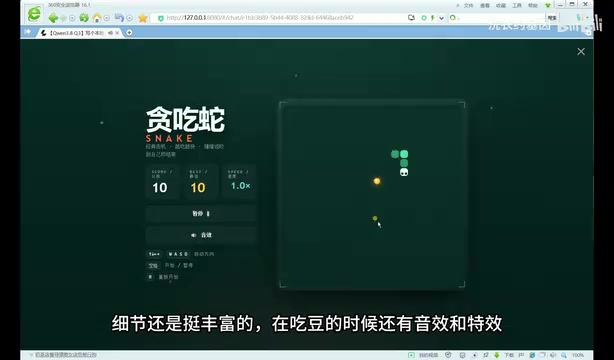
For local deployment, this speed comfortably reaches "usable" and even "pleasant" territory. The creator first ran a warm-up test with a web-based Snake game, and the Qwen3 27B output was rich in detail — complete with sound effects and visual effects when eating pellets, and all function buttons working properly.
Judging by the completeness of the generated code alone, this 27B model was already showing signs of being "impressively capable."
Agent Showdown: Three Models, One PPT Task
The real hardcore test was the Agent task. An AI Agent refers to a large language model that goes beyond passive Q&A to actively plan, call tools, and interact with its environment. A typical Agent workflow looks like this: the model receives a user instruction → autonomously breaks it down into subtasks → sequentially calls external tools (search engines, code executors, file operation APIs, etc.) → dynamically adjusts strategy based on intermediate results → delivers a complete final product. This places far higher demands on instruction following, long-range reasoning, and tool-use accuracy than ordinary conversation.
The creator set up a skill environment called "Hornis" with hundreds of built-in skills (tool functions callable by the model), using a unified prompt to compare PPT creation across different models. This "same framework, same prompt, different models" comparison method maximizes isolation of toolchain effects, directly measuring each model's Agent capabilities.
The test prompt was simple: search the web for "all the requirements a great PPT should have," then use three local models to create a PPT comparing Agent performance data, listing the skills used, in a "vivid tech style," with content and page count left entirely to the model's discretion.
The three models in the comparison:
- Qwen3 27B (64K context)
- Leizhen T1 (256K context)
- Yizhentuo Ri (256K context)
A notable detail: the other two models had context windows 4× larger than Qwen3's — theoretically a significant advantage for long tasks, since a larger context means the model can "remember" more conversation history and intermediate results, reducing errors from forgetting earlier steps or performing redundant operations in multi-step Agent tasks.

Qwen3 27B: Professional Task Decomposition and Self-Review
Qwen3 27B's performance exceeded expectations. It autonomously decomposed the task and laid out execution steps — "just looking at it felt professional." Throughout the process, the 64K context didn't cause any errors or infinite loops.
Even more surprisingly, after completing the PPT, it called the vision model to perform a self-review — this is precisely where native multimodal capability shines: the model can not only generate the PPT but also "see" what it generated, assess whether the layout is reasonable and the content complete, achieving a full "generate → review → revise" closed loop. It saved all important backups and incremental files to an external drive as requested, and concluded with a detailed completion summary listing every skill used.
The final product: a 16-page PPT, generated entirely through local deployment on 16GB of VRAM.
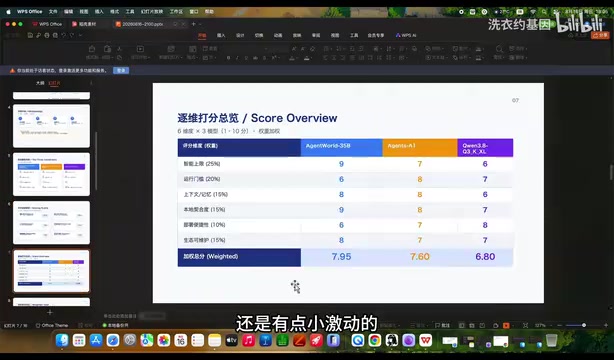
During a second test run, Qwen3 27B took about 12 minutes, produced an even more attractive cover, maintained reasonable layouts on every page, and even "created a hexagonal radar comparison chart" — with all elements fully editable. This means the output wasn't screenshots or images, but actual PowerPoint vector objects that users can further modify and refine.
The Other Models: Rambling and "Going Through the Motions"
In contrast, the two models with larger context windows delivered disappointing results:
Agent A1 had high expectations placed on it, but turned out to be the "most rambly" of the three — "hadn't actually done anything but kept babbling away," alternating between "Great, everything's fine" and "This is perfect." The final product was charitably described as having a certain "abstract, eclectic mixed-media beauty." This behavior is known in the Agent field as "overconfident idling" — the model generates large volumes of self-affirming text without effectively calling tools to perform actual operations, essentially reflecting insufficient instruction-following and tool-calling capabilities.
Agent World 35B-A3B (MTP Apex iBalance GGUF) was more conservative — stable in executing system operations without errors, but the output quality was questionable: "If you really want to call it a PPT, you'd be doing your conscience a disservice." Its problem was clear: unless you gave it explicit, detailed, mandatory instructions, it would cut corners. This reflects a common model capability gap — lacking autonomous planning ability, only capable of passively executing explicit commands, unable to proactively fill in details, optimize layouts, or perform quality reviews like Qwen3.
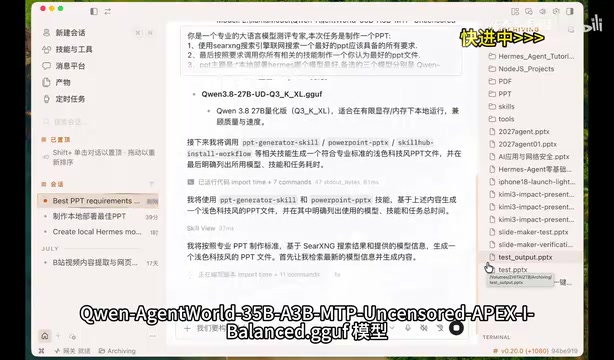
As the creator put it: if these three models were your employees, which one would you keep? The facts speak for themselves.
Reflections and Outlook: The Accelerating Pace of Open-Source Models
The most valuable takeaway from this test is what it reveals about the importance of proper attribution when diagnosing problems. The creator admitted: "If it weren't for Qwen3 27B, I might have blamed all the previous task failures on Hornis and its various skills."
In other words, with the same Agent framework, the same skill environment, and the same prompts, swapping in a stronger model eliminated all the frequent errors, infinite loops, and half-hearted outputs. This demonstrates that in Agent applications, the model's own capabilities are often the decisive variable determining success or failure — not the toolchain. This finding aligns closely with industry consensus: an Agent system's performance is the product of "model capability × tool quality × prompt engineering," but model capability carries the highest weight — an underpowered model cannot be compensated for by even the best toolchain.
Looking ahead, the creator also expressed anticipation for Qwen's future open-source releases — from Qwen3 35B-A3B to 122B-10B class MoE models. MoE (Mixture of Experts) architecture is one of the most important efficiency breakthroughs in the current large model landscape. Taking "35B-A3B" as an example: the total parameter count is 35 billion, but only about 3 billion parameters (the Active parameters) are activated per inference. This means the model has 35 billion parameters' worth of knowledge capacity but only requires the compute and VRAM footprint of a 3B-parameter model. By the same logic, a future "397B-17B" MoE model would possess nearly 400 billion parameters of knowledge, but only activate 17 billion during inference — a scale that could run smoothly on consumer GPUs. The creator's vision of "running 397B-17B on a $3,000 home PC" in two years isn't far-fetched — it's a reasonable extrapolation of MoE architecture development. When that day comes, the capability ceiling for local deployment will be fundamentally rewritten.
Conclusion
This test proves a fact: a consumer-grade GPU with 16GB of VRAM can already locally deploy a natively multimodal 27B model and complete complex Agent tasks. While careful tradeoffs between quantization precision, context length, and multimodal capabilities are necessary, the 70 T/s speed and the quality of a 16-page editable PPT are enough to turn "local PPT freedom" from a slogan into reality.
The pace of open-source model progress is visibly narrowing the gap with closed-source models. And all of this is happening on a single GPU with just 16GB of VRAM.
Related articles

Python Visitor Pattern and Better Alternatives Explained
A deep dive into Python's visitor pattern and four alternatives: method pattern, pattern matching, dictionary mapping, and functools.singledispatch. Choose the best decoupling design by change frequency.

357 Days of Deep Experience: Why Omarchy Made Me Stop Distro-Hopping
A 357-day deep dive into Omarchy: 59-second install, out-of-the-box audio and GPU support, the Quattro QuickShell rewrite migration pains, and why Arch users should try it.

uGAP: An AI Platform Unifying 100+ African Geospatial Datasets
uGAP is an African geospatial AI platform by a University of Cape Town team, unifying 120+ African datasets with a Python SDK for discovery, processing, and model training, already used in cyclone flood mapping.