Running Qwen3 27B on 16GB VRAM: 192K Context + Vision Benchmark
Full benchmark of running Qwen3 27B with 192K context on a 16GB GPU via Adaptive KV Streaming.
This article explores the core bottleneck of running long-context LLMs on consumer GPUs (RTX 5080, 16GB VRAM): KV cache grows linearly with context length, far exceeding VRAM capacity. It covers llama.cpp's Adaptive KV Streaming — storing full KV data in system RAM while using a ring buffer for active prefetching that overlaps transfers with computation, replacing passive OS paging. Tests with IQ3_S quantization at 192K context show ~48 tokens/sec for short chats and ~10 tokens/sec for long contexts, with speed capped by memory bandwidth. Code generation, CTF, and image recognition all performed well; the censored Huihui variant matched capability but was significantly slower on roleplay tasks.
KV Cache: The Real Bottleneck for Long-Context Inference
Many people assume that fitting a large model onto a small VRAM GPU is primarily a matter of model weights. In practice, what truly stalls long conversations is the KV cache. It stores the attention data computed from previous tokens, and the longer the context, the more space it consumes — this is the core reason why a model can load just fine yet becomes progressively slower or crashes during extended conversations.
Raymond Fwine's article addresses exactly this problem. On a 16GB VRAM GPU, he experimented with Unified Memory to let the system automatically page data in and out. Under long contexts, however, the frequent page swaps destroyed inference efficiency. This approach might seem convenient, but it hands scheduling control over to the operating system — which has no awareness of what data the inference program needs next — resulting in constant page thrashing that inflates inference time.
The KV cache (Key-Value Cache) originates from the self-attention mechanism in Transformers. Every time a new token is generated, the model must compute attention weights between the current token and all previous tokens. To avoid recomputing Key and Value matrices for every historical token, the inference engine caches them for direct reuse. The problem is that KV cache size grows proportionally with sequence length, and also scales with the number of layers, attention heads, and head dimensions. For a 27B-parameter model at 192K context, the KV cache alone can require tens of gigabytes — far exceeding consumer GPU VRAM capacity. This explains a common phenomenon: the model weights load without issue, but once the conversation grows long enough, the system begins stuttering or crashing — the culprit is usually not the weights, but the bloated KV cache.
The Approach Behind Adaptive KV Streaming
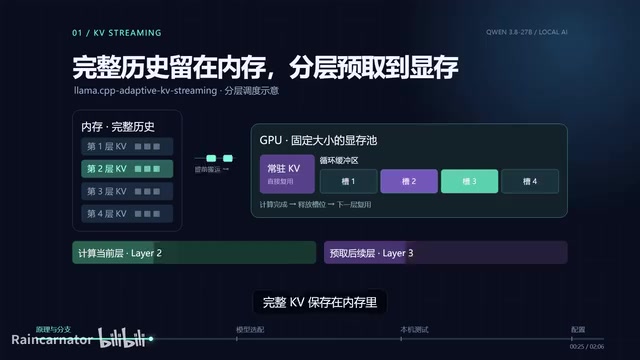
The modification he implemented is called llama.cpp Adaptive KV Streaming. The core idea is to shift data movement from passive OS-managed paging to active, program-directed scheduling.
Specifically: the full KV data is stored in system RAM, with only a resident portion kept in VRAM. A ring buffer is used to asynchronously prefetch the KV data needed by upcoming layers into VRAM. This allows data transfer and computation to overlap, eliminating the serial wait of "finish computing one layer, then fetch data for the next." The implementation also hands off freed compute capacity to KV usage after the prefill phase completes.
The standout feature of this approach is that it preserves the complete conversation history without periodically truncating context to save space. The trade-offs are clear: it consumes large amounts of system RAM, and speed under long contexts is bounded by memory-to-GPU transfer bandwidth. In short, it trades bandwidth for completeness.
A ring buffer (also called a circular buffer) is a fixed-size queue structure that wraps around and overwrites the oldest data once full. In the Adaptive KV Streaming implementation, it maintains a sliding-window staging area in VRAM: while computing layer N, the inference program asynchronously loads the KV data needed for layers N+1 and N+2 from RAM into circular slots in VRAM. Old slots are freed once consumed, making room for subsequent layers. This causes memory-to-VRAM transfers and GPU matrix computation to overlap in time — the GPU no longer stalls waiting for data, and bandwidth utilization improves. Compared to OS-level unified memory paging, the key advantage here is that the scheduler has full knowledge of the computation graph and can make precise prefetch decisions, rather than relying on a generic Least Recently Used (LRU) page replacement policy.
Choosing a Quantization Format: Bit Depth Isn't Everything
This test used the IQ3_S quantization (labeled GSQ RCO IQ3S in the video) combined with Q5_K in a mixed scheme, while the vision projector was kept at higher precision.
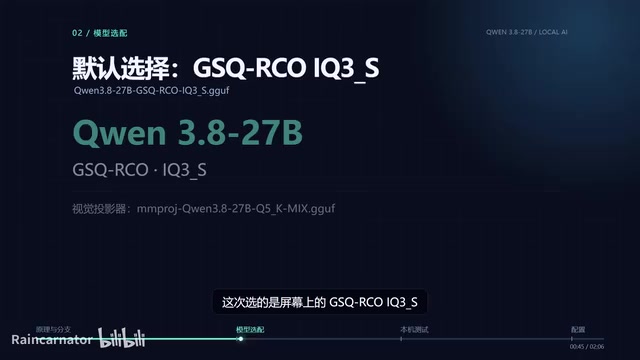
The smaller IQ3_XXS can save additional space, but community feedback suggests degraded Chinese-language performance — it wasn't re-tested under identical conditions here. Q4_K_M offers higher precision at a larger file size, which would crowd out KV space. An easily overlooked point: you can't judge real-world quality by quantization bit depth alone — the code implementation matters just as much.
Versions with MTP (Multi-Token Prediction) were also checked. They share identical model tensors with standard versions; the only addition is the prediction heads. This doesn't mean the model is "smarter." More importantly, the inference framework used here doesn't support speculative batching, so enabling MTP triggers an immediate error — the standard version was chosen by default.

The censored variant (Huihui) was also tested as a backup. It's worth noting that reduced file size or censorship processing doesn't necessarily preserve task capability unchanged.
The IQ (Importance Quantization) series introduced in llama.cpp is a non-uniform quantization scheme, distinct from traditional K-Quants like Q4_K and Q5_K. It dynamically adjusts quantization precision based on each weight's impact on model output: weights that significantly affect perplexity retain higher precision, while less critical ones are compressed more aggressively. IQ3_S and IQ3_XXS are both 3-bit quantizations, but IQ3_S preserves precision for more critical weights, resulting in more stable performance on multilingual tasks (especially non-English scenarios) at the cost of a slightly larger file. MTP (Multi-Token Prediction) is an auxiliary training objective that attaches several prediction heads to the end of the model, training it to simultaneously predict multiple future tokens. This improves representation quality during training — its presence primarily benefits training efficiency and representation optimization, not inference-time "intelligence." Whether it provides benefits at inference time depends entirely on framework support.
RTX 5080 Benchmark: Speed and Memory Usage
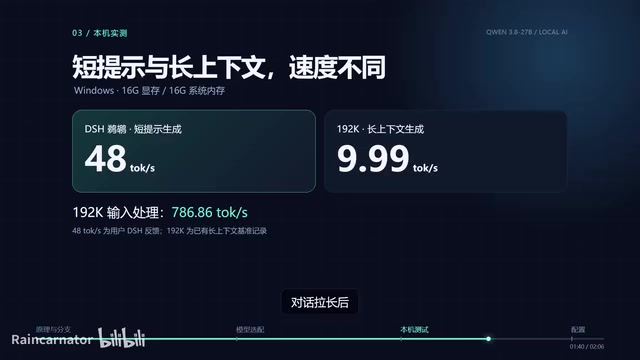
Testing was done on an RTX 5080. The final configuration uses IQ3_S with 192K context and vision capability enabled.
In short-conversation scenarios, running a "teapot car" generation task in DSH achieved approximately 48 tokens/sec, with memory and VRAM usage staying relatively stable.
Moving to 192K long-context testing revealed clear differences: input processing ran at approximately 787 tokens/sec, while generation speed dropped to around 10 tokens/sec. As conversations grew longer, wait times increased noticeably — this is the bandwidth bottleneck described earlier making itself felt.
Task Capability Comparison
Real-world capability tests covered several dimensions:
- Code generation: The generated program passed 6 unit tests
- CTF tutorial challenge: Provided the correct answer
- Screenshot error recognition: Correctly identified the error shown in the image
The censored variant (Huihui) answered all three correctly with no obvious capability regression. Differences emerged in roleplay tasks, however: Huihui took 86 seconds while the original only needed 35 seconds, and Huihui also output internal dictionary text alongside its response. Based on these results, the standard version is recommended for everyday use, switching to the censored variant only when its specific features are needed.
Deployment Notes
If your system only has 16GB of RAM, make sure to close memory-heavy background applications before starting — the approach of storing complete KV data in system RAM will easily run out otherwise. This solution is fundamentally an engineering optimization built on the premise of "not enough VRAM, supplement with RAM." It makes running a 27B-class model with 192K context and vision on a 16GB GPU feasible, but the speed ceiling is constrained by hardware bandwidth. Long-context scenarios require setting realistic expectations around wait times.
For users looking to squeeze out longer context windows on consumer hardware, the Adaptive KV Streaming approach is worth paying attention to: it doesn't sacrifice history completeness, and instead reclaims scheduling control from the OS, using active prefetching and computation-transfer overlap to alleviate the bottleneck.
Related articles

Letting AI Build AI Tools: A 7-Day, 31-Commit Bootstrapping Post-Mortem
An engineer ran a fully autonomous AI-builds-AI pipeline for 7 days, 31 commits, with a 1-in-6 success rate. This post-mortem covers 5 failure types, 11 structural rules, and how every mistake became a permanent immunity gate.

Building an AI-Powered E-Commerce Business from Scratch: A Real-World Account of Multi-Agent Architecture for Print-on-Demand
A blogger builds a print-on-demand e-commerce company from scratch using AI agents — documenting specialized Agent profiles, GPT-5.6 vs Claude Fable multi-model orchestration, and reusable skill accumulation.

AI Agent Earns $10K in One Week: 3 Key Upgrades Explained
A blogger shares how he earned $10K in a week with an AI Agent — not by adding more skills, but through verification, approval gates, and subagents to raise trust and enable true automation.