Running the 573GB MiMo V2.6 Pro Open-Source Model on a Three-Mac Cluster: Real-World Testing

Three Macs cluster together to run the 573GB MIT-licensed MiMo V2.6 Pro LLM in real-world coding tests.
A blogger chained an M4 Max, M5 Max, and Mac Studio into a cluster to run MiMo V2.6 Pro, an open-source model requiring ~573GB of memory under the permissive MIT License. With a 71.9 SWE benchmark score beating GLM's 66.9, the model impressed on complex tasks — but proved extremely sensitive to quantization, with the 3-bit version crashing repeatedly. Only 8-bit quantization was usable. Tests spanned 3D solar systems, nuclear explosions, raw WebGL faces, and a GTA V recreation, with the Pro version excelling at complex visuals while the Flash variant offered a better speed-to-quality tradeoff.
Running an MIT-Licensed LLM on a Consumer Mac Cluster
A content creator pulled off something impressively hardcore: chaining three Macs together into a cluster to run MiMo V2.6 Pro, a massive open-source model that requires roughly 573GB of memory. What makes this model stand out isn't just its size — it's licensed under the MIT License, making it extraordinarily friendly for commercial use. That's a meaningful differentiator in today's landscape of "open" models with strings attached.
The blogger made a point of calling out the licensing issue: GLM, widely regarded as one of the best-performing openly available weights, uses a custom license that requires you to register with the developer once your revenue crosses a certain threshold. MiMo V2.6 Pro's MIT license carries no such baggage — grab it and ship it, no questions asked.
On benchmarks, the model puts up strong numbers: 71.9 on the SWE benchmark, besting GLM's 66.9. DeepSeekAd V4.1 claims a 74 on SWE, but after digging into the fine print, the blogger found that figure was cherry-picked from multiple runs (open code scored 65, PI scored 66 in practice). He was also candid that he couldn't confirm whether MiMo's numbers were similarly curated.
What is the MIT License? The MIT License (Massachusetts Institute of Technology License) is one of the most permissive open-source licenses in existence. Its only real requirement is that you preserve the original copyright notice. Everything else — using, copying, modifying, merging, publishing, distributing, sublicensing, and even selling commercial products — is fair game with no royalties or reporting obligations. Compare that to GPL (which requires derivative works to be open-sourced), or Apache 2.0 (which includes patent grant clauses), and the commercial friction is essentially zero. In the LLM world, licensing is an especially sensitive issue: many models marketed as "open source" actually use Community Licenses that kick in commercial restrictions once monthly active users or annual revenue exceeds certain thresholds. MiMo V2.6 Pro's MIT license means any developer or enterprise can integrate it into a commercial product without compliance headaches.
Why a Cluster Is Non-Negotiable
This model ships pre-quantized and requires approximately 573GB of memory to run. The blogger tried quantizing it further to fit within a 512GB system — and quickly discovered that MiMo V2.6 Pro is extremely sensitive to quantization. The harder you squeeze it, the more coding errors and artifacts pile up, and the experience degrades sharply.
His recommendation was unambiguous: even for the Flash variant, stick to 8-bit quantization and go no lower. Anything more aggressive produces results that are effectively unusable.
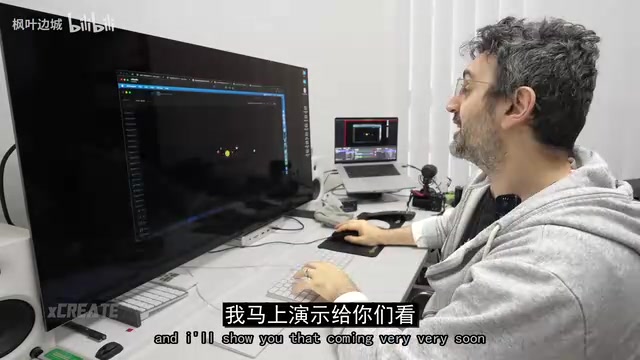
To run the full model, he assembled a three-machine cluster: an M4 Max, an M5 Max, and a Mac Studio. He initially tried running it on just the Mac Studio and M4 Max, but any task exceeding 100,000 tokens would crash due to memory exhaustion. Adding the third machine resolved the problem. After connecting everything, a simple "hello" test ran at around 15 tokens/sec.
What is quantization? Quantization compresses model weights from high-precision floating-point numbers (e.g., FP16 or BF16, 16 bits per parameter) down to lower-precision integers (INT8 = 8 bits, INT4 = 4 bits), reducing memory footprint and improving inference speed at the cost of some accuracy. 8-bit quantization, for instance, cuts memory requirements roughly in half compared to FP16. However, different models tolerate quantization very differently: some maintain output quality even at 4-bit or 3-bit compression, while models like MiMo V2.6 Pro are highly sensitive to precision loss — low-bit quantization causes reasoning chains to break down and code generation error rates to spike sharply, a behavior tied to the model's internal attention mechanisms and weight distributions. The SWE (Software Engineering) benchmark measures a model's ability to resolve real GitHub repository issues and is considered one of the best proxies for practical engineering capability, going well beyond simple code completion tasks.
Benchmark Tasks: From Solar Systems to Nuclear Explosions
The blogger ran a battery of coding tasks to stress-test the model. A basic 3D solar system generated in just 1,800 tokens with thinking mode disabled — decent, if unspectacular. When he ran the same prompt on the 3-bit quantized version, he got a black screen. Quantization sensitivity confirmed.
A thermonuclear explosion scene was more impressive. The full-precision version produced a convincing effect; the 3-bit version immediately threw a runtime error, even with thinking mode enabled.
One notable quirk: with temperature set to 0, the model sometimes got stuck in a "thinking loop." His workaround was to open the token inspector, manually locate the gray nodes where the model was on the verge of ending its reasoning phase, click the end-think tag to force-terminate the thinking step, and then let code generation continue.
For an exploding-building task, the model produced a destructible LEGO-brick-style building with realistic physics after two dialogue turns (~65,000 tokens of context). The blogger was genuinely impressed. Speed had dropped to roughly 12 tokens/sec by that point.
Why do reasoning models get stuck in thinking loops? Large reasoning models typically generate an internal chain-of-thought inside
<think>tags before producing a final answer, iteratively reasoning through and validating assumptions. When sampling temperature is set to 0, the model greedily picks the highest-probability token at every step — maximally deterministic in theory, but potentially catastrophic during the thinking phase, where the lack of randomness can cause the model to loop through the same reasoning steps indefinitely without converging on a termination signal. This "thinking loop" behavior has been documented in DeepSeek-R1 and other reasoning models. Common mitigations include capping the maximum thinking token budget, raising the temperature specifically during the thinking phase while keeping output temperature low, or — as the blogger did — using a frontend tool to manually inject an end marker and force truncation.
WebGL Faces and GTA Recreations
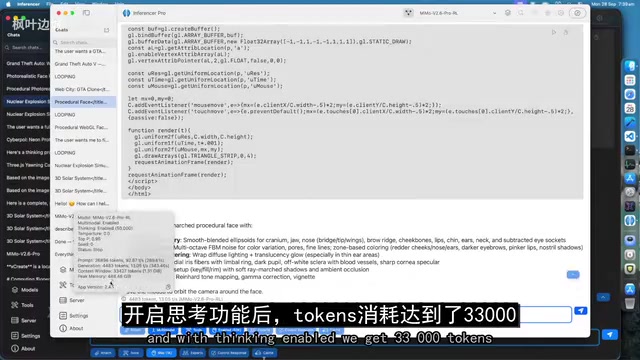
Rendering a human face in raw WebGL without Three.js was a harder test. With thinking disabled, the model produced an egg shape with spikes and two noses. With thinking enabled, it spent 33,000 tokens and generated a genuinely attractive face — albeit with a single prominent unibrow.
The headline test was a Grand Theft Auto V recreation. The model didn't shy away from writing "Rockstar North presents Grand Theft Auto 5" directly — no hedging around real company names the way some models do. The 100,000-token version let the player drive around and pick up $5,000, though the lighting was dim and controls were stiff. Crucially, no runtime errors.

He also compared Agent mode (which splits code into separate JS, CSS, and other files for better structure at the cost of more tokens) against single-file mode. In a direct comparison with Qwen 4 EXP, he felt MiMo 2.6 Flash produced better character animations and a more attractive city in the GTA test, with better driving feel — though left/right directions were inverted, a quirk he noted even top-tier models like Opus occasionally get wrong.
Multimodal Wins and Knowledge Gaps
The cluster now supports multimodal inputs. When fed a screenshot of Age of Empires II, the model immediately recognized the game, pulled appropriate background images from Unsplash, and built out a menu system — no runtime errors at launch. The game was skin-deep though: mining worked but villagers couldn't be trained, requiring follow-up prompts to flesh things out.

Tomb Raider fared worse. The model didn't seem to recognize the IP, and the generated character sank into the floor and couldn't move — though gun reflections and barrel-shooting effects were passable.
Knowledge Q&A produced an interesting reversal: on a question about Craig David's discography, the full Pro version actually gave a less complete answer than the 3-bit quantized version. The blogger took this as a reminder that MiMo Flash is already a very capable model on its own. The Pro version's edge shows up specifically in complex visual generation tasks like the nuclear explosion and 3D face — but you pay for it with cluster requirements and noticeably slower inference.
Final Takeaways
The core message from this experiment is clear: MiMo V2.6 Pro is worth paying attention to, thanks to its MIT license and strong benchmark numbers — but it is extremely sensitive to quantization, impossible to run on a single consumer machine, and requires a multi-Mac cluster to perform at its best. For developers who can scrape together enough memory across machines, the ability to chain consumer-grade hardware into something capable of running frontier open-source models is, in itself, pretty exciting.
Related articles

Gaussian Process Bandit Optimization: Exploration Strategies and Inference Regret Guarantees
Cumulative regret guarantees in Bayesian optimization fail to reflect final recommendation quality. This article examines a new study that provides inference regret guarantees for Gaussian process bandit optimization through exploration query strategies and fill distance analysis, validated on hyperparameter optimization and control tasks.

The Most Detailed Codex Guide on Bilibili: From Installation to Real-World Practice
The most detailed Codex guide on Bilibili: from app store installation to daily work mode configuration, with a real coffee shop project demonstrating file organization, data extraction, dashboard creation, and other practical tasks. Learn to use Plan Mode and desktop pets to leverage Codex efficiently.

Appearance Compensation in Volume Rendering: Why RGB Accuracy Cannot Guarantee Density Correctness
Volume rendering research reveals that volumetric data perfectly reproducing external RGB views may still contain density errors: appearance compensation can double central density and keep external rays unchanged even when L2 error exceeds 14.52%. Density recovery depends on appearance capacity, spatial resolution, and measurement design.