Runway WorldPrompt Deep Dive: The Engineering Breakthrough Behind Real-Time World Models

Runway Worlds 2 upgrades video generation into a real-time, steerable world model via persistent context and timed actions.
Runway's WorldPrompt and its underlying GWM Worlds 2 engine represent a paradigm shift in generative AI — from one-shot video output to continuously running, interactive worlds. The system's two core mechanisms are persistent context, which maintains a historical state cache to solve temporal consistency in long-sequence generation, and timed actions, which let users precisely intervene in the world's evolution at specified moments. Behind it all lies a demanding systems engineering challenge: balancing inference latency, visual quality, and scene coherence while synchronizing audio and video generation. If this technical path matures, potential applications span filmmaking, gaming, simulation training, and beyond.
From Video Generation to Real-Time Worlds
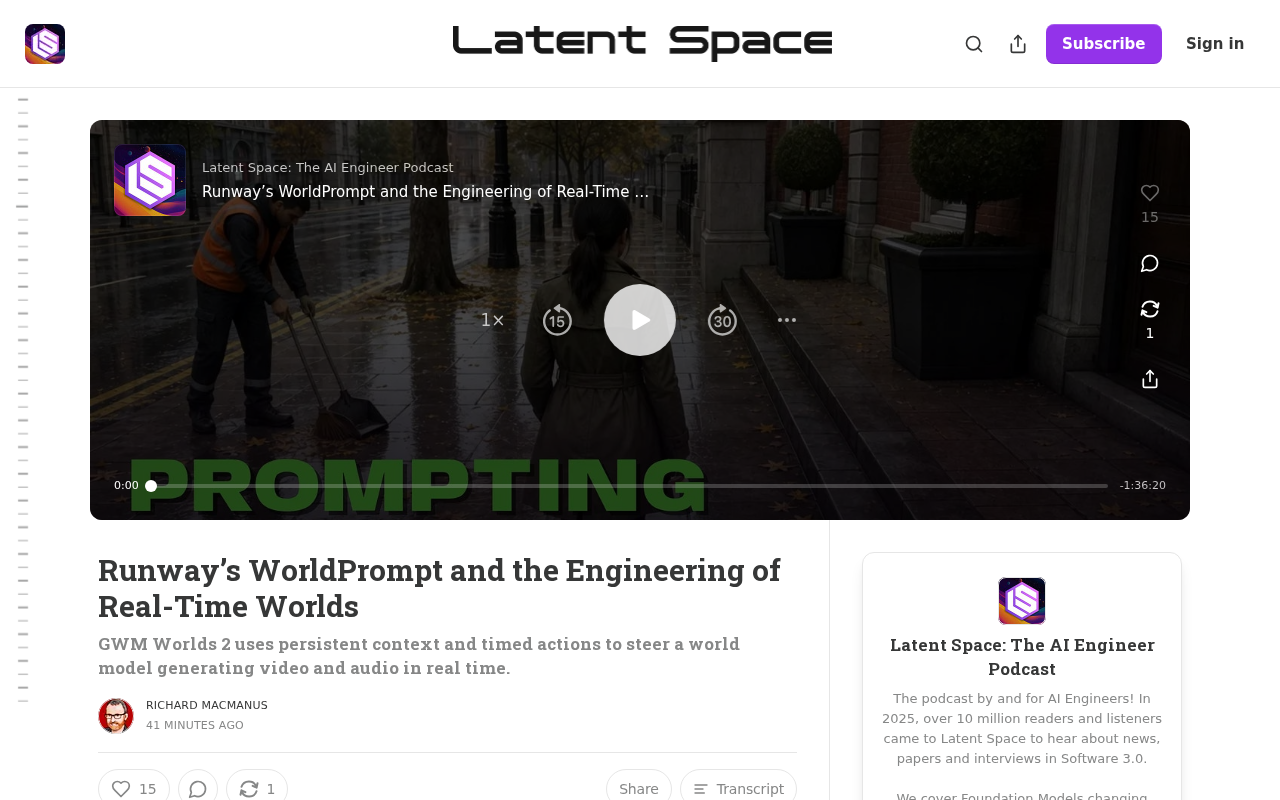
Runway's WorldPrompt and the underlying GWM Worlds 2 engine mark a fundamental shift in generative AI — from "generating a video clip" to "building a continuously running world." Traditional video generation models are one-shot outputs: you provide a prompt, the model returns a fixed sequence of frames. Worlds 2 takes a fundamentally different approach. It is a persistent world model that generates video and audio in real time, continuously adapting the world's evolution based on context and user input.
This leap from "static output" to "dynamic evolution" essentially redefines video generation — not as a rendering task, but as a real-time simulation task. The world is no longer painted in a single pass; it is extrapolated frame by frame.
The concept of a world model originates from cognitive science and reinforcement learning, where it refers to an agent's internal representation of its environment — one that not only describes the current state but predicts future states. In AI research, projects like DeepMind's Gato, Meta's JEPA, and Google DeepMind's Dreamer have each explored different forms of world models. Applying this idea to video generation means the model is no longer simply "compressing and replaying" visual patterns from training data — it attempts to build a causal reasoning mechanism that understands the physical laws, spatial relationships, and temporal logic within a scene. Runway's GWM (Generative World Model) naming follows this academic tradition, signaling an ambition to build generative systems with an intrinsic understanding of the world, rather than mere pixel predictors.
Persistent Context: Giving the World Memory
One of Worlds 2's key technical innovations is persistent context. In traditional frame-by-frame or segment-by-segment generation, models tend to "forget" — an object present one second might vanish or morph the next, making visual consistency extremely difficult to maintain. Persistent context allows the world model to remember previously generated states, preserving coherence in objects, lighting, and spatial relationships across the scene.
This directly addresses one of the most stubborn problems in real-time generation: temporal consistency. A truly believable world must feel like it continuously exists — not like each frame is being reimagined from scratch. Persistent context is the underlying mechanism that sustains this sense of continuity, giving the world model something akin to "memory" so that long-running scenes don't fall apart.
Temporal consistency has long been an unsolved challenge in video generation. Early diffusion models sampled each frame independently, causing abrupt changes in an object's color, shape, or even existence between adjacent frames — commonly known as "flickering" or "hallucination drift." The mainstream fix has been to introduce optical flow constraints or cross-frame attention mechanisms, but these carry enormous computational costs over long sequences. Persistent context differs by explicitly maintaining a continuously updated state cache, so the model always "sees" its history when generating new content rather than reasoning from scratch each time. This is architecturally similar to the KV Cache mechanism in large language models — trading memory for speed by storing historical information to reduce redundant computation and maintain coherence.
Timed Actions: Injecting Controllability into the World
Memory alone isn't enough — a useful world also needs to be steerable. Worlds 2 introduces the concept of timed actions: users can trigger predefined actions or events at specific points in time, enabling precise intervention in how the world evolves.
This design transforms the generation process from passive viewing into active directing. You can plan a sequence of events and have the world change according to your intent at specified moments — whether it's a camera movement, a scene transition, or the appearance of a specific element. Timed actions and persistent context work in tandem: the former provides a controllable intervention interface, while the latter ensures the world remains coherent after each intervention. Together, they make "real-time control of a generated world" genuinely possible.
The Engineering Challenges of Real-Time Generation
Synchronously generating video and audio in real time is an extraordinarily difficult engineering problem. Real-time constraints require the model to complete inference for every frame within an extremely tight latency budget — while simultaneously maintaining image quality and consistency. These three goals are often in direct conflict. Higher visual quality typically demands more compute, while real-time delivery requires minimizing latency at all costs.
Worlds 2 earns the label "engineering a real-time world" precisely because it requires careful trade-offs across model architecture, context management, and inference optimization. Persistent context demands efficient state storage and retrieval; timed actions require low-latency response pathways; and the synchronized generation of audio and video imposes strict scheduling requirements on the entire system. These are not purely model capability problems — they are systems engineering problems.
The fundamental bottleneck in real-time inference is the inherent tension between autoregression and parallelization. Video generation typically depends sequentially on preceding frames, making it a naturally serial process — yet real-time delivery requires per-frame inference time to fall below the frame interval (e.g., roughly 33 milliseconds at 30fps). Common industry strategies include model distillation (compressing large models into lightweight versions), speculative decoding (using a small model to draft predictions that a larger model then verifies), and pipelined scheduling on dedicated inference hardware. Synchronized audio-video generation adds another layer of complexity: both generation streams must maintain strict clock alignment, and any latency jitter in either stream will break perceived synchrony — a challenge that becomes especially acute in distributed inference scenarios.
Significance and Outlook
Runway's WorldPrompt points toward a new direction for generative AI: world models as interactive, persistent, and controllable real-time environments. Once this capability matures, its applications will extend far beyond filmmaking — into gaming, simulation training, virtual scene construction, and more.
Of course, a significant gap remains between technical demonstration and production-ready product. Visual quality stability during real-time generation, long-run consistency, and the cost of serving large numbers of concurrent users are all challenges that will require sustained effort. But through its two core mechanisms — persistent context and timed actions — Worlds 2 has already sketched a clear technical roadmap. It treats "generating a world" as what it truly is: a serious systems engineering challenge.
Related articles

Chain of Thought Isn't Just for AI: How Humans Can Use CoT to Improve Thinking Quality
Chain of Thought isn't just a prompt trick for large models. Starting from a Hacker News discussion, this article analyzes why CoT works for human thinking too, breaks down actionable ways to transfer it, and highlights the key differences between human CoT and machine CoT.
Cloudflare Teams Up with OpenAI: Closi…
Cloudflare Teams Up with OpenAI: Closing the Loop from Vulnerability Discovery to Defense with AI
Cloudflare uses OpenAI Daybreak to investigate security vulnerabilities and generate reviewable remediation plans, while developers use Codex to boost coding efficiency and quality.

Orca Multi-Agent Orchestration in Practice: A Guide to Parallel Collaboration with Claude and Codex
Orca is Stable AI's free open-source agent workbench supporting 34 agents like Claude Code and Codex in parallel. Learn its Git worktree isolation, multi-model orchestration, and mobile management.