Rust 1.100.0 Released, Sparking Community Discussion
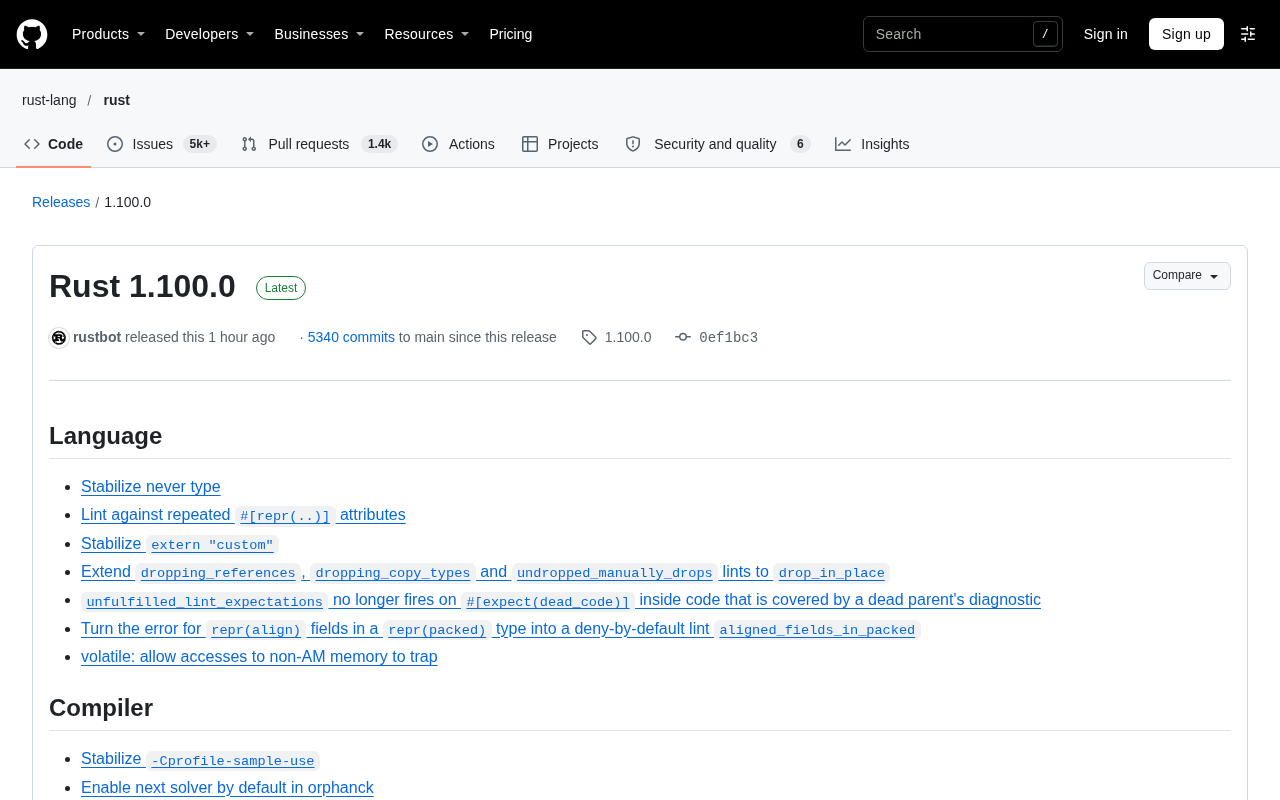
Rust 1.100.0 is officially released, and the version-number milestone sparks lively discussion in the Hacker News community.
Rust 1.100.0 has been officially released on GitHub. As a stable version advancing on a six-week cadence, crossing version 100 has drawn widespread attention from the developer community. On Hacker News, the release link received 269 points and 56 comments, reflecting continued interest in Rust's evolution. Since the release page does not list a detailed changelog, much of the discussion is based on developers' understanding of and expectations for the Rust roadmap, covering language features, compiler performance, standard library evolution, and application prospects. The article also reminds developers to keep the compiler in sync with companion tools such as Cargo, Clippy, and rustfmt, and notes that Rust's backward-compatibility commitment makes upgrades usually smooth.
Rust 1.100.0 has been officially released on GitHub. As an important milestone for the Rust language, the version number itself has drawn widespread attention from the developer community. On Hacker News, the release link received 269 points and 56 comments, and the level of discussion reflects the community's continued interest in Rust's evolution.
Release Overview
According to the release page on GitHub, Rust 1.100.0 is a new version rolled out under the Rust project's established release cadence. The Rust team typically ships a stable release every six weeks, with each release including compiler improvements, standard library updates, and toolchain adjustments. Although this release page does not list a detailed changelog, crossing the version-number threshold is itself a notable moment.
Original link: rust-lang/rust releases/tag/1.100.0
Rust's release process is known for its stability and predictability, with each version undergoing rigorous testing across the nightly, beta, and stable channels. The release of 1.100.0 marks the completion of another six-week cycle and lays the groundwork for future versions.
The six-week release cycle is a key part of Rust's governance system. Before each stable release, changes first enter the nightly channel for daily builds and experimental validation, then move to the beta channel for about six weeks of stabilization testing, and only then are merged into stable. This process is coordinated by the Release Team, ensuring that any change entering the stable channel has undergone sufficient regression testing and compatibility checks.
Version numbers follow the Semantic Versioning (SemVer) specification: the major version has remained at 1 since 1.0, the minor version increments every six weeks, and patch versions are used for urgent fixes. Therefore, the 100 in 1.100.0 only reflects the number of releases and does not represent breaking API changes. Rust provides a backward-compatibility commitment for the stable channel, so old code should continue to compile on new compilers, which is the fundamental reason upgrades are usually smooth.
Community Reaction and Discussion
In the Hacker News comment section, developers discussed Rust 1.100.0 from multiple angles. The 269 points indicate that the news has considerable traction in the technical community, while the 56 comments show the depth of discussion.
Community discussion usually focuses on several areas: language features that may be included in the new version, compiler performance, the direction of standard library evolution, and Rust's prospects in systems programming, web development, embedded systems, and other domains. Because the release page itself contains limited information, much of the discussion may be based on developers' understanding of and expectations for the Rust roadmap.
For a language like Rust that emphasizes safety and performance, each release is seen as a reflection of ecosystem maturity. The 1.100.0 version number may also prompt discussion in the community about version semantics and release strategy.
Significance for Developers
For developers using Rust, keeping up with new versions is an important part of maintaining project health. Rust's backward-compatibility commitment means upgrades are usually smooth, but it is still advisable to check dependency compatibility before upgrading.
The release of Rust 1.100.0 also reminds developers to pay attention to toolchain updates, including version changes in companion tools such as Cargo, Clippy, and rustfmt. These tools are released in sync with the compiler and together form the complete development experience.
The Rust toolchain is distributed and managed uniformly through rustup, which installs the stable channel by default. Developers can use rustup update to upgrade the compiler, Cargo, Clippy, rustfmt, and other components all at once. Because these tools are built and tested within the same release cycle as the compiler, mixing toolchain versions may lead to inconsistent lint rules or formatting output, so it is recommended to keep the entire toolchain updated in sync.
Before upgrading, you can use cargo tree to inspect the dependency tree and validate in advance on the beta or nightly channel through CI; if the project has high requirements for compilation stability, you can also use a rust-toolchain.toml file to pin a specific version, ensuring consistency between the team and the CI environment.
Conclusion
The release of Rust 1.100.0 is one waypoint in the language's development. Although the original information is limited, the community's active participation and discussion demonstrate the vitality of the Rust ecosystem. Developers can obtain more details and community feedback through the official release page and the Hacker News discussion thread.
Related articles

AI Teams Up with Mathematicians to Attack the Riemann Hypothesis: 17 Million Lines of Code Tear Open a 167-Year Gap
In November 2026, Anthropic mathematicians and Claude claimed to have discovered a proof of the Riemann Hypothesis, publishing 17 million lines of Lean formalized code that passed machine verification. This article analyzes the event's impact on mathematics and cryptography, and the deeper questions raised by the separation of discovery and understanding.
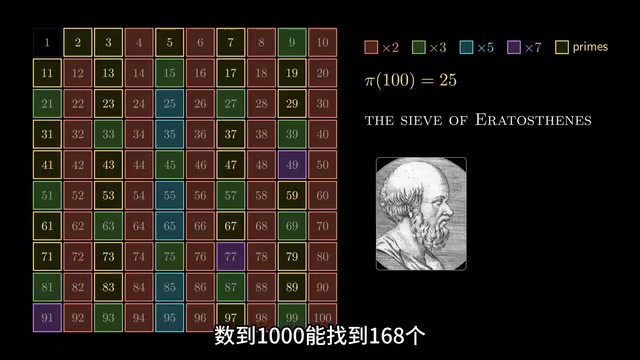
AI Claims Formal Proof of the Riemann Hypothesis — But Machine Verification Isn't a Mathematical Proof
In Nov 2026, Anthropic's Levent Alpöğe released a Riemann Hypothesis proof of 175,000 code files that passed machine formal verification. But machine verification isn't a mathematical proof: the kernel can't confirm the proposition is the Riemann Hypothesis humans understand, and there's no human-readable paper. This article breaks down how ζ function zeros determine prime-count deviation, and the core of the controversy.

Anthropic Raises Over $80 Billion in IPO, DeepSeek Secures $100 Billion in Funding: AI Weekly Roundup
This week in AI: Anthropic's Nasdaq IPO raises $93.5B in the largest ever, DeepSeek closes ~100B yuan round, AI claims formal Riemann proof, MiniMax breaks crypto candidates in seconds.