SAGA Framework: Enabling LLM Agents to Abstract Reusable Knowledge from Experience

SAGA lets LLM agents continuously self-evolve from experience via three-tier knowledge abstraction, no fine-tuning needed.
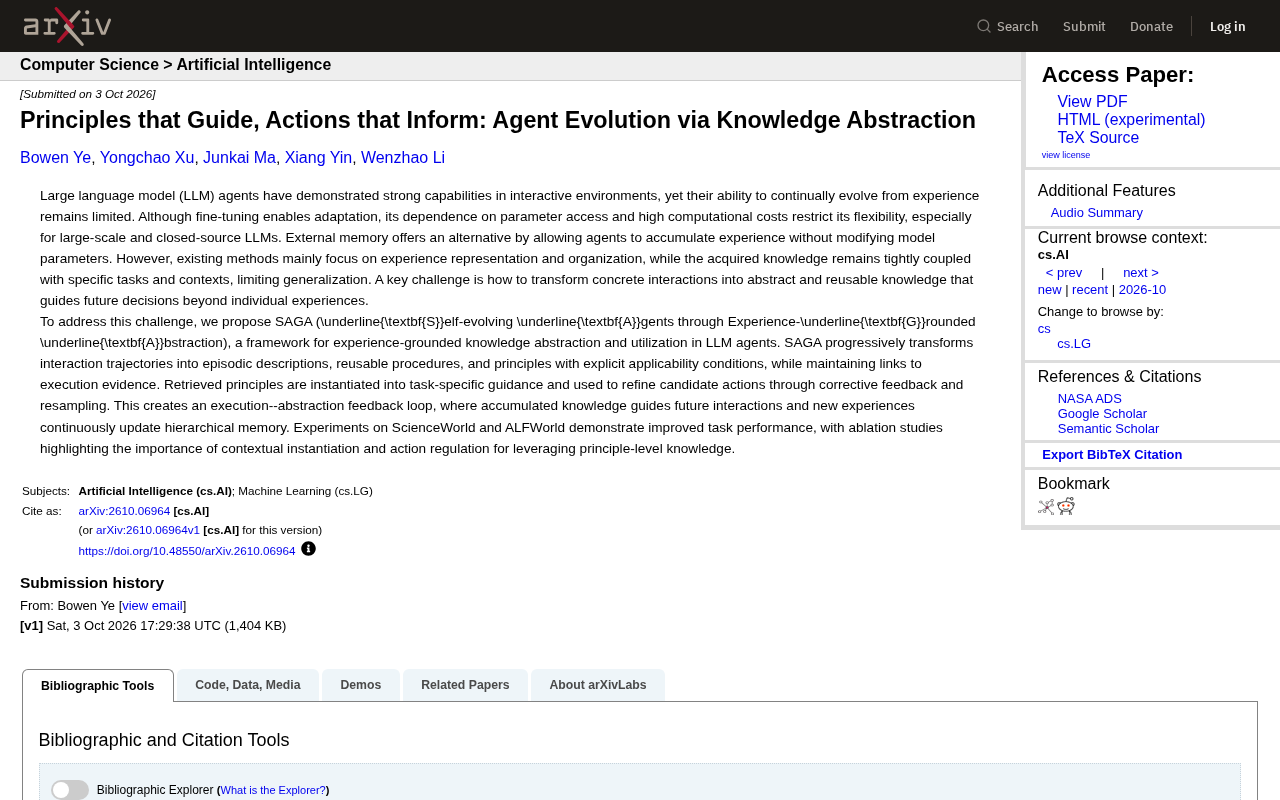
SAGA (Self-evolving Agents through Experience-Grounded Abstraction) is a fine-tuning-free continual learning framework for LLM agents. It distills interaction trajectories into three tiers — episodic descriptions, reusable procedures, and context-conditioned principles — with each principle retaining links to real interactions for traceability. When facing new tasks, the system retrieves relevant principles, instantiates them as task-specific guidance, and refines candidate actions via corrective feedback and resampling, forming an execution-abstraction feedback loop. Experiments on ScienceWorld and ALFWorld validate the framework, with ablation studies highlighting contextual instantiation and action regulation as the two key mechanisms.
The Core Bottleneck of Agent Evolution
LLM agents have demonstrated impressive capabilities in interactive environments, but their ability to continuously evolve remains fundamentally constrained. The most common approach to having agents learn from experience — fine-tuning — requires access to model parameters and incurs significant computational costs, making it nearly impractical for large-scale or closed-source models.
External memory mechanisms offer an alternative: agents can accumulate experience without modifying model parameters. However, most existing methods remain at the level of "representing and organizing experience" — the knowledge acquired stays tightly coupled to specific tasks and contexts, with limited generalization capability.
This new arXiv paper targets a critical question: How can concrete interaction behaviors be transformed into abstract, reusable knowledge that can guide future decisions beyond any single experience?
What Is SAGA
The researchers propose SAGA (Self-evolving Agents through Experience-Grounded Abstraction), a framework whose core objective is experience-driven knowledge abstraction and utilization.
Rather than simply accumulating historical records, SAGA distills interaction trajectories into three hierarchical levels of knowledge:
- Episodic descriptions: Concrete records of individual interaction sessions;
- Reusable procedures: Operational patterns derived from multiple interactions;
- Principles with explicit applicability conditions: The highest level of abstracted knowledge, annotated with "when to apply" context.
Critically, these abstracted principles don't float in isolation — they always retain links to the execution evidence they were derived from. Every principle can be traced back to the real interactions that grounded it, ensuring both interpretability and fidelity throughout the abstraction process.
How Principles Guide Action
When the agent faces a new task, SAGA retrieves relevant principles and instantiates them as task-specific guidance. Rather than providing direct answers, this guidance works through "corrective feedback" and "resampling" to refine candidate actions.
This forms what the paper calls the execution-abstraction feedback loop: accumulated knowledge guides future interactions, while new experiences continuously update the hierarchical memory system. The entire process creates a self-reinforcing cycle of continuous evolution — all without touching model parameters.
This three-tier knowledge architecture has parallels in cognitive science: episodic memory records specific events, procedural memory stores operational skills, and semantic memory carries generalizable concepts and rules. SAGA's design mirrors the layered structure of human memory — just as people don't memorize each individual bike-riding experience, but gradually internalize reusable balance skills and general principles. In engineering terms, this layering typically relies on the LLM's own inductive capabilities: after accumulating enough episodic records, the agent uses prompting to cluster and abstract these records into higher-level knowledge entries. Unlike simple text chunk retrieval in RAG, principle-level knowledge undergoes semantic compression, resulting in less noise during retrieval — but this also requires an "instantiation" step to restore it into executable instructions.
Experimental Validation and Key Findings
The research team validated SAGA on two classic interactive environment benchmarks:
- ScienceWorld: An environment simulating scientific experiment reasoning tasks;
- ALFWorld: A household task environment combining textual and embodied interaction.
Experimental results show improved task completion performance. Even more valuable are the insights from ablation studies, which reveal two critical factors:
- Contextual instantiation: Abstract principles must be combined with the current task context to be effective — generic knowledge without grounding can actually mislead decision-making;
- Action regulation: Correcting and resampling candidate actions is essential for translating principle-level knowledge into executable behavior.
Together, these findings show that having abstract knowledge is not enough — how to effectively apply it in specific situations is where the real challenge lies.
ScienceWorld and ALFWorld are commonly used controlled benchmark environments in agent research. ScienceWorld is built on the TextWorld engine and requires agents to complete physical and chemical science reasoning tasks (such as "boil water" or "measure the weight of an object") in a text-simulated laboratory, emphasizing multi-step causal reasoning. ALFWorld combines text instructions with embodied navigation, where agents must execute everyday tasks like "put the apple in the refrigerator" in a virtual home setting, testing spatial understanding and goal decomposition. Both environments share a relatively clear task structure and enumerable state spaces, making results easy to reproduce and compare — but also meaning that generalization to real-world open environments remains uncertain, a limitation the authors candidly acknowledge.
Why This Work Deserves Attention
In the broader research landscape, SAGA addresses a longstanding tension in the agent field: parametric memory vs. external memory. Fine-tuning can encode knowledge directly into the model, but its cost and inaccessibility limit its applicability; external memory is flexible, but often falls into a trap of "storing without understanding" — experiences are recorded but cannot generalize.
SAGA's approach introduces hierarchical abstraction on top of external memory, moving knowledge from specific to general while anchoring the abstraction process with execution evidence to prevent knowledge from drifting away from reality. This design of "principles that guide, actions that inform" directly echoes the paper's subtitle.
For LLM agent applications that need to run long-term and learn continuously — such as automated research assistants or embodied task agents — this kind of fine-tuning-free experience accumulation mechanism has real practical value. It provides a viable path for agent evolution in scenarios involving closed-source large models.
The tension between "parametric memory vs. external memory" reflects deeper system design trade-offs. Fine-tuning encodes knowledge into model weights with zero extra inference overhead, but requires gradient access, large amounts of labeled data, and a full redeployment with every update — and is completely unavailable for closed-source models like GPT-4o or Claude. External memory (e.g., vector databases) stores knowledge outside the model, allowing easy addition and deletion, but retrieved snippets consume context window space and raw experiences are often redundant and difficult to directly act on. Recent middle-ground solutions include prompt caching and on-demand LoRA adapter loading, each with their own constraints. SAGA's approach of performing "knowledge distillation" at the external memory level — trading precision for abstraction — is a pragmatic trade-off under these constraints, with the cost of introducing dependency on the LLM's own inductive quality.
Limitations and Future Directions
As a newly released preprint, the current validation is primarily conducted in two relatively structured environments — ScienceWorld and ALFWorld — and performance in more open and complex real-world settings remains to be seen. Additionally, questions around retrieval efficiency in hierarchical memory, arbitration mechanisms when principles conflict, and other issues are directions worth exploring in follow-up work.
Overall, SAGA provides a clear framework that advances "learning from experience" from vague memory accumulation to a level of knowledge engineering that is abstract, traceable, and reusable.
Related articles

Random Pruning of the DPO Computation Graph: 1.4x Training Speedup and Lower Peak Memory
DPO training too slow and memory-hungry? This paper proposes a random pruning framework for the DPO computation graph, sampling independently across position, sequence, and branch dimensions; branch pruning achieves a 1.426x step-time speedup and cuts training time by about 30%, with in-depth attribution of memory and time gains.

Why Does JEPA Underperform MLM in Longitudinal EHR Representation Learning?
New study compares JEPA and MLM for longitudinal EHR representation learning on MIMIC-IV: three JEPA variants train stably without collapse but underperform MLM; target size, not heterogeneity, drives prediction error.

Transfer Learning + Visible Light Communication: A New Approach to Energy-Efficient Indoor Positioning
A study proposes a transfer learning-based visible light communication indoor positioning method, achieving 47% accuracy improvement on the BOSCH factory dataset, 67.5% model efficiency under high noise, and introducing the ME composite metric for energy-efficient positioning in energy-constrained industrial IoT scenarios.