SAGE: Schema-Guided LLM Grant Review Achieves Moderate-to-High Human-AI Agreement
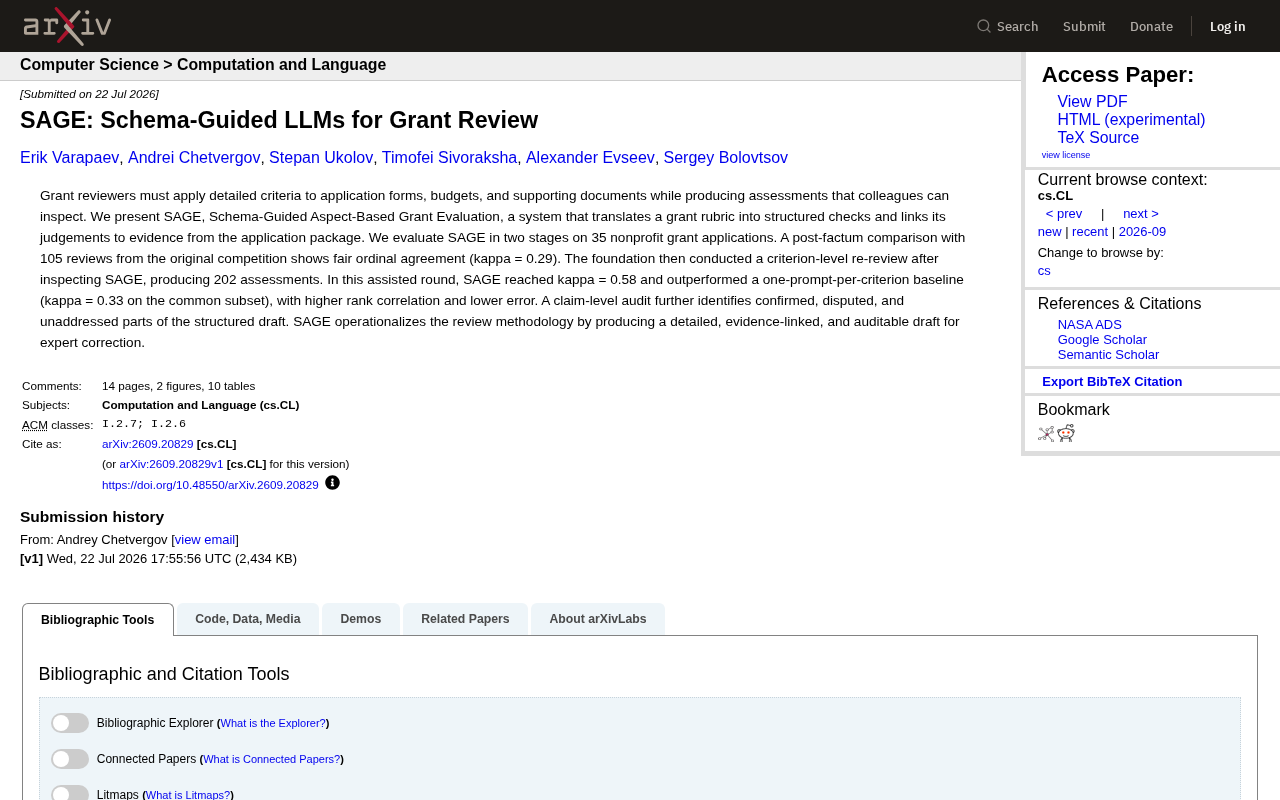
SAGE uses structured schemas to guide LLMs in grant review, reaching kappa=0.58 in human-AI collaboration mode.
SAGE (Schema-Guided Aspect-Based Grant Evaluation) translates grant rubrics into structured check items and links each judgment to evidence in the application package. Tested on 35 nonprofit grant applications across two phases, it achieved kappa=0.29 in fully automated mode and kappa=0.58 when human experts reviewed based on SAGE's output — well above the simple one-prompt-per-criterion baseline of 0.33. A claim-level audit mechanism further tags each draft judgment as confirmed, disputed, or unaddressed, helping reviewers focus efficiently while maintaining transparency.
The Challenge of Grant Review: Rigor Meets Auditability
Grant review is a highly judgment-intensive process. Reviewers must evaluate applications, budgets, and supporting materials against detailed rubrics — and produce assessments that can withstand peer scrutiny. This means the process must be not only accurate but also transparent: every judgment should be traceable to clear evidence.
At scale, however, human review struggles with inconsistency, time costs, and limited traceability. Different reviewers can reach very different conclusions on the same application, and those conclusions often lack explicit links to specific evidence. A recent study published on arXiv introduces a system called SAGE, which aims to bring large language models (LLMs) into this workflow in a structured, principled way.

What Is SAGE: Translating Rubrics into Structured Checks
SAGE stands for Schema-Guided Aspect-Based Grant Evaluation. Its core idea is to translate grant review rubrics into a series of structured check items, each linking its judgment to specific evidence within the application package.
This design delivers two key benefits. First, it breaks down vague evaluation criteria into actionable checking logic, reducing arbitrariness. Second, by binding judgments to evidence, SAGE produces not a black-box verdict but an auditable draft — one that expert reviewers can examine line by line, confirming or correcting the model's assessments.
In other words, SAGE doesn't try to replace human reviewers. Instead, it operationalizes the methodology into a "detailed, evidence-linked, auditable" first draft for experts to refine. This positioning aligns with the prevailing approach to AI-assisted professional decision-making: machines handle structuring and initial screening; humans make the final call.
Two-Phase Evaluation: From Post-Hoc Comparison to Assisted Review
The research team evaluated SAGE across 35 nonprofit grant applications in two phases.
Phase 1: Post-Hoc Comparison
Researchers compared SAGE's evaluations against 105 human reviews from the original competition, yielding an ordinal agreement of kappa = 0.29 — a "fair" level. This number isn't high, but it reflects SAGE's alignment with historical human reviews in a fully automated, zero-intervention setting. Given that human reviewers themselves show significant inter-rater variability, a score of 0.29 suggests the model captures at least some of the review logic — though it falls short of being reliable on its own.
Cohen's Kappa (κ) measures inter-rater agreement by accounting for agreement that could occur by chance, making it more rigorous than raw accuracy. Common benchmarks: κ < 0.20 is slight, 0.21–0.40 is fair, 0.41–0.60 is moderate, 0.61–0.80 is substantial, and above 0.80 is near-perfect. Notably, even experienced human experts reviewing the same task often land in the 0.4–0.6 range — so a "fair" 0.29 doesn't mean the model is useless; it more reflects the inherently subjective and difficult nature of grant review.
Phase 2: Assisted Review
More compelling is Phase 2. After the foundation examined SAGE's outputs, it conducted a criterion-by-criterion re-review, producing 202 evaluations. In this human-AI collaboration mode, SAGE's agreement rose to kappa = 0.58 — a moderate-to-high level.
The significance here: when human experts used SAGE as a reference and reviewed from that foundation, overall agreement improved substantially. This validates SAGE's core positioning — it's an assistive tool whose value is most fully realized in a collaborative setting.
Structured Methodology Outperforms Simple Prompting
To verify the value of structured design itself, the team also benchmarked against a simple baseline: one prompt per criterion.
On the shared subset, this baseline reached only kappa = 0.33, while SAGE achieved 0.58. SAGE also showed higher rank correlation and lower error rates. This comparison demonstrates that simply feeding rubric criteria to an LLM one by one isn't enough — translating criteria into structured checks and anchoring judgments to evidence is what drives the performance gain.
This finding carries broad implications for AI application development: in professional domains, a carefully designed structured framework (schema) tends to deliver more stable and reliable results than stacking prompts.
Claim-Level Auditing: Distinguishing Confirmed, Disputed, and Unaddressed
Another highlight of SAGE is its claim-level audit mechanism. The system annotates each judgment in the structured draft, flagging whether it is "confirmed," "disputed," or "unaddressed."
This granular auditing capability lets expert reviewers quickly zero in on areas requiring close attention, without having to re-read the entire draft word by word. It improves efficiency while strengthening the transparency and accountability of the review process — precisely what high-stakes decisions like grant awards demand.
The claim-level audit design draws on the "fine-grained interpretability" research tradition in NLP. Traditional AI decision-support systems typically output an overall score or conclusion, making it hard for human experts to know where to trust the model and where to be skeptical. By decomposing the draft into the smallest verifiable units and annotating the evidence status of each, claim-level auditing effectively constructs a traceable reasoning chain from "application text" to "review conclusion." This design is increasingly common in AI-assisted systems for high-stakes fields like healthcare and law — when the cost of errors is high, "knowing where the model is uncertain" is often more valuable than "knowing what answer the model gave."
Significance and Outlook
SAGE offers a paradigm worth emulating: in professional review settings, AI's optimal role isn't "replacement adjudicator" but "generator of auditable first drafts." Through schema guidance, evidence linking, and claim-level auditing, it genuinely engineers review methodology into practice.
The numbers tell a meaningful story: SAGE's kappa = 0.58 in assisted mode falls short of perfect, but it clearly outperforms the simple baseline and demonstrates real potential for human-AI collaboration. For funding organizations long burdened by inconsistent and hard-to-trace review processes, tools like this could deliver meaningful workflow improvements.
That said, 35 applications is a limited sample, and how well the model generalizes to larger, more diverse review contexts remains to be tested. But as an exploration of combining structured methodology with LLMs for serious decision-making, SAGE's approach is undeniably instructive.
Related articles

When Did Paid Childcare Become the Norm? Working Mothers and the Evolution of Childcare
When did paid childcare become the norm? This article traces the evolution from the rise of childcare centers in the 1970s–80s and the 1990s linking of federal subsidies to work requirements, to declining stigma and rising costs, and explores advocates' 25-year effort to catch up with other countries on childcare and paid parental leave.

Red Flags for Product-Market Fit: A Practical Guide from Top VCs and the Superhuman Founder
Investors from Iconiq and Sapphire Ventures and Superhuman founder Rahul Vohra share PMF red flags and practical methods, including the 40% disappointment rule, retention curves, and acquisition costs.

What Task Should AI Agents Take Over Most? Heated Reddit Discussion
Reddit discussion: Which task do you most want AI agents to take over completely? Cross-app data migration, CRM updates, and report generation top the list, but insufficient reliability and the trust gap are the biggest obstacles to automation adoption.