Sakana AI Scientist v2 Deep Dive: Architecture and Practice of an Autonomous AI Research System

A comprehensive analysis of Sakana AI Scientist v2's architecture for end-to-end autonomous AI research.
This article provides a deep dive into Sakana AI's AI Scientist v2, an open-source end-to-end autonomous research system. It covers the five core modules — idea generation, experiment design, code execution, result analysis, and paper writing — along with key v2 upgrades in code debugging, ablation study design, and paper quality. The article also explores practical applications, impact on research paradigms, and the significance of its open-source strategy.
Introduction
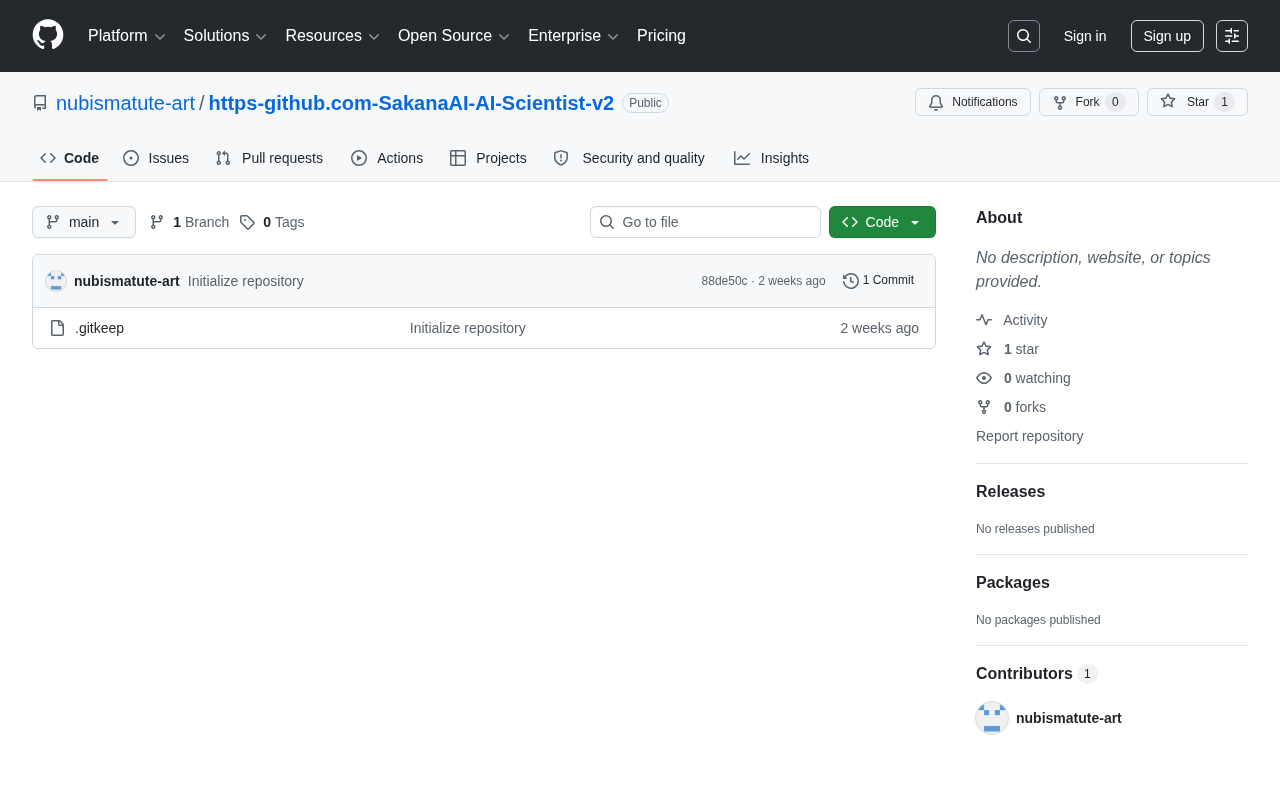
The AI Scientist project by Sakana AI is one of the most representative open-source projects in the field of autonomous AI research. Recently, the v2 release of this project has been gaining sustained attention on GitHub, with multiple developers forking and mirroring the repository. This article provides a comprehensive deep dive into AI Scientist v2, covering its technical architecture, core modules, version upgrade highlights, and industry applications.
What Is AI Scientist?
AI Scientist is an end-to-end autonomous research system developed by Sakana AI, a Japanese AI research company. Sakana AI was co-founded in 2023 in Tokyo by David Ha, a former Google Brain researcher, and Llion Jones, a former Google DeepMind researcher and co-author of the seminal Transformer paper "Attention Is All You Need." The company's name comes from the Japanese word for "fish" (魚), symbolizing the collective intelligence behavior of fish swarms in nature. Sakana AI focuses on exploring nature-inspired AI approaches, including evolutionary algorithms, model merging, and other unconventional methods, positioning itself distinctly from mainstream large model companies.
The system's core objective is to enable large language models (LLMs) to independently complete the entire research workflow — from proposing research ideas, designing experiments, writing code, running experiments, and analyzing results, to writing academic papers. Large language models are deep learning models built on the Transformer architecture and trained on massive text datasets. Notable examples include OpenAI's GPT series, Anthropic's Claude series, and Google's Gemini series. The reason LLMs can be applied to research scenarios lies in their powerful natural language understanding and generation capabilities, code writing abilities, and logical reasoning skills. In AI Scientist, the LLM serves not merely as a text generator but as the "brain" of the entire system, driving decision-making across the full pipeline from hypothesis formulation to paper writing.
Core Design Philosophy
Unlike traditional AI-assisted tools, AI Scientist is not simply a researcher's assistant. Instead, it builds an intelligent agent (Agent) capable of autonomously driving the entire research workflow. AI Agents represent one of the hottest technical paradigms in the AI field today. The core idea is to move LLMs beyond passively answering questions, enabling them to proactively plan tasks, invoke tools, execute actions, and iterate based on feedback. A typical Agent architecture comprises four core components: Perception, Planning, Action, and Memory. AI Scientist is a deep application of this paradigm in the research domain — the system plans experimental workflows through multi-step reasoning, interacts with external environments through code execution tools, and adjusts subsequent strategies based on experimental feedback, forming a complete autonomous decision-making loop.
Its design philosophy is reflected across three dimensions:
- Full-pipeline automation: Covers every critical stage of research, from literature review to paper generation, without requiring human intervention
- Iterative exploration: The system can autonomously adjust research directions and experimental designs based on results, forming a closed feedback loop
- Reproducibility assurance: All experimental code and results are traceable and reproducible, meeting scientific research standards
Key Upgrades in AI Scientist v2
The first version of AI Scientist already demonstrated the enormous potential of LLMs in autonomous research, capable of generating papers with meaningful academic value. The v2 release builds on this foundation with substantial improvements across multiple dimensions:
Enhanced Code Generation and Debugging
The v2 release significantly improves the robustness of the code execution pipeline. The system now has stronger self-repair capabilities when encountering code errors, reducing experiment interruptions caused by bugs and notably improving overall experiment success rates. The technical foundation for this improvement lies in advances in LLM code generation capabilities — when code execution throws an error, the system feeds the error message back to the LLM, which analyzes the root cause and generates a fix. This process can iterate through multiple rounds until the code runs successfully.
Upgraded Experiment Design Strategies
The new version introduces more sophisticated experiment planning strategies, enabling the system to design more rigorous comparative experiments and ablation studies that more closely approach the scientific standards of human researchers. An ablation study is a standard methodology in machine learning research. Its core approach involves systematically removing or replacing individual components of a system to verify each component's contribution to overall performance. The term is borrowed from the neuroscience concept of "ablation" — removing specific brain regions to study their function. In AI research papers, ablation studies are a key focus for reviewers because they demonstrate that each proposed technical innovation is both necessary and effective. The fact that AI Scientist v2 can autonomously design ablation studies marks a milestone, indicating that its experiment design capabilities are approaching those of professional researchers.
Improved Paper Writing Quality
The paper writing module has been re-optimized, producing papers with noticeably improved structural completeness, argumentative logic, and adherence to academic writing conventions, resulting in higher readability and professionalism.
Technical Architecture Deep Dive
The technical architecture of AI Scientist v2 consists of five core modules that work in concert to form a complete autonomous research pipeline:
1. Idea Generation
Based on existing literature and research trends, the system automatically generates valuable research hypotheses. This module retrieves and comprehends large volumes of academic literature to identify research directions that have not been fully explored. This process involves Retrieval-Augmented Generation (RAG) technology — the system first retrieves relevant papers from academic databases, then feeds the retrieved results as context to the LLM, enabling it to propose new research hypotheses with a thorough understanding of existing work, thereby avoiding duplication of prior research or proposing impractical ideas.
2. Experiment Design
Translates research hypotheses into executable experimental plans, including dataset selection, model configuration, evaluation metric specification, and baseline design for comparative experiments.
3. Code Execution
Automatically writes experimental code, runs it in a sandbox environment, and performs automatic debugging and repair when errors occur. This is one of the most significantly improved modules in the v2 release. A sandbox is a security isolation mechanism that allows programs to run in a restricted environment, preventing them from causing damage to the host system. In AI Scientist's code execution module, the sandbox environment is critical — since the system automatically generates and executes code, unrestricted execution could result in unexpected file operations, network requests, or even system-level commands. Common sandbox implementations include Docker container isolation, virtual machine isolation, and system call restrictions based on seccomp/AppArmor. The first version of AI Scientist sparked community discussion due to insufficient security isolation, and the v2 release has strengthened this aspect.
4. Result Analysis
Performs statistical analysis and visualization of experimental data, automatically generating charts and key metric comparisons to provide data support for paper writing.
5. Paper Writing
Organizes the entire research process into an academically compliant paper, including complete sections such as abstract, introduction, methodology, experiments, and results discussion. The system-generated papers follow the submission format requirements of major academic conferences (such as NeurIPS, ICML, ICLR, etc.), including LaTeX typesetting, reference management, and standardized presentation of figures and tables.
Application Scenarios and Industry Significance
Although the research output generated by AI Scientist currently still falls short of top human researchers in terms of novelty and depth, the automation capabilities it demonstrates already hold practical value.
Applicable Scenarios
- Rapid prototype validation: Quickly performing preliminary validation on a large number of research hypotheses to help research teams identify the most promising directions
- Repetitive experiment automation: Helping researchers complete highly repetitive tasks such as hyperparameter tuning and ablation studies, freeing up their creative capacity
- Research education and training: Providing junior researchers with complete reference examples of the research workflow, lowering the barrier to entry for scientific research
Impact on Research Paradigms
AI Scientist represents an entirely new model of research collaboration — human researchers are responsible for proposing high-level research directions and making creative judgments, while AI systems handle the execution of extensive experimental validation and initial paper drafting. This division of labor has the potential to dramatically improve research efficiency. This trend aligns with the broader wave of "AI for Science" (AI-driven scientific discovery) in recent years — from DeepMind's AlphaFold predicting protein structures, to AI accelerating drug discovery and materials science research, AI is moving beyond the tool level into the methodology level of scientific research, reshaping how humanity explores the unknown.
Open-Source Ecosystem and Community Development
Sakana AI's decision to fully open-source AI Scientist carries significant implications for the entire AI research community. From a strategic perspective, open-sourcing enables rapid establishment of technical influence and community ecosystem, which is particularly important for a recently founded startup. At the same time, autonomous AI research is a frontier field that requires extensive community validation and feedback, and open-sourcing can accelerate technological iteration. The multiple forks and mirror backups appearing on GitHub also reflect the community's emphasis on the project's continued availability — in the open-source world, widespread forking of important projects is a strong signal of community trust and reliance.
Open-sourcing delivers the following value:
- Lowered barriers to entry: Any researcher or developer can freely access and deploy the system
- Community-driven improvement: The various fork versions appearing on GitHub indicate that the community is actively participating in feature extensions and bug fixes
- Standardization advancement: Lays the groundwork for evaluation standards and reproducibility norms in autonomous AI research
Summary and Outlook
AI Scientist v2 represents an important iteration in the field of autonomous AI research. Although it is still a long way from truly replacing human researchers, the end-to-end automated research capabilities it demonstrates have already charted a clear direction for future paradigm shifts in scientific research.
For AI researchers and developers, following and contributing to the AI Scientist open-source project not only provides insight into the cutting edge of AI research automation but also offers the opportunity to make meaningful contributions in this rapidly evolving field. As large language model capabilities continue to advance, the practicality and research quality of autonomous AI research systems will see further breakthroughs.
Related articles

Gaussian Process Bandit Optimization: Exploration Strategies and Inference Regret Guarantees
Cumulative regret guarantees in Bayesian optimization fail to reflect final recommendation quality. This article examines a new study that provides inference regret guarantees for Gaussian process bandit optimization through exploration query strategies and fill distance analysis, validated on hyperparameter optimization and control tasks.

The Most Detailed Codex Guide on Bilibili: From Installation to Real-World Practice
The most detailed Codex guide on Bilibili: from app store installation to daily work mode configuration, with a real coffee shop project demonstrating file organization, data extraction, dashboard creation, and other practical tasks. Learn to use Plan Mode and desktop pets to leverage Codex efficiently.

Appearance Compensation in Volume Rendering: Why RGB Accuracy Cannot Guarantee Density Correctness
Volume rendering research reveals that volumetric data perfectly reproducing external RGB views may still contain density errors: appearance compensation can double central density and keep external rays unchanged even when L2 error exceeds 14.52%. Density recovery depends on appearance capacity, spatial resolution, and measurement design.