Salem Robotics: A Hardware-Agnostic Software Platform for Autonomous Robotic Inspections

Salem Robotics builds hardware-agnostic autonomous software for robotic inspections in hazardous facilities.
Salem Robotics provides a hardware-agnostic software platform that turns any compatible robot into an autonomous inspector for nuclear facilities, chemical plants, and other hazardous environments. Built by PhD-level roboticists with a decade of Los Alamos National Laboratory experience, the system handles navigation, door opening, valve turning, and measurements, then generates compliance-ready reports with heatmaps and flagged risks.
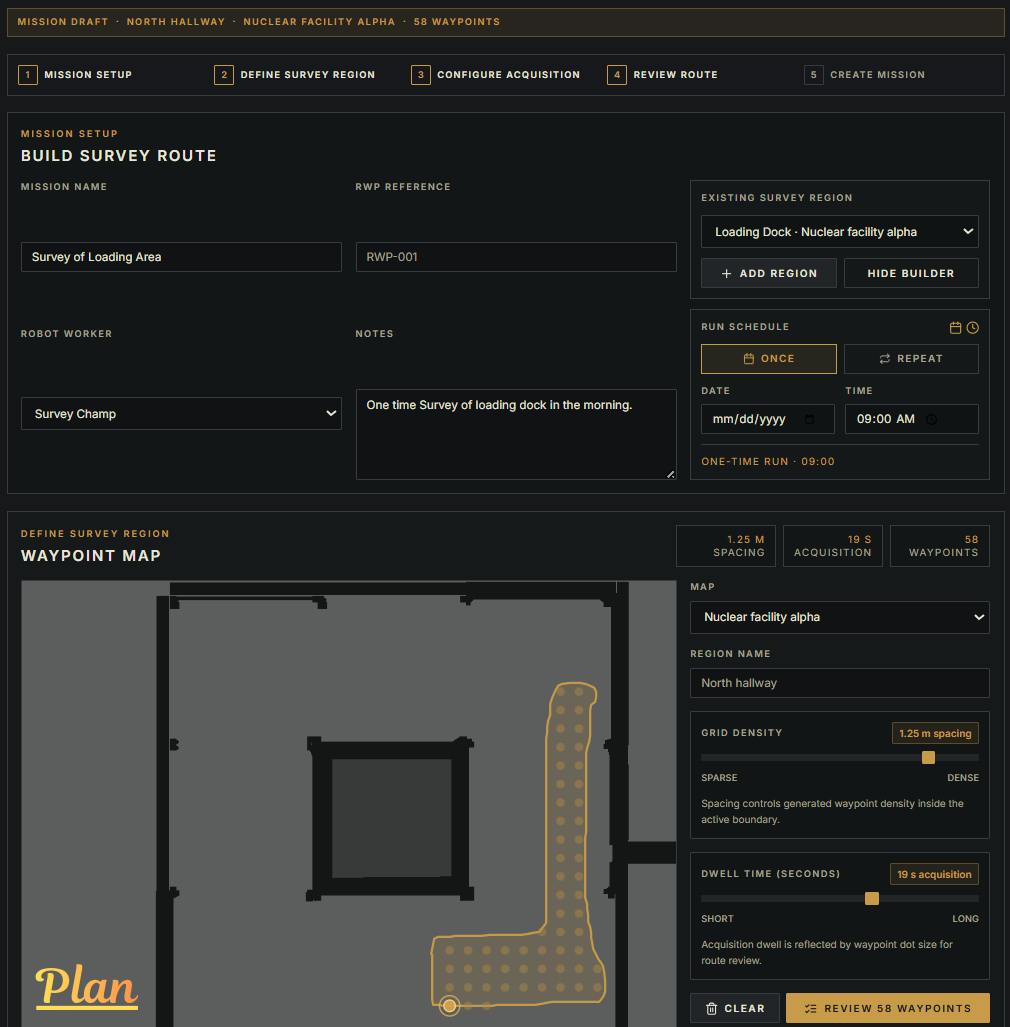
In high-risk environments like nuclear facilities and chemical plants, safety inspections have long depended on human workers — technicians entering the field with handheld detectors and clipboards, a process that's both inefficient and exposes them to radiation, toxic gases, and other hazards. Salem Robotics, which recently launched on Product Hunt, aims to reshape this workflow with a "robotic software brain." Its core offering is autonomous inspection, detection, and manipulation — operators simply draw a route on a dashboard, and the robot handles the rest.
Core Positioning: Not Building Robots, but Building the Robot's "Brain"
Salem Robotics' most critical differentiator is its hardware-agnostic positioning. Rather than designing a robot from scratch, it provides an autonomous software system that can be deployed across different robotic platforms. Users can install it on robots they already own, or have Salem provide compatible hardware directly.
This "software-first" strategy carries significant strategic weight in the robotics industry. Hardware R&D cycles are long, costly, and slow to iterate, while the intelligence layer — navigation, perception, decision-making — is where the real bottleneck lies for today's robots. Decoupling the brain from the body means Salem can serve multiple application scenarios more quickly while lowering the procurement barrier for customers.
Based on the feature descriptions, the system can execute a remarkably complex chain of tasks: autonomous navigation, opening doors, turning valves, and performing measurements, ultimately generating a "compliance-ready" report complete with heatmaps and flagged risk points. This goes well beyond simple patrol-and-photograph — it's a complete workflow involving physical manipulation.
Target Scenario: Autonomous Inspection and Manipulation in Hazardous Facilities
Salem Robotics is squarely targeting the hazardous facilities vertical market. In traditional inspection workflows, technicians must physically enter nuclear facilities, chemical plant floors, and similar environments, collecting data point by point with handheld detectors and filling out records manually. This process suffers from three key pain points:
- Safety risks: Personnel are chronically exposed to radiation, toxic, or flammable environments
- Low efficiency: Manual recording and post-hoc compilation make it difficult to scale
- Compliance pressure: Inspection reports must meet stringent regulatory requirements
Salem's solution transforms "humans entering the field" into "robots entering the field." Operators draw a route on the dashboard, and the robot autonomously executes the mission and returns structured reports. This model is especially well-suited for industrial scenarios requiring regular, repetitive, and standardized inspections, protecting personnel safety while improving data consistency and auditability.
Interestingly, the product is categorized on Product Hunt under Robots, Artificial Intelligence, and Climate Tech simultaneously. The Climate Tech tag suggests the system may also be applicable to energy, emissions monitoring, and other scenarios closely tied to environmental compliance.
Technical Foundation: A Decade of Expertise from Los Alamos
For any technology product, the team's background is often a critical signal of its ability to deliver. Salem Robotics emphasizes that its system is "built on published research, created by PhD-level robotics experts with a decade of experience at Los Alamos."
Los Alamos National Laboratory is one of the most important national laboratories in the United States, with a long history of research in nuclear-related and high-risk environments. This background aligns perfectly with Salem's focus on hazardous facility inspections — the team has firsthand knowledge of radiation environments, compliance requirements, and autonomous operations within complex facilities. Compared to teams entering from consumer or commercial robotics, this kind of technical pedigree carries far more credibility in specialized vertical markets.
The product was launched by Janak Panthi as Maker and has received 75 votes on Product Hunt, ranking 17th. While the vote count is mid-range for the day's leaderboard, for a B2B professional robotics product with a high entry barrier, this level of attention is already noteworthy.
Observations and Reflections: A Pragmatic Example of Physical AI in Action
Salem Robotics' value lies not in a flashy vision of general-purpose humanoid robots, but in pragmatically solving a clearly defined, high-value problem. It gets three things right:
The right scenario. The ROI logic for hazardous facility inspections is crystal clear — using robots to replace humans in dangerous zones yields directly quantifiable safety benefits, and customers have strong willingness to pay.
The right architecture. The hardware-agnostic software layer strategy lets Salem avoid head-to-head competition with hardware giants like Boston Dynamics, instead building a moat in the more defensible "autonomous intelligence" layer.
Delivering outcomes, not capabilities. What it promises isn't "a robot that can walk and see," but a "compliance-ready report." This deliverable-oriented product definition is exactly what B2B customers are truly willing to pay for.
Of course, challenges remain. Industrial-grade autonomous manipulation — especially physical interactions like opening doors and turning valves — demands extremely high reliability; any failure in a hazardous environment could have severe consequences. Whether compliance reports can truly gain acceptance from regulatory bodies also requires long-term real-world validation. But regardless, Salem Robotics demonstrates a clear path for "physical AI" deployment: In the places humans should least have to go, let robots go first.
Related articles

Claude Autonomously Designs Proteins with 35% Success Rate, Far Exceeding Human Expert Performance
Anthropic's Claude achieves 35% wet-lab success rate in autonomous protein design, far surpassing the 10-15% human expert average, signaling AI's move toward real scientific productivity.

Perplexity Discover's Multilingual Support Suddenly Disappears — Why Are International Users Upset?
Perplexity Discover's multilingual news feature suddenly dropped non-English support, frustrating international users. We analyze possible causes and the broader challenges of AI product internationalization.

GitHub Daily · August 20: Mojo Tops the Charts & The Local-First Open Source Rebellion
GitHub Trending Aug 20: Mojo tops charts for AI compute stack ambitions, OpenLogi surges 1225 stars with local-first philosophy, and privacy rebellion dominates.