Salesforce Global Outage: A Wake-Up Call on Single Points of Failure in the SaaS Era
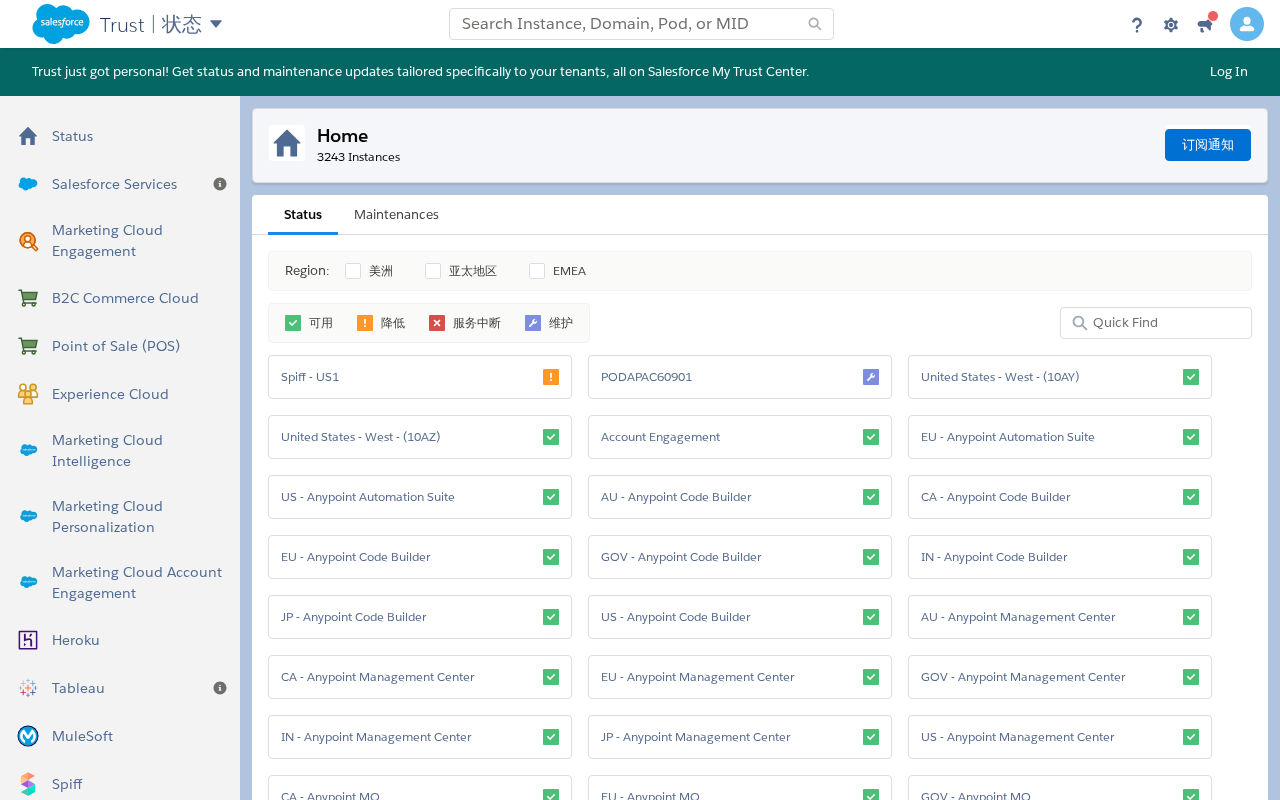
Salesforce's global outage exposes the single-point-of-failure risks of heavy SaaS vendor dependence.
Salesforce recently experienced a global service outage affecting multiple core products, triggering widespread discussion on Hacker News. As the CRM backbone for sales, support, and operations teams worldwide, the outage left frontline workers unable to function and exposed a fundamental tension in the SaaS model: trading control for convenience. With most companies lacking viable backup systems, the only option was to wait for recovery. The article recommends building continuity plans, backing up data regularly, and scrutinizing SLA terms — while urging the industry to treat availability and resilience as first-class concerns alongside cloud-native efficiency.
Incident Overview
Salesforce recently experienced a global service outage, with its official status page (status.salesforce.com) showing multiple products affected. The incident sparked heated discussion on Hacker News, where the post quickly accumulated 240 upvotes and 146 comments — reflecting the widespread impact this SaaS giant's failure had on enterprise users worldwide.
As the world's leading CRM (Customer Relationship Management) platform, Salesforce powers the core business processes of tens of thousands of companies — from sales pipeline management and customer service to marketing automation. When a global outage hits, the damage isn't limited to IT departments. It directly disrupts frontline sales reps, support agents, and operations teams.
Why One Outage Triggers So Much Attention
What makes Salesforce unique is how deeply embedded it is in the lifeblood of business operations. Unlike general-purpose tools, a CRM system is often the "single source of truth" for a company's sales and customer data. When access goes down, sales reps can't pull up customer records, support teams can't process tickets, and the integrations and automated workflows built around Salesforce grind to a halt in a cascading chain reaction.
The intensity of the community discussion reveals a pain point shared by many tech professionals and business decision-makers: deep dependence on a single SaaS vendor means that when something goes wrong on the vendor's side, downstream companies are essentially powerless — left with no choice but to wait for recovery.
The Single Point of Failure Problem in the SaaS Era
Cloud computing and the SaaS model have delivered remarkable efficiency gains, but they've also reshaped enterprise risk profiles. In the era of on-premises systems, companies at least had direct control over their own infrastructure. Under the SaaS model, availability is entirely entrusted to the vendor.
The Double-Edged Sword of Centralization
Consolidating business operations onto a single platform offers real benefits: simpler operations, smoother integrations, and predictable costs. But the trade-off is putting all your eggs in one basket. When a core platform like Salesforce experiences a global outage, affected companies can't mitigate the damage by switching regions or falling back to degraded service — because the problem originates at the platform level, not at any individual node.
It's worth noting that Salesforce itself uses a multi-tenant architecture — all customers share the same underlying infrastructure, with logical isolation ensuring data security. This design allows the platform to serve a massive customer base at minimal marginal cost, but it also means that when a core component fails, the blast radius spans all tenants rather than being confined to a specific user group. By contrast, some enterprise cloud services offer a "Dedicated Instance" option, which limits the failure blast radius — but at a significantly higher cost. Understanding this architectural difference helps companies make more accurate assessments of availability risk during vendor selection.
The Absence of a Viable Fallback
For most enterprises, there simply is no ready-made "backup system" for their CRM. Continuously syncing data to a second system is expensive, and most teams' daily workflows are entirely built around Salesforce. As a result, during an outage, companies are often left with no better option than logging paper tickets, pausing certain operations, and waiting for an official fix.
How Enterprises Can Manage SaaS Dependency Risk
While it's not realistic to eliminate dependence on critical SaaS platforms, companies can take steps to reduce the impact of failures:
- Establish a business continuity plan: Define temporary workflows for when core SaaS platforms go down — such as offline logging and priority triage — so that teams aren't completely paralyzed.
- Conduct regular data exports and backups: Even without building a full backup system, maintaining local or third-party backups of critical data can preserve business essentials in extreme situations.
- Scrutinize SLA and compensation terms: Understand the vendor's Service Level Agreement, and be clear about the boundaries of liability and the compensation mechanisms that apply during outages.
- Monitor official status pages: Add status pages like status.salesforce.com to your monitoring setup so you receive outage information as early as possible and avoid mistaking vendor-side issues for problems within your own systems.
Implications for the Industry
This Salesforce global outage is another reminder to the entire industry: as organizations pursue cloud-native and SaaS-driven efficiency, availability and resilience deserve equal attention. For vendors, the key to maintaining customer trust lies in improving fault tolerance, reducing mean time to recovery, and communicating transparently and promptly when things go wrong.
For enterprise users, the challenge is finding the right balance between "convenience" and "control." Going fully on-premises isn't realistic for most organizations — but blindly entrusting all core business operations to a single platform carries risks that cannot be ignored. SaaS outages aren't rare black swan events. They are a real-world risk management issue that needs to be part of any organization's regular planning.
Note: This article is based on Salesforce's official status page and discussions on the Hacker News community. For the specific scope of affected products and recovery timelines, please refer to the latest official announcements.
Background: Understanding SLAs
An SLA (Service Level Agreement) is a vendor's written commitment to availability, typically expressed as an annual uptime percentage. For example, 99.9% availability translates to a maximum of roughly 8.7 hours of downtime per year; 99.99% reduces that to approximately 52 minutes. However, it's important to note that SLA compensation is usually issued as "service credits" rather than cash, and the compensation cap is typically only a fraction of your monthly fee — far from covering the actual business losses caused by an outage. Before signing any contract, companies should carefully read the exclusion clauses — many force majeure events or scheduled maintenance windows don't count toward SLA violations — and benchmark SLA metrics against their own acceptable downtime tolerance, rather than treating them as an absolute guarantee of availability.
Related articles
Automattic Executives Signed Reciprocal Severance Agreements During Mullenweg's Brief Ouster
Automattic's CFO and General Counsel signed reciprocal severance agreements during Matt Mullenweg's brief ouster, covering one year's salary and accelerated equity vesting, raising corporate governance concerns.
H3 Singularity Optimization: 40% Speed Boost With Better Image Quality
A Reddit user's Minimax Singularity workflow tip: insert an RTX upsampler before H3 Latent for 40%+ speed gains and better quality. Covers parameters, 12-bit output, and more.
Glyph: A Multi-Strategy Agent System for Automated Enterprise Data Catalog Annotation
Glyph is a multi-strategy LLM agent system for enterprise data catalogs that automates column description generation and sensitivity ontology tagging, grounding outputs in pipeline source code to improve accuracy.