Sam Altman: OpenAI Won't Go Public Until Its Models Are Safe Enough

Altman ties OpenAI's IPO to model safety commitments, declaring there is no set timeline for going public.
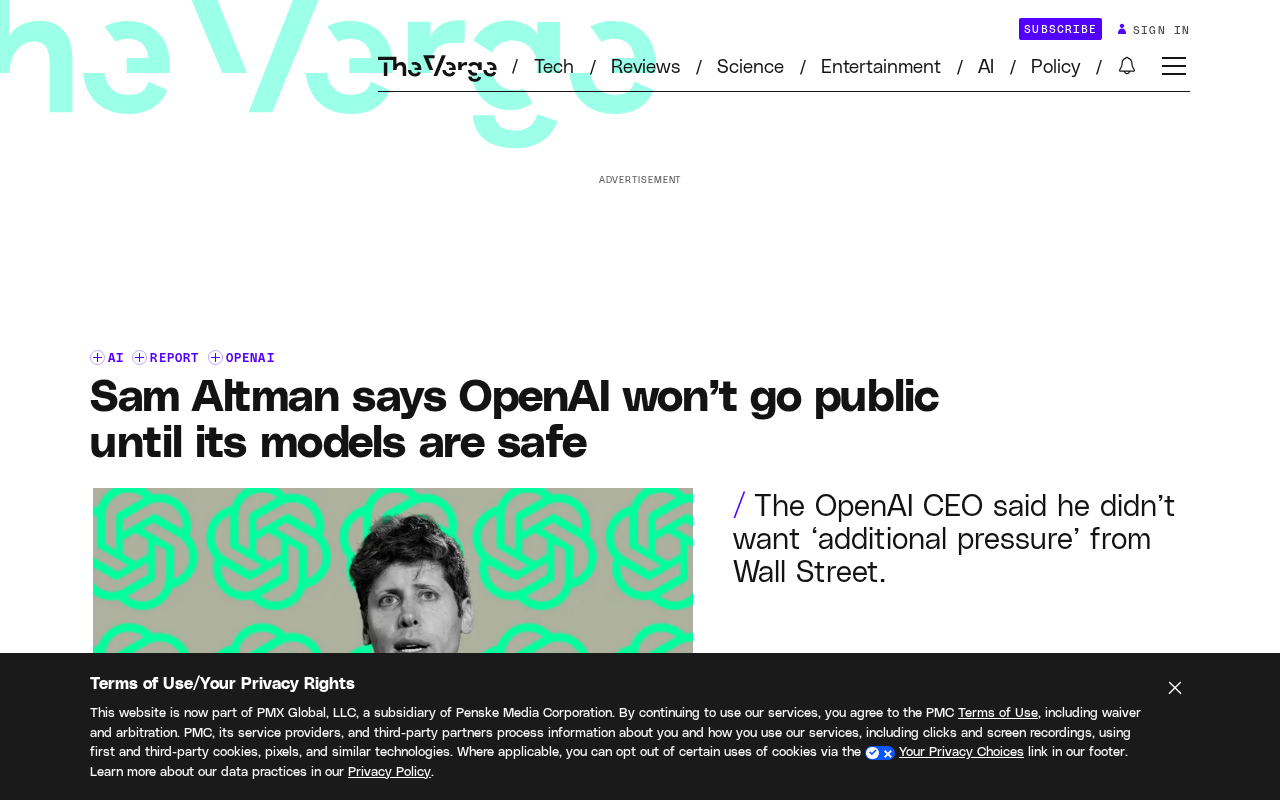
OpenAI CEO Sam Altman has stated that the company will not seek an IPO until it can make more reliable commitments on model safety, with no set timeline currently in place. Altman noted that as model capabilities surge forward, the accompanying risks demand more serious attention. By making safety a non-financial prerequisite for going public, OpenAI responds to regulatory pressure while preserving maximum strategic flexibility — avoiding accountability to capital market quarterly cycles without making any specific commitments. However, with no industry-wide safety standard in place, who determines when models are "safe enough" and when that bar has been met remains an open question, leaving room to interpret this statement as both a genuine safety stance and a calculated PR move.
The IPO Question Resurfaces
Speculation about when OpenAI will go public has been building for months, with investors and industry watchers eagerly awaiting signals that the AI giant is ready to enter the capital markets. In his latest statement, CEO Sam Altman offered an answer that is both clear and deliberately vague: OpenAI will not pursue a public offering until the company can make stronger commitments on model safety — and there is no set timeline for when that might happen.
By linking the IPO — traditionally a purely financial milestone — to model safety, a question of technology and ethics, Altman has done something notable. For a company with sky-high valuations and intense market expectations, voluntarily placing a non-financial precondition on going public is a signal worth examining.
Why Safety Has Become a Prerequisite for Going Public
In his remarks, Altman noted that OpenAI intends to keep pushing AI capabilities forward — but as models surge forward in capability, the company has developed a clearer picture of the risks that come with that progress. In other words, the more powerful the models, the more seriously the potential safety concerns need to be taken.
Setting safety commitments as a threshold for an IPO reflects a particular posture in OpenAI's public communications: the company wants to signal that before chasing commercialization and capital returns, it needs to ensure its technology is controllable and trustworthy. This is both a response to regulatory pressure and a continuation of the long-running "AI safety" narrative OpenAI has cultivated.
That said, this framing also raises open questions — who gets to define "safe enough," and by what standard? In the absence of unified industry safety benchmarks, commitments like this remain largely principled statements that are difficult to quantify.
The AI safety field currently lacks industry-wide standards. The main evaluation frameworks — including OpenAI's own Preparedness Framework and Anthropic's Responsible Scaling Policy (RSP) — are each developed internally by the companies themselves. These frameworks typically classify model capabilities into risk tiers and require additional safety measures before a dangerous threshold is crossed, but the definition of "dangerous threshold" still relies heavily on each company's internal judgment. This is precisely why, when Altman ties going public to models being "safe enough," outside observers have no independent way to verify when that condition has been met — and no third-party body holds sufficient authority to make that determination. This institutional gap is the core reason AI safety commitments are so hard to quantify.
What "No Timeline" Actually Means
Equally notable is Altman's emphasis that there is no set timeline. For the market, this means expectations for a near-term OpenAI IPO should be tempered. For the company, it preserves significant strategic flexibility — freeing OpenAI from the pressure of quarterly capital market cycles, and allowing it to move according to its own judgment about the balance between safety and capability.
The "indefinite" framing effectively keeps decision-making authority firmly within the company. It responds to persistent outside questioning without making any specific time commitment — a classic communication strategy of staking a position while preserving room to maneuver.
The Tension Between Capital Expectations and the Safety Narrative
OpenAI currently faces a structural contradiction: on one side, enormous funding needs and investor expectations for returns; on the other, its own long-held principle of safety first. Delaying an IPO until models are "safe enough" is, in some sense, an attempt to find equilibrium between these two forces.
For the broader AI industry, how leading companies navigate the relationship between commercialization and safety carries real benchmark significance. If OpenAI genuinely holds to the principle of safety before going public, it could set a reference point for other players. Conversely, if this turns out to be rhetorical cover for a delayed decision, it may be read as waiting for better valuations and market conditions.
OpenAI's capital structure makes the commercialization pressure particularly acute. In previous funding rounds, some investment agreements reportedly included conversion clauses — giving investors the right to demand higher returns if the company fails to complete an IPO or other liquidity event within a specified period. Additionally, OpenAI is in the process of converting from a nonprofit entity to a for-profit company, a transition that involves complex legal and regulatory requirements and draws in a wider set of stakeholders. This means "when to go public" is not a decision Altman or the company can make entirely on its own — existing contractual obligations in capital agreements represent a separate layer of constraint.
Takeaway
Altman's statement deeply ties OpenAI's path to an IPO to model safety, while explicitly declining to set any timeline. Whether this reflects genuine safety considerations, a strategic and PR-minded positioning, or some combination of both, the message is clear: for the foreseeable future at least, OpenAI is not in a rush to enter the public markets. For those tracking the trajectory of the AI industry, the question to watch next is how OpenAI defines and demonstrates what it means by "safe."
Related articles

WebMCP: Every Website as Its Own MCP Server, So AI Agents No Longer Rely on Screenshots
WebMCP lets websites expose tools via the document.modelcontext API, becoming directly callable MCP servers. This article explains its architecture, the Claude Code remote-debugging demo, Chrome's current support stage, and its impact on the agent ecosystem.
MCP Protocol-Driven AI Testing Agent: …
MCP Protocol-Driven AI Testing Agent: Automated Execution, Diagnosis, and Reporting
Introduces an MCP protocol-based AI testing Agent: using FastMCP to expose PyTest execution tools, running Llama 3.2 3B locally with Ollama for failure diagnosis, automatically generating timestamped reports and comparing them with historical results to create a closed loop of test execution, root cause analysis, and fix tracking.

AI Agent Draws an Architectural Elevation in 15 Seconds — Open-Source Drawing Software Rewritten by AI
An AI Agent controls open-source drawing tool VectorCraft via MCP Server, executing 1,077 commands with zero errors to draw an architectural elevation in 15 seconds and export editable SVG/PDF.