Same Prompt Fed to 11 AI Models — Why Did They Produce 11 Different Answers?

Same prompt, 11 AI models, 11 different answers — revealing why model selection is a critical engineering decision.
A viral Hacker News experiment fed the same prompt to 11 different LLMs and got 11 different answers. This article explores why — from architectural differences and training data to sampling randomness — and provides practical guidance on building domain-specific evaluation sets and implementing multi-model routing strategies for production AI applications.
The Model Selection Dilemma Sparked by a Single Prompt
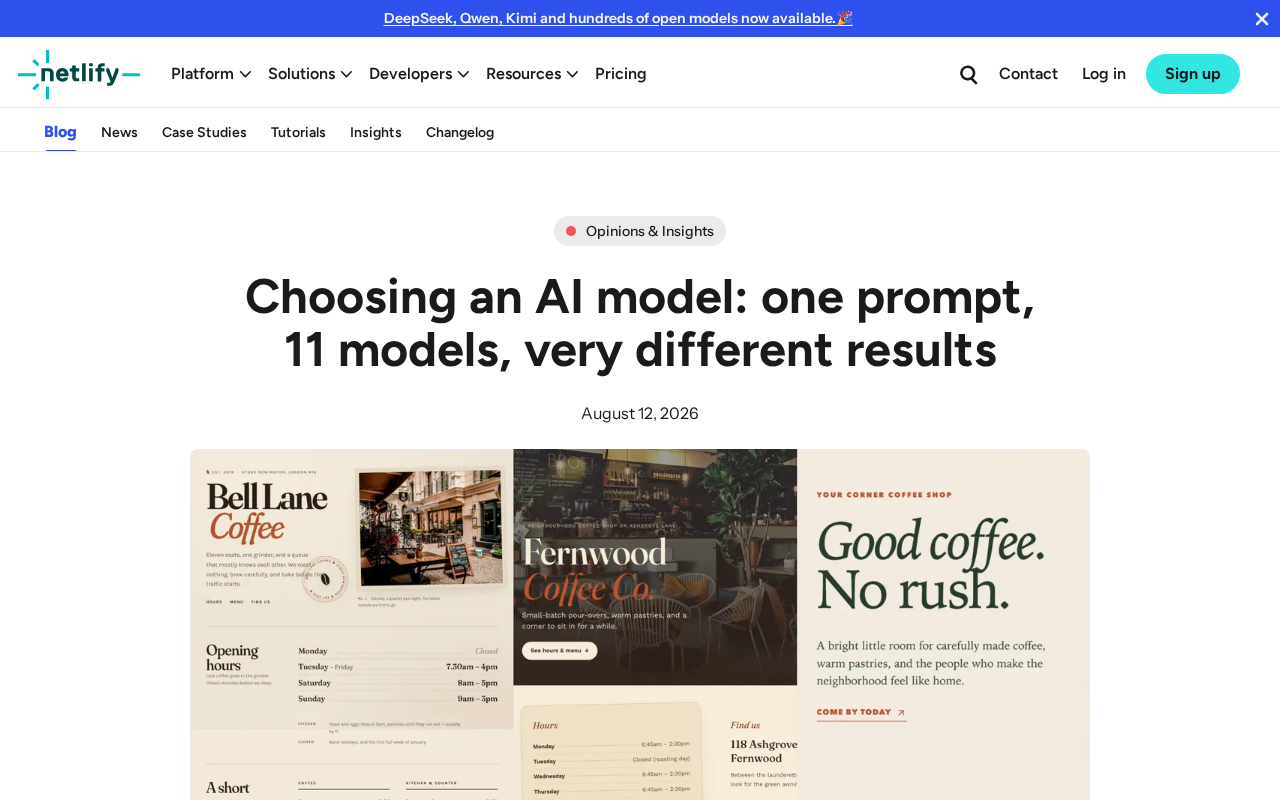
In the era of exploding generative AI applications, developers and users face an increasingly practical question: given the same task, which AI model should you choose? A recent article that sparked heated discussion on Hacker News (earning 50 points and 26 comments) offered an intuitive answer — feed the same prompt to 11 different large language models simultaneously and observe what each one returns.
The conclusion isn't surprising, but it's worth pondering: 11 models produced 11 distinctly different answers. This simple experiment reveals a fact many people overlook — in today's AI ecosystem, "model selection" itself is an engineering decision that demands serious attention, not a black-box component that can be swapped out casually.
Why the Same Prompt Produces Different Results Across AI Models
Fundamental Differences in Training Data and Model Architecture
Different large language models are trained by different teams, with vast differences in their underlying architectures, parameter scales, and training corpora. OpenAI's GPT series, Anthropic's Claude, Google's Gemini, Meta's Llama, and various open-source models — they've all "seen different worlds." This directly causes divergence in how they understand and express responses to the same question.
While virtually all mainstream large language models today are based on the Transformer architecture proposed by Google in 2017, each organization has taken distinctly different technical paths in their specific implementations. For example, the GPT series uses a pure decoder-only architecture, while earlier models like T5 used an encoder-decoder structure. In terms of parameter scale, from lightweight models with billions of parameters to flagship models with hundreds of billions or even trillions of parameters, scale differences often bring qualitative leaps in capability — the so-called "emergent abilities." Additionally, models like Google's Gemini and Mistral's Mixtral employ Mixture of Experts (MoE) architecture, activating only a subset of parameters during inference — a design that fundamentally changes how models process information. On the training data front, some models emphasize academic papers and code repositories, while others lean more toward web text and multilingual data. These differences directly shape a model's "knowledge structure" and "thinking habits."
Even different versions from the same company can produce vastly different output styles due to differences in alignment strategies and RLHF (Reinforcement Learning from Human Feedback) fine-tuning approaches. Some models tend to give detailed, lengthy answers, while others prefer concise and direct responses.
It's worth noting that different companies employ fundamentally different alignment methods. OpenAI primarily relies on RLHF, where human annotators rank model outputs by preference, and these preference data are used to train a reward model that guides the LLM's behavior. Anthropic developed Constitutional AI on top of this, allowing models to self-evaluate and self-correct based on a set of predefined principles, reducing dependence on extensive human annotation. Meta's Llama series, as open-source models, typically have lighter alignment, allowing the community to perform custom fine-tuning. These different alignment philosophies directly determine how models behave when facing sensitive topics, ambiguous instructions, or open-ended questions — some models are more conservative and cautious, while others are more open and direct.
Randomness Introduced by Sampling Mechanisms
Beyond the models' inherent differences, sampling parameters like temperature and top-p during the generation process also play a critical role. Even with the same model, running the same prompt multiple times at a non-zero temperature can produce different outputs. This means "different results" stem both from fundamental differences between models and from the inherent randomness of the generation mechanism.
To understand this randomness, you need to understand how LLMs generate text. At each step, the model computes a probability distribution over all possible next tokens in its vocabulary, then selects one. The temperature parameter controls how "sharp" this probability distribution is: at temperature 0, the model always picks the highest-probability token (greedy decoding), making output completely deterministic; the higher the temperature, the greater the chance of lower-probability tokens being selected, making output more random and creative. Top-p (nucleus sampling) is another control strategy — rather than fixing the number of candidate tokens, it dynamically selects the smallest set of tokens whose cumulative probability reaches threshold p. For example, top-p=0.9 means sampling only from the tokens comprising the top 90% of cumulative probability. There's also top-k sampling, which selects only from the k highest-probability tokens. Different combinations of these parameters can make the same model produce stylistically different outputs for the same input — which is why controlling sampling parameters is an indispensable prerequisite when conducting rigorous model comparison experiments.
Practical Implications for Developers: How to Choose the Right AI Model
Don't Blindly Trust a Single Model
The most practical takeaway from this experiment is: any approach that treats a single model as the sole source of truth is dangerous. In the comment section discussions, many developers shared similar experiences — across tasks like code generation, text summarization, and data extraction, different models have different strengths and weaknesses, and no single model dominates across all scenarios.
For teams building production-grade applications, this means model selection should be based on task-specific empirical evaluation, not overall scores on leaderboards. A model that ranks high on general benchmarks may not suit your vertical business scenario.
Build Your Own LLM Evaluation Baseline
Rather than agonizing over "which model is best," a more pragmatic approach is to build an evaluation set for your core use cases, using real business data to compare multiple models side by side. This "one prompt, multiple models" comparison method is precisely a lightweight yet highly valuable evaluation approach.
Currently popular public benchmarks — such as MMLU (Massive Multitask Language Understanding) for multidisciplinary knowledge, HumanEval for code generation ability, and GSM8K for mathematical reasoning — provide standardized references for cross-model comparison, but they have significant limitations. First, these benchmark questions are widely public, and some models may have "seen" them during training, leading to inflated scores (the data contamination problem). Second, general benchmarks cannot capture the requirements of specific business scenarios — for instance, the accuracy and formatting requirements of a legal document review task are entirely different from those of a creative copywriting task. Therefore, an increasing number of teams are building "domain-specific evaluation sets": extracting 50-200 representative samples from real business data, defining clear scoring dimensions (such as accuracy, completeness, format adherence, hallucination rate, etc.), and then systematically scoring each candidate model. Although this approach requires more upfront investment, it provides information far more valuable for decision-making than public leaderboards. Open-source tools like OpenAI Evals, Promptfoo, and LangSmith are also lowering the barrier to building such evaluation pipelines.
Through side-by-side comparison, teams can intuitively observe: which model is better at following instructions, which produces fewer hallucinations, and which achieves the best balance between cost and quality.
Multi-Model Routing Strategies Are Becoming Industry Mainstream
From "Pick One Model" to "Intelligently Dispatching Multiple Models"
This discussion also reflects a clear industry trend: more and more applications no longer rely on a single model, but instead adopt multi-model routing strategies. Based on task type, complexity, and cost budget, requests are dynamically dispatched to the most suitable model — simple tasks are handled by cheap smaller models, while complex reasoning is handed to powerful flagship models.
The technical implementation of multi-model routing is evolving rapidly. The most basic approach is rule-based routing — dispatching requests to preset models through keyword matching or task labels. For example, all code-related requests go to a model with strong programming capabilities, and translation requests go to a model with excellent multilingual performance. A more advanced approach is intelligent routing based on semantic classifiers, using a lightweight classification model to perform intent recognition and complexity assessment on input requests, then selecting the most appropriate target model accordingly. For example, a simple factual query might be routed to a small model costing one-tenth of the flagship model, while a complex question requiring multi-step reasoning gets escalated to the most powerful model. In industry practice, OpenRouter provides a unified API interface to access dozens of different models with support for automatic fallback and load balancing; Martian focuses on building an intelligent routing layer, claiming to reduce API costs by 40%-70% while maintaining output quality. Providers like Anthropic and OpenAI also offer complete model tiers within their product lines (e.g., Claude Haiku/Sonnet/Opus, GPT-4o-mini/GPT-4o), essentially encouraging users to select different model levels based on their scenarios.
This architecture not only significantly optimizes costs but also improves overall system robustness — when a particular model service becomes unavailable or its performance degrades, the system can quickly switch to an alternative.
The Core Value of Model Comparison Tools
For this reason, tools that enable convenient side-by-side comparison of multiple AI models are becoming increasingly important. Whether it's an internally built evaluation pipeline or a third-party comparison platform, their core value lies in reducing the decision cost of model selection, transforming "11 models with 11 different answers" from a confusing phenomenon into a quantifiable, actionable engineering problem.
Conclusion: Embrace Model Diversity and Make Choices Systematically
The seemingly simple experiment of "one prompt, 11 models, different results" actually touches the core proposition of AI application deployment. In an era where large language models are blooming everywhere, diversity of answers is not a defect — it's reality.
Truly mature AI engineering practice should embrace this diversity, using systematic evaluation and flexible multi-model architectures to find the most suitable model for each specific task — rather than futilely searching for a "universal model" that solves everything. After all, choosing the right model often determines the final quality of an application far more than optimizing prompts.
Related articles

WorkBuddy Step-by-Step Tutorial: Get an Automated Workflow Running in Half an Hour
A step-by-step breakdown of the WorkBuddy automated workflow: why most people only use it as a chat app, how the 27-anchor course and 12 templates help beginners get up and running in half an hour, plus notes on usage boundaries.

The Truth About Free Claude Code: Three Legitimate Paths and One Scam
Is free Claude Code possible? We break down the real cost of Pro and Max (with exchange rates and taxes), how community free methods work and their privacy trade-offs, plus fake installers and phishing traps—and three legitimate free paths.

Codex Cloud Mode Explained: Environment Setup and Use Cases
This article explains how Codex cloud mode works, environment setup steps, and use cases, including how to create environments, connect GitHub repositories, set scheduled tasks, and compare cloud vs. local mode.