Samsung Invests $100M in Kairos Power to Build Nuclear Reactors for Google
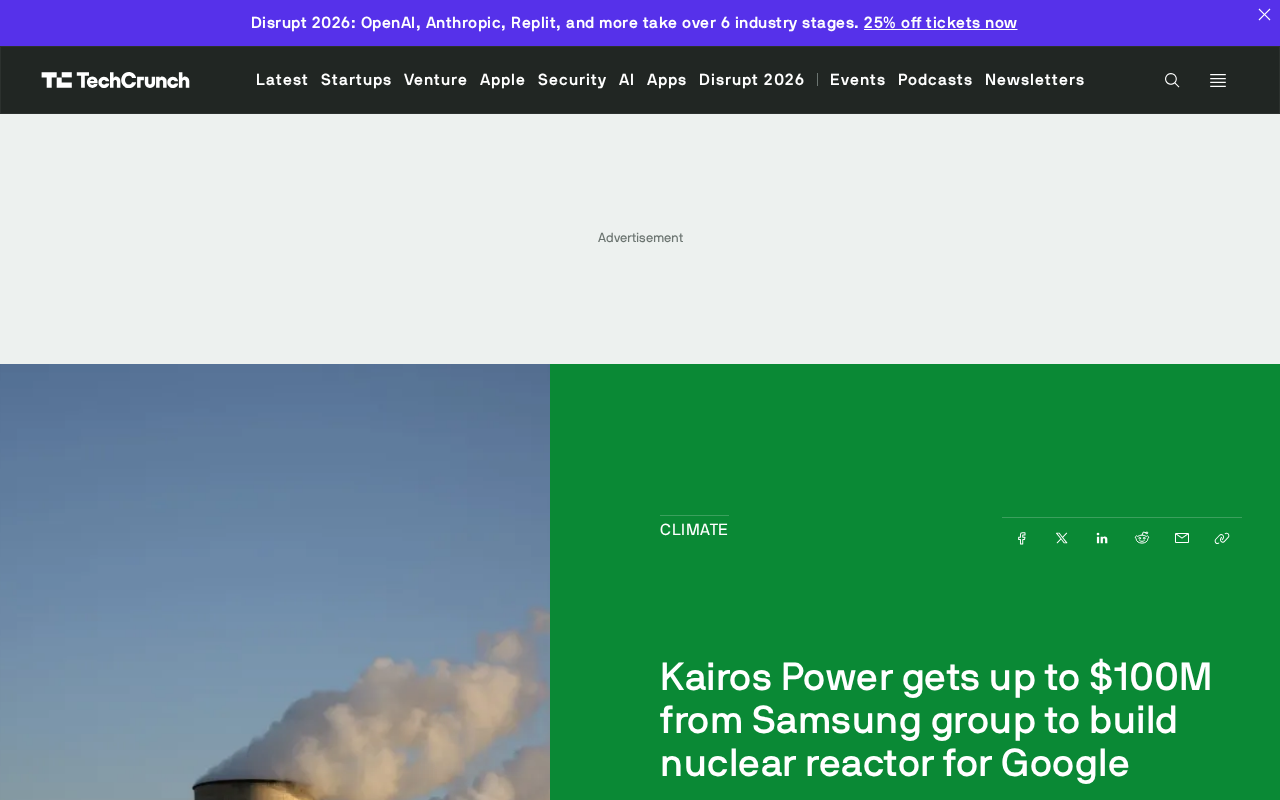
Samsung C&T invests $100M in Kairos Power to build a nuclear plant supplying clean power to Google's AI data centers.
Samsung C&T has agreed to invest up to $100 million in Kairos Power to help build its first 50MW small modular nuclear reactor, with Google as a key customer. The deal highlights a shift in AI-era computing bottlenecks from chips to power supply, as large-scale data centers require stable around-the-clock electricity that nuclear energy is better positioned to deliver than intermittent renewables. Samsung C&T is deeply involved as a construction partner — not just a financial backer — serving dual purposes of engineering risk reduction and strategic positioning. This tripartite model of tech company, nuclear startup, and construction giant may become a new paradigm for clean energy infrastructure, though nuclear projects still face significant regulatory, cost, and timeline hurdles.
Samsung Enters Nuclear Energy, Betting on the Power Gap of the AI Era
Kairos Power has reached an agreement with Samsung C&T, which will provide up to $100 million to help build the company's first 50-megawatt nuclear power plant. One of the core customers for this reactor is Google — a tech company being driven by the enormous power demands of AI data centers and eager to lock in long-term, stable clean energy.
This deal reflects a key trend in the tech industry: the bottleneck for computing expansion is gradually shifting from chips to power supply. As the scale of large model training and inference grows exponentially, hyperscale data center operators are turning their attention to nuclear energy as an option that can provide around-the-clock baseload power.
Why Google Needs Nuclear Power
Google has publicly outlined its energy procurement strategy on multiple occasions, with advanced nuclear energy being a key component. Compared to the intermittent nature of wind and solar, nuclear power provides stable electricity unaffected by weather — a critical advantage for AI data centers that need to operate at high loads 24/7.
Kairos Power's focus is on next-generation advanced reactor technology, designed to improve on traditional large-scale nuclear plants in both safety and cost. The planned 50-megawatt project falls into the small and medium modular category, making it better suited to flexibly match the power consumption scale of data centers while striking a balance in site selection and construction timelines.
For Google, getting in early as a "future customer" of Kairos Power's project means securing clean, predictable power supply in pursuit of both its carbon neutrality and computing expansion goals.
Kairos Power uses Fluoride Salt-Cooled High-Temperature Reactor (FHR) technology, which is fundamentally different from traditional pressurized water reactors: the coolant is molten salt rather than water, and the reactor operates at atmospheric pressure rather than high pressure, fundamentally eliminating the risk of steam explosions. This design also operates at higher temperatures, delivering greater power generation efficiency. Small Modular Reactors (SMRs) typically refer to nuclear units with a single-unit capacity below 300 megawatts. Their core advantage lies in factory prefabrication and modular assembly, which dramatically reduces on-site construction time and costs — which is precisely why AI data center operators find them particularly attractive: units can be added incrementally in step with computing expansion, rather than committing the tens of billions of dollars required for a traditional large-scale nuclear plant all at once.
Samsung C&T's Role and Strategic Intent
Samsung C&T's investment of up to $100 million is not purely financial — the company will be deeply involved in the construction phase. As a globally leading engineering and construction firm with extensive experience in large infrastructure projects, Samsung C&T's participation helps reduce the construction risks for Kairos Power's first commercial plant.
For Samsung Group, this also represents a strategic positioning move in the emerging advanced nuclear energy sector. Nuclear construction, supply chains, and subsequent operations and maintenance could all become new growth drivers amid the energy transition. As tech giants increasingly treat electricity as a strategic resource to be secured, deep ties with nuclear energy suppliers carry significant long-term value.
A Snapshot of the AI Power Race
This deal is not an isolated event — it's a concrete illustration of a broader industry trend. In recent years, multiple tech companies have been exploring nuclear power to meet data center electricity needs, from SMRs to advanced nuclear fission technology, making it a hot topic at the intersection of tech and energy.
Notably, this tripartite model of "tech company + nuclear startup + construction conglomerate" could become the defining path for future clean energy infrastructure deployment: tech companies provide demand and long-term procurement commitments, startups provide technological innovation, and industrial and construction groups provide capital and engineering capabilities.
Of course, nuclear projects typically take years to go from planning to grid connection, and face multiple challenges including regulatory approval, cost control, and public acceptance. Whether Kairos Power's 50-megawatt plant can be delivered on schedule remains to be seen. But one thing is certain: the battle for power in the AI era has fully ignited, and nuclear energy is increasingly being viewed by more and more players as the key to breaking through.
The regulatory pathway for nuclear projects also warrants attention. In the United States, small modular reactors must complete two main stages through the Nuclear Regulatory Commission (NRC): design certification and an operating license — a process that typically takes 5 to 10 years. Kairos Power completed its construction permit application for its non-power demonstration reactor (Hermes) in 2023, making it one of the most advanced SMR developers in terms of progress. Additionally, the U.S. Department of Energy has provided funding to multiple companies including Kairos through its Advanced Reactor Demonstration Program (ARDP), which has reduced the capital risk of technology commercialization to some extent and accelerated regulators' familiarity with new reactor technologies.
Related articles

Amphibious Transforming Drone: Beyond 100x Power Savings, What Are the Real Needs?
Is the amphibious transforming drone just a gimmick? Starting from the 100x power difference of the M4 Morphobot, explore real application scenarios and thesis topic ideas, analyzing boundary conditions where pure drones and pure ground robots both fail.

Warhound Raises $200 Million: Genetically Engineered "War Dogs" Paired with Anduril Gear
Warhound raises $200M, backed by Ben Lamm and Palmer Luckey, to genetically engineer dogs for military and law enforcement use and equip them with Anduril gear. This article analyzes its technology direction, funding logic, and ethical controversy.

Claude API Comes to Google Cloud: IAM Integration and SDK Access Guide
Anthropic hosts the full Claude API on Google Cloud with IAM-controlled permissions and unified billing. This guide covers the Vertex AI and Anthropic-hosted entry points, IAM role configuration, and SDK access.