Sarvam Token Factory Launches: India-Hosted Inference for 8 Open Models

Sarvam launches an OpenAI-compatible inference platform on India-based GPU clusters, hosting 8 open models.
Indian AI company Sarvam has officially opened Sarvam Token Factory, offering all developers unified inference for 8 open models running on GPU clusters within India via an OpenAI-compatible API. It mixes in-house Sarvam 105B with third-party models like GLM 5.3, DeepSeek V4.1 Flash, Kimi K3.1 Pro, and Gemma 4 31B to ensure capability coverage and reduce churn risk. Its core differentiation is geographic anchoring: data sovereignty compliance and local low latency as a moat for Indian clients in finance, healthcare, and government. Success depends on model update speed and price stability; the source lists only 5 models, with performance and pricing data unavailable.
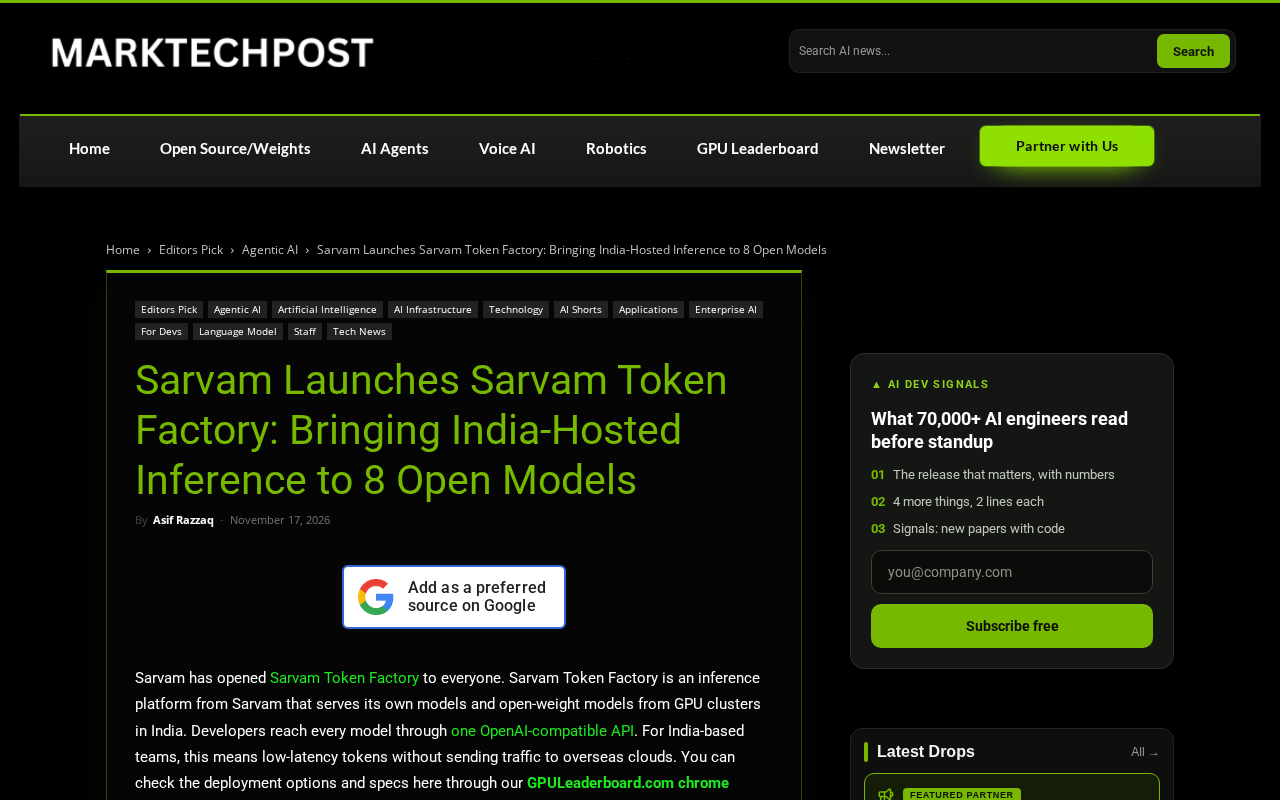
Indian AI company Sarvam has officially opened its inference platform, Sarvam Token Factory. The platform is open to all developers, with its core selling point being that it hosts multiple open models on GPU clusters located in India and serves them through a unified OpenAI-compatible API.
One API, Eight Models
According to official information, Sarvam Token Factory currently offers inference services for 8 open models. The ones explicitly listed in the original text include Sarvam 105B, GLM 5.3, DeepSeekAd V4.1 Flash, Kimi K3.1 Pro, and Gemma 4 31B. All of these models run on GPU clusters located in India, and users can call them through an endpoint compatible with the OpenAI interface.
This "multi-model + single API" design eliminates the engineering cost of integrating with each model provider separately. For projects already using the OpenAI SDK, migration in theory only requires replacing the base URL and model name—a common entry point in the current competitive landscape of inference platforms.
An OpenAI-compatible API refers to an HTTP interface whose endpoint paths, request body fields (such as model, messages, temperature), and response structures all follow OpenAI's public specification. This means that existing OpenAI official SDKs, LangChain, LlamaIndex, and other ecosystem tools usually require no changes to code logic—you only need to point base_url to the new service and replace the model identifier.
This compatibility layer does not mean the models behave identically: different models may vary in sensitivity to system prompts, the degree of support for function calling formats, and the chunking granularity of streaming output. Common pitfalls during actual migration include incomplete alignment of function calling JSON schemas, some models not supporting response_format structured output, and different token counting methods leading to billing estimate deviations. For developers, a compatible API lowers the cost of trial and error, but production environments still require regression testing for specific models.
What India-Hosted Means
Sarvam makes "India-hosted" its core narrative, pointing to data sovereignty and localization compliance requirements. For Indian financial, healthcare, and government clients, inference requests not leaving the country is often a hard requirement. Multi-model hosting provided by a local vendor effectively fills the compliance gap left by international API services.
Another practical benefit is network latency. The round-trip delay caused by cross-region calls to overseas APIs directly translates into user experience differences in real-time interactive applications. Local clusters can theoretically significantly reduce this overhead, though the original text does not provide specific latency or throughput figures.
Data sovereignty refers to the claim that data is subject to the laws of the country where it is generated or stored, typically implemented through data localization requirements. In recent years, India has strengthened constraints on personal data processing and cross-border flows through frameworks such as the Digital Personal Data Protection Act (DPDP Act), and financial regulators also have local storage requirements for payment and credit data.
For inference services, this means that prompts submitted by users, attached documents, and model outputs may all be considered data that must remain within the country. When using overseas APIs, this content is processed on foreign servers, which may trigger compliance reviews. The value of local hosting lies in bringing the inference step under domestic jurisdiction. Note, however, that whether compliance actually holds also depends on the operator's log retention policy, whether data flows to third parties, and whether a zero-retention option is offered. A "local data center" alone does not automatically equal compliance.
The Strategic Intent Behind the Model Mix
Judging from the model list, Sarvam's offering structure is quite mixed: it includes its own Sarvam 105B as the flagship, while also bringing in external open models such as GLM, DeepSeek, Kimi, and Gemma. This "in-house + third-party" combination, on one hand, gives the platform more complete capability coverage—from general conversation to lightweight reasoning, each has a corresponding option; on the other hand, it reduces the risk of customers churning because a single model underperforms.
Note that the source material only mentions that the platform serves 8 models but lists only 5 of them; the remaining 3 are not explained in the original text.
Open-weight models refer to models whose parameter weights can be publicly downloaded and deployed on owned or rented hardware, as opposed to closed-source models that can only be accessed via API. The GLM, DeepSeek, Kimi, and Gemma series all fall into this category, and their license terms vary: some use the permissive Apache 2.0, while others carry restrictions on usage scale or commercial use.
A hosting provider offering these models on its platform needs to handle license compliance, inference engine adaptation (such as the degree to which vLLM or SGLang support specific architectures), and quantization precision selection. For users, the benefit of calling open models through an aggregation platform is that deployment and operations are eliminated; the cost is losing direct control over inference parameters, context length limits, and underlying hardware. In addition, open models iterate frequently, and a platform's model versions may lag behind upstream releases, so it is worth paying attention to its version update cadence and deprecation policy.
The Competitive Landscape of Open Inference Platforms
Sarvam Token Factory's positioning places it in the same lane as the model-aggregation inference services emerging globally. The differentiator is its geographic anchoring: it does not pursue globally uniform supply but instead treats India's data residency needs as its moat.
Whether this path can succeed depends on two things: first, whether model update speed can keep up—open models iterate frequently, and the platform needs to continuously integrate new versions; second, whether pricing and stability are competitive, and this information is still blank in the available material. For developers interested in India's AI infrastructure, this platform is worth adding to the candidate list, but specific performance and pricing should still be based on official documentation.
One-line Summary
Sarvam launches an OpenAI-compatible inference platform on India-based GPU clusters, hosting 8 open models.
Paragraph Summary
Indian AI company Sarvam has officially opened its inference platform Sarvam Token Factory, offering all developers unified inference services for 8 open models, running on GPU clusters within India and accessible via an OpenAI-compatible API. The platform adopts a mixed supply strategy of its in-house Sarvam 105B plus third-party models such as GLM 5.3, DeepSeek V4.1 Flash, Kimi K3.1 Pro, and Gemma 4 31B, ensuring capability coverage while reducing the risk of customer churn due to a single model underperforming. Its core differentiation lies in geographic anchoring: it uses data sovereignty compliance and local low latency as its moat, serving Indian clients in finance, healthcare, and government that are sensitive to cross-border data transfers. The article notes that whether this path can succeed depends on model update speed and price stability, and that the original text lists only 5 models, with performance and pricing data still unavailable.
Related articles

The Bottleneck of AI Programming Isn't Generation: Why Software Factories Collapse
After AI coding tools went mainstream, PR review quality dropped and incidents rose. The speaker argues the bottleneck isn't code generation but models' inability to sustain maintainability.
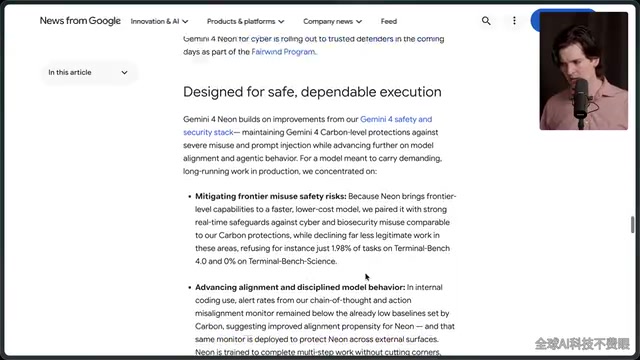
Gemini 4 Neon Hands-On: 10 Hours to Achieve What Opus Couldn't in Days, 20x Faster Warm Start
Google's surprise Gemini 4 Neon release made critic Theo change his tune: 10 hours to finish what Astra couldn't in ten days, 20x faster warm start, coherence beating Opus.

Gemini 4 Neon Hands-On: Which $20 AI Subscription Should You Choose?
Bilibili creator tests Gemini 4 Neon: composite intelligence index 61, beating Claude Opus 5.5, with API 25% cheaper. With a $20 budget, how to choose between Google AI Pro, Claude Pro, and ChatGPT Plus? Includes three must-know pitfalls and recommendations by user type.