Saving Insufficient Data with Pure Noise: OpenReview Paper Reproduction and Rethinking

Reproduction confirms pure-noise over-sampling boosts imbalanced classification, with gains orthogonal to network scale.
This reproduction study rebuilds Zada et al.'s pure-noise over-sampling method (OPeN) in PyTorch and verifies its four core claims. Experiments confirm that mixing pure noise images into minority classes improves minority-class accuracy and overall generalization; the dedicated batch normalization layer outperforms the baseline; improvements remain robust to data augmentation intensity; and gains appear even on balanced data. Supplementary experiments find OPeN's benefits are orthogonal to those from larger networks or more complex data augmentation, suggesting an independent gain path. The article notes the mechanism remains unclear and the necessity of the dedicated BN layer needs stricter analysis.
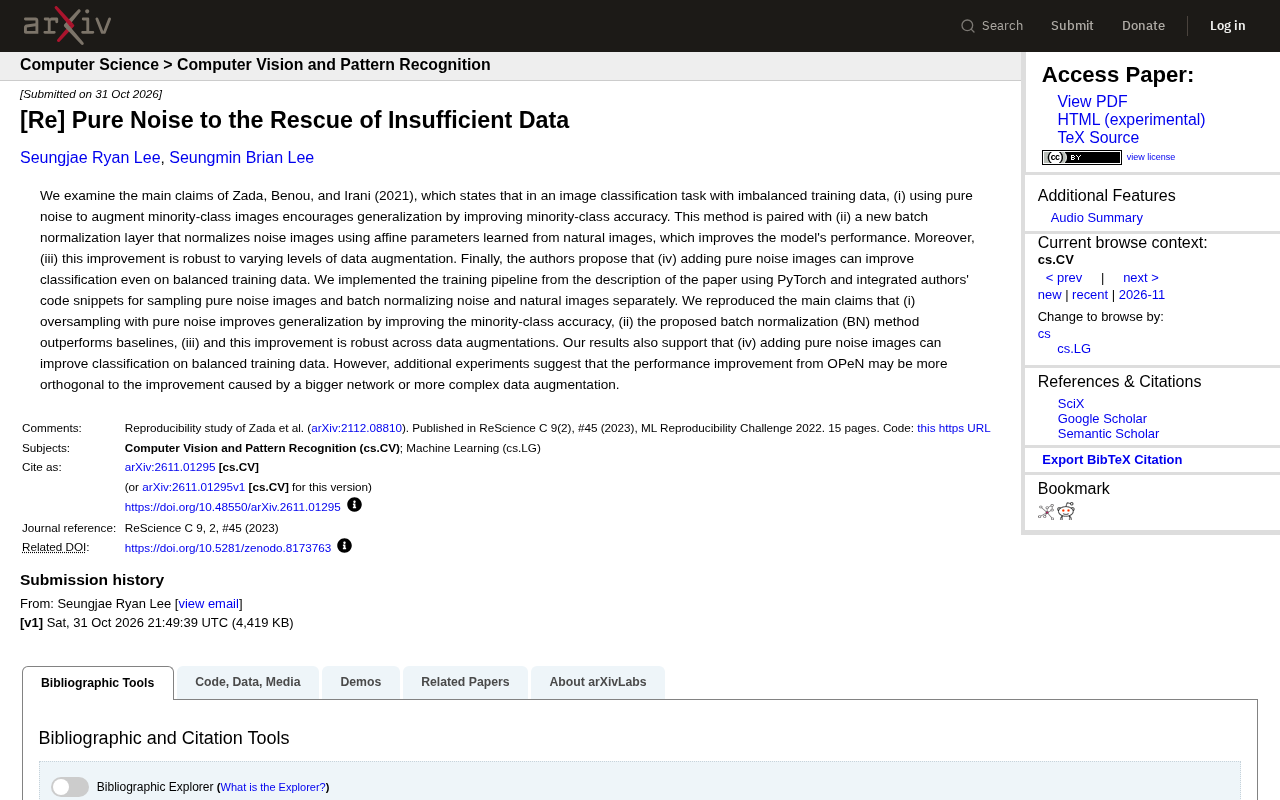
When training data is class-imbalanced, recognition accuracy for minority classes often drops significantly. In 2021, Zada, Benou, and Irani proposed a counterintuitive idea: mixing pure noise images into minority classes can actually improve generalization. This reproduction study (an OpenReview submission from rss) rebuilds the training pipeline in PyTorch, verifies the original paper's four core claims one by one, and offers noteworthy supplementary findings.
Reproduction Method: Rebuilding the Training Pipeline in PyTorch
The reproduction strictly follows the original paper's description to build the training pipeline and directly integrates the code snippets provided by the authors—including the sampling logic for pure noise images and the implementation that separates noise images from natural images for batch normalization.
The key detail lies in the design of the batch normalization (BN) layer: the authors propose normalizing noise images using affine parameters learned from natural images, rather than letting noise images compute their own statistics independently. The reproduction preserves this structure to ensure fairness in comparative experiments. The entire pipeline covers the class-imbalanced setting in image classification tasks and designs separate verification experiments for each of the original paper's four claims.
Batch Normalization (BN) is a commonly used normalization technique in deep networks that stabilizes training and accelerates convergence by standardizing the activations of each mini-batch (subtracting the mean and dividing by the standard deviation) and then applying a learnable affine transformation (scaling and shifting). Conventional BN computes statistics independently for each batch, but in this paper's scenario, the distributions of noise images and natural images differ greatly. If noise images were allowed to compute BN statistics independently, it would introduce normalization scales inconsistent with natural images and break feature consistency. The original paper's approach is to normalize noise images using affine parameters (i.e., scaling and shifting parameters) learned from natural images, so that noise images share the same normalization basis as natural images in feature space. The reproduction retains this structure, thereby ensuring that the benefits of noise augmentation are not confounded by differences in normalization.
Verification of Core Claims: Is Noise Really Useful?
Minority-Class Over-Sampling and Generalization Improvement
The first claim of the original paper is that over-sampling minority-class images with pure noise improves generalization by raising minority-class accuracy. The reproduction experiments confirm this effect: on class-imbalanced training data, the over-sampling strategy with pure noise indeed brings improvements in minority-class accuracy, which propagate to overall generalization performance.
This result is noteworthy because it challenges the intuition that "data augmentation should approximate the real distribution." Pure noise clearly contains no semantic information, yet it seems to change how the model shapes the decision boundary for minority classes.
Minority Over-sampling is a classic strategy for handling class imbalance, aimed at balancing class distribution by increasing the number of minority-class samples. Common approaches include randomly duplicating minority-class samples or using interpolation methods such as SMOTE to generate synthetic samples. Traditional over-sampling easily leads to overfitting because duplication or simple interpolation does not introduce new information. The pure-noise over-sampling proposed in this paper takes a different path: it directly mixes pure noise images semantically unrelated to real images into minority classes, expanding the sample space at extremely low cost. The counterintuitive aspect is that noise carries no class semantics, yet it may improve minority-class recall by changing the geometric shape of the decision boundary. Understanding this background helps grasp the design logic of the reproduction experiments—namely, comparing minority-class accuracy under three conditions: "no over-sampling," "traditional over-sampling," and "pure-noise over-sampling."
Advantages of a Dedicated Batch Normalization Layer
The second claim concerns a BN layer designed specifically for noise. The reproduction results show that this method of normalizing noise images with affine parameters from natural images outperforms the baseline. In other words, the normalization of noise images cannot simply use conventional BN, otherwise the benefits it brings would be undermined. This finding suggests that noise augmentation is not as simple as "adding noise randomly"; the accompanying normalization strategy is an integral part of the method's effectiveness.
Robustness to Data Augmentation
The third claim is that this improvement remains stable under different degrees of data augmentation. The reproduction experiments support this conclusion: when the intensity of data augmentation varies, the gain from pure noise does not noticeably disappear. This is a positive signal for practical applications—it means the method does not depend on a specific augmentation configuration.
Gains on Balanced Data Too
Perhaps the most surprising is the fourth claim: even on balanced training data, adding pure noise images can improve classification. The reproduction results also support this. If true, this means the mechanism of pure noise goes beyond "compensating for insufficient minority-class samples" and may touch on a more general regularization effect.
Regularization in machine learning broadly refers to any technique used to suppress overfitting and improve generalization, such as weight decay, dropout, and data augmentation. Its core idea is to introduce some constraint or noise during training so that the model does not over-memorize the details of training samples. The fourth claim of this paper—that adding pure noise on balanced data also improves classification—suggests that pure noise may play an implicit regularization role: it forces the model to face inputs different from the real distribution during training, thereby learning smoother and more robust decision boundaries. This is similar in mechanism to traditional data augmentation (such as rotation, cropping, and color jitter), but pure noise is more "destructive," so its regularization effect may be more significant. The reproduction experiments support this claim and also provide an entry point for subsequent analysis of noise augmentation from a regularization perspective.
Supplementary Experiments: Orthogonality of the Source of Gains
The reproduction work does not stop at verifying the original claims. The authors additionally design experiments to examine the relationship between the performance improvement brought by OPeN and other factors. The results show that this improvement may be more orthogonal to the improvements brought by "larger networks" or "more complex data augmentation"—that is, the gains from pure noise augmentation do not simply replace model capacity or augmentation complexity, but may be another independent path to gains.
This finding leaves room for future research: if the gains from noise augmentation and those from network scale and augmentation strategies can be additive, then combining these means in practical systems may yield better results. Of course, orthogonality also reminds us that the mechanistic explanation claimed in the original paper may not be complete; what noise actually does in feature space still requires more detailed analysis.
Orthogonality in experimental analysis usually refers to the independence and additivity of the effects of two improvement factors on performance—that is, the gain from one factor does not depend on whether the other factor is present. The supplementary experiments in this paper find that the improvement brought by pure noise augmentation (OPeN) is orthogonal to the improvements brought by "larger networks" or "more complex data augmentation." This means that noise augmentation does not simply replace model capacity or augmentation complexity, but may be an independent path to gains. From an experimental design perspective, verifying orthogonality usually requires controlling variables: fix the network scale and compare the difference with and without noise augmentation, then fix noise augmentation and compare the effects of different network scales. If the gains under the two conditions do not interfere with each other, the two can be considered orthogonal. This finding has guiding significance for practical systems that combine multiple techniques, and it also suggests that the original paper's mechanistic explanation may not yet cover all the channels through which noise augmentation acts.
Practical Implications and Limitations
From an engineering perspective, this reproduction strengthens the credibility of the OPeN method: all four claims are supported under an independent implementation, and the code snippets can be reused directly. For teams facing minority-class recognition challenges, pure-noise over-sampling is a low-cost direction to try.
It should be noted that the reproduction experiments also expose ambiguities in mechanistic understanding. Why pure noise is effective, whether the dedicated BN layer is indispensable, and how to quantify the orthogonal relationship between gains and model capacity—these questions are not thoroughly answered in the reproduction. The original paper's claims hold at the phenomenological level, but at the explanatory level, more rigorous analysis is still needed.
Overall, this is a solid reproduction: it confirms the main conclusions of the original paper and also provides new perspectives through supplementary experiments. For researchers and engineers concerned with data imbalance and data augmentation, this reproduction is worth reading.
One-line Summary
A reproduction study confirms that pure-noise over-sampling improves imbalanced classification performance, and the gains are orthogonal to network scale.
Paragraph Summary
This reproduction study rebuilds the pure-noise over-sampling method (OPeN) proposed by Zada et al. in PyTorch and verifies the original paper's four core claims one by one. Experiments confirm that mixing pure noise images into minority classes improves minority-class accuracy and overall generalization; the dedicated batch normalization layer (normalizing noise with affine parameters from natural images) outperforms the baseline; the improvement remains robust to changes in data augmentation intensity; and gains are observed even on balanced data. Supplementary experiments further find that the benefits of OPeN are orthogonal to the improvements brought by larger networks or more complex data augmentation, suggesting it may be an independent path to gains. The article also notes that the mechanism by which pure noise works has not been fully elucidated, and the necessity of the dedicated BN layer and the source of gains still require more rigorous analysis.
Related articles

Deleted Reddit Post Sparks Debate Over AI Content Moderation
A Reddit post removed with only a 'Removed by Reddit' notice highlights AI content moderation's transparency gaps, misjudgment risks, and appeal challenges for platforms and creators.

DSH + Ollama Local LLM Deployment in Practice: Free Chat with Da Fei Yu
Bilibili creator tests DSH + Ollama local LLM deployment end to end: Ollama install, Xunlei-accelerated downloads, ModelScope GGUF model import, DSH custom API address setup, and a comparison of Qwen 3.5 4B, 8B, Gemma, and other models on 8GB VRAM, with advice on choosing local deployment vs. API calls.

Tested: A $899 Mac Mini vs. a $200/Month AI Subscription
Real-world test of whether an M4 Mac mini can replace a $200 AI subscription: 16GB can't fit large models, and both speed and quality fall short—but privacy, no caps, and near-zero running costs make it an ideal host for an always-on agent. Includes buying advice per configuration and money-saving strategies.