Scalable Sparse Autoregressive Variational Inference: Tackling Non-Gaussian Spatial Fields

A variational inference framework fusing sparse autoregressive structure, normalizing flows, and amortized neural networks for scalable non-Gaussian spatial modeling.
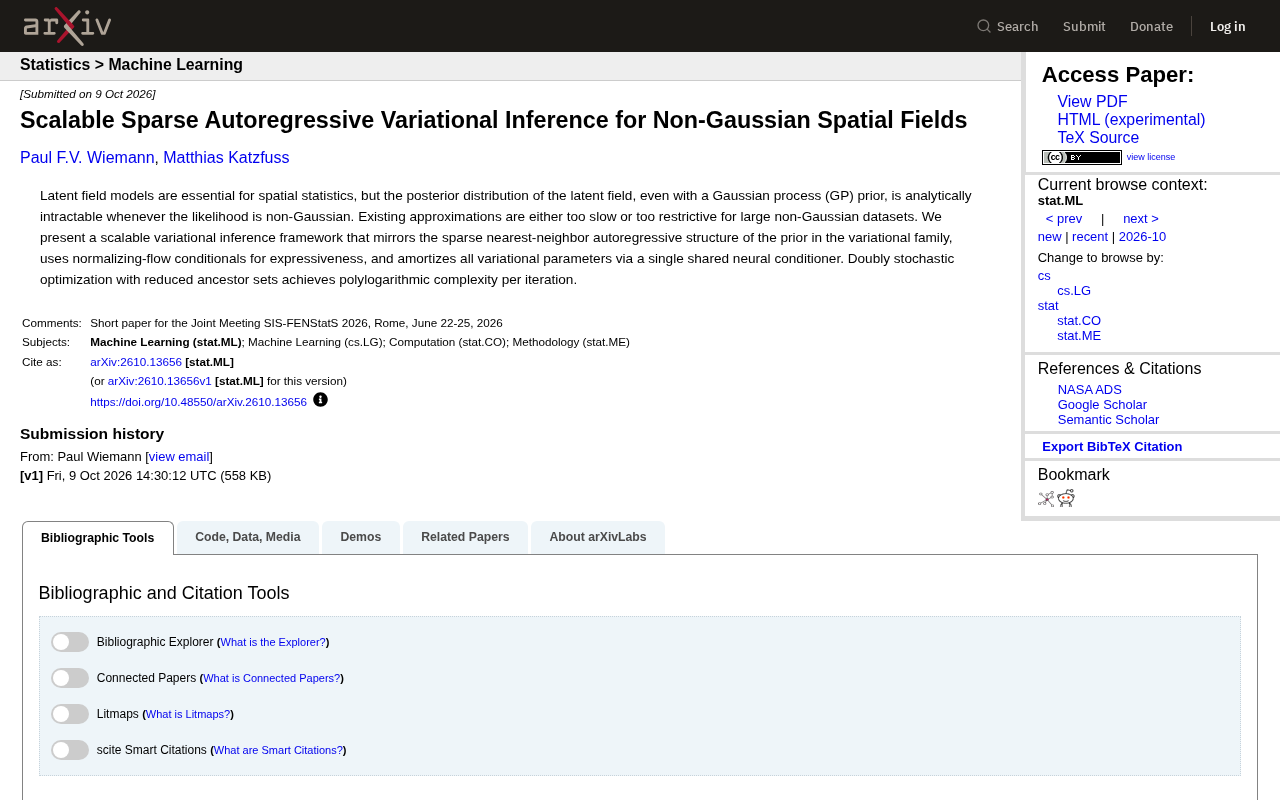
Latent field models are central to spatial statistics, but non-Gaussian likelihoods render posteriors analytically intractable, and existing methods struggle to balance scalability with expressiveness. This work proposes a variational inference framework that addresses this tension through three key designs: a variational family mirroring the NNGP's sparse autoregressive structure; normalizing-flow conditionals that overcome the limits of Gaussian approximations; and a shared neural conditioner that amortizes all variational parameters across spatial locations. Combined with doubly stochastic optimization and reduced ancestor sets, per-iteration complexity drops to polylogarithmic scale, making the framework practically applicable to large-scale non-Gaussian spatial data in remote sensing, environmental monitoring, and disease mapping.
The Core Challenge in Spatial Statistics
Latent field models are a cornerstone of spatial statistics, widely used in geospatial data modeling, environmental monitoring, and epidemiological distribution prediction. Researchers typically place Gaussian Process (GP) priors on latent fields to capture spatial correlations.
The problem arises when the likelihood function is non-Gaussian — for example, with count data, binary data, or heavy-tailed distributions — making the posterior distribution of the latent field analytically intractable. This remains true even when the prior is a Gaussian process. In other words, the more closely a model reflects the complexity of real-world data, the higher the computational cost of inference.
Why Existing Methods Fall Short
When faced with large-scale non-Gaussian datasets, existing approximate inference methods tend to fall into one of two traps: either they are too slow to handle massive spatial observations, or they rely on assumptions that are too rigid to capture complex posterior distributions.
This trade-off between speed and expressiveness has long constrained the real-world applicability of spatial statistical models in big-data settings. What researchers need is an inference framework that maintains scalability without sacrificing modeling flexibility.
Three Technical Pillars of the New Framework
This work proposes a scalable variational inference framework built around three complementary technical components.
Sparse Autoregressive Structure That Mirrors the Prior
The variational family directly mirrors the sparse nearest-neighbor autoregressive structure of the prior. Rather than constructing a variational approximation from scratch, the framework inherits the sparse dependency structure of the spatial prior itself — where each location depends only on a small set of nearest neighbors. This structural alignment dramatically reduces the complexity of the parameter space.
The Nearest Neighbor Gaussian Process (NNGP) provides the theoretical foundation for this sparse structure. In a full Gaussian process over n observations, the joint covariance matrix scales as n×n, making direct computation O(n³) in time and O(n²) in memory — essentially infeasible for large datasets. The key idea behind NNGP is to condition each location only on its m nearest neighbors (where m ≪ n), sparsifying the dense covariance matrix into a banded or tree-like structure. When the variational family directly inherits this autoregressive factorization, its structure aligns perfectly with the prior, preserving the physical meaning of spatial correlations while enabling direct reuse of sparse linear algebra operations — avoiding the structural mismatch that often plagues general-purpose variational families.
Normalizing-Flow Conditionals for Greater Expressiveness
To make the approximate distribution sufficiently flexible, the framework introduces normalizing-flow conditionals. By composing a series of invertible transformations, normalizing flows can capture highly non-Gaussian, nonlinear posterior shapes — compensating for the limited expressiveness of traditional Gaussian approximations.
Normalizing Flows are a class of generative models that construct complex probability distributions by stacking invertible, differentiable transformations. The basic principle is to start from a simple base distribution (typically standard normal) and apply a series of parameterized bijective transformations, "flowing" probability mass into the shape of the target distribution. Because each transformation is invertible, the density can be computed exactly via the Jacobian determinant, supporting both sampling and likelihood evaluation. In variational inference, normalizing flows enhance the flexibility of the variational distribution: traditional mean-field approximations assume a Gaussian posterior, severely underestimating multimodality and nonlinear correlations, whereas normalizing-flow conditionals can theoretically approximate arbitrarily complex shapes. Common flow architectures include Real-NVP, Neural Autoregressive Flows (NAF), and Continuous Normalizing Flows (CNF), each with different trade-offs between computational efficiency and expressiveness.
Neural Conditioner for Amortized Parameterization
All variational parameters are amortized through a shared neural conditioner. Rather than optimizing parameters independently for each data point, amortized inference uses a single neural network to generate parameters across all locations — reducing total parameter count and improving generalization across spatial positions.
Amortized Inference originates from the Variational Autoencoder (VAE) paradigm: instead of maintaining and individually optimizing a separate set of variational parameters for each data point, a shared inference network is trained to take observations as input and directly output the corresponding variational parameters. This approach offers two key advantages: first, the parameter count drops from O(n) to the fixed size of the network itself, which is especially important for large-scale datasets; second, the inference network learns a mapping from data to posterior parameters and can generalize to new observations in a single forward pass, without re-running an optimization loop. In the spatial statistics setting, the neural conditioner can also naturally encode geometric information — such as location coordinates and neighborhood structure — into the parameter generation process, allowing variational parameters to adapt to local spatial characteristics rather than treating all locations uniformly.
Doubly Stochastic Optimization and Computational Complexity
On the optimization side, the framework employs doubly stochastic optimization combined with a reduced ancestor sets strategy.
The key outcome of this combination is that per-iteration computational complexity is reduced to polylogarithmic complexity. For datasets with hundreds of thousands or even millions of spatial observations, this complexity level makes inference genuinely feasible in practice — not just theoretically possible.
In Doubly Stochastic Optimization, the "doubly" refers to two levels of randomization: the first is mini-batch stochastic sampling over data (stochastic gradient), and the second is Monte Carlo estimation of variational expectations (stochastic ELBO gradient). Together, they ensure that each gradient update requires neither a full pass over the data nor analytically intractable expectation integrals. The reduced ancestor sets strategy specifically targets autoregressive graphical models: in a complete directed acyclic graph (DAG), computing the log-joint density gradient for a given node theoretically requires tracing back through all its ancestor nodes, with complexity growing linearly with chain depth. By truncating to a finite-depth ancestor set, the graph traversal cost per gradient computation is compressed to polylogarithmic scale, while the resulting bias is generally manageable in practice. Together, these two techniques make training feasible at the scale of millions of spatial points.
Significance and Application Prospects
By integrating sparse autoregressive structure, normalizing flows, and amortized neural networks, this work achieves a better balance between scalability and expressiveness. For domains that need to process large-scale non-Gaussian spatial data — such as remote sensing imagery analysis, air quality modeling, and disease mapping — this framework offers an inference pathway that combines accuracy with efficiency.
From a methodological perspective, it also reflects a broader trend in probabilistic machine learning: augmenting classical variational inference with neural networks while retaining the structural priors of graphical models, so that statistical models remain interpretable while gaining the flexibility characteristic of deep learning.
Related articles

Random Pruning of the DPO Computation Graph: 1.4x Training Speedup and Lower Peak Memory
DPO training too slow and memory-hungry? This paper proposes a random pruning framework for the DPO computation graph, sampling independently across position, sequence, and branch dimensions; branch pruning achieves a 1.426x step-time speedup and cuts training time by about 30%, with in-depth attribution of memory and time gains.

Why Does JEPA Underperform MLM in Longitudinal EHR Representation Learning?
New study compares JEPA and MLM for longitudinal EHR representation learning on MIMIC-IV: three JEPA variants train stably without collapse but underperform MLM; target size, not heterogeneity, drives prediction error.

Transfer Learning + Visible Light Communication: A New Approach to Energy-Efficient Indoor Positioning
A study proposes a transfer learning-based visible light communication indoor positioning method, achieving 47% accuracy improvement on the BOSCH factory dataset, 67.5% model efficiency under high noise, and introducing the ME composite metric for energy-efficient positioning in energy-constrained industrial IoT scenarios.