Scimplify Raises $25M to Break China's Grip on Critical Materials Supply Chains with AI

Indian B2B platform Scimplify raises $25M to integrate specialty chemicals supply chains with AI and challenge China's dominance.
Indian B2B specialty chemicals platform Scimplify has closed a $25 million funding round, with its annualized revenue run rate tripling to $200 million, and plans to enter the U.S. market. The company connects fragmented small and medium-sized chemical manufacturers worldwide with buyers through an AI platform, addressing pain points in specialty chemicals procurement such as information asymmetry, complex specifications, and long certification cycles. The article notes that the specialty chemicals supply chain has long been dominated by China, and geopolitical friction is pushing the West to seek alternatives, but alternative capacity is fragmented and lacks international certification capabilities. Scimplify's positioning is not to directly replace Chinese manufacturing, but to integrate dispersed capacity outside China, enabling it to serve global customers. This case reflects the trend of AI shifting from consumer internet to the deep waters of industrial supply chains, where the competitive barrier lies in the thickness of industry data rather than algorithms themselves.
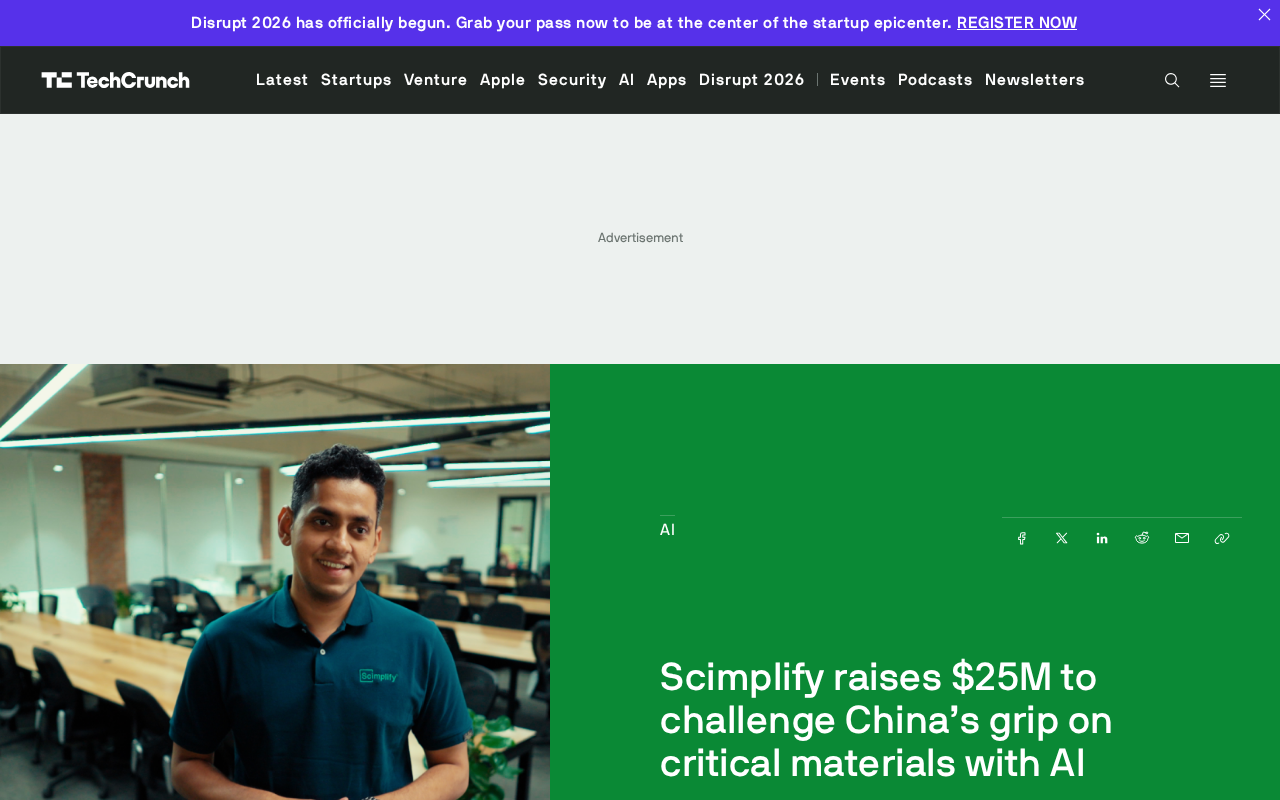
Indian B2B specialty chemicals platform Scimplify has announced the close of a $25 million funding round, with its annualized revenue run rate having tripled to $200 million. The company plans to use the capital to enter the U.S. market. At its core, the story is about using AI to rebuild a sector long dominated by China — the global supply chain for critical materials and specialty chemicals.
The "Invisible War" Over Critical Materials
Specialty chemicals and critical materials underpin modern industry — from electronic-grade reagents used in semiconductor manufacturing and precursors for battery cathode materials, to pharmaceutical intermediates and agrochemical feedstocks. The global landscape here faces an unavoidable fact: China holds a complete capacity advantage across many categories, spanning raw materials, intermediates, and finished products, and there is no short-term substitute for this advantage.
The rare earth export control standoff is only the tip of the iceberg. The broader specialty chemicals supply chain is similarly concentrated, meaning any geopolitical friction can translate into raw material supply disruption risks for manufacturers. Western governments and industries have repeatedly discussed "supply chain de-risking" in recent years, but the real difficulty lies in the fact that this industry is highly fragmented, information asymmetry between supply and demand sides is extreme, and buyers struggle to find alternative suppliers and complete quality verification within a short timeframe.
Scimplify is targeting precisely this gap.
Annualized Revenue Run Rate is a financial metric commonly used by SaaS and platform companies, calculated by multiplying the most recent month's revenue by 12, or a quarter's revenue by 4, to "annualize" the current revenue level into a comparable scale figure. It reflects a company's revenue volume at its current growth rate, rather than actual total revenue over the past 12 months. For high-growth B2B platforms, this metric can more timely reflect the pace of business expansion, but it can also be amplified by short-term fluctuations, so it needs to be cross-validated with metrics like customer retention rates and fulfillment capabilities when evaluating.
Electronic-grade reagents refer to chemical reagents with purity meeting electronic industry standards, typically requiring metal ion impurity content at the ppb (parts per billion) or even ppt (parts per trillion) level. Every step of semiconductor manufacturing — photolithography, etching, cleaning, doping — relies on different grades of electronic-grade chemicals. The technical barrier for these products lies not in chemical synthesis itself, but in ultra-clean purification and trace analysis capabilities, with global high-end capacity long concentrated in Japan, the U.S., Germany, and China. Battery cathode material precursors are upstream raw materials for ternary lithium battery cathodes (such as NCM, NCA), typically referring to compounds like nickel-cobalt-manganese hydroxide. Their particle size distribution, tap density, and impurity control directly determine the final battery's energy density and cycle life, making them one of the highest-value segments in the new energy industry chain.
How AI Is Reconstructing the Chemicals Supply Chain
Scimplify's business model can be understood as a "digital matchmaking and fulfillment platform for specialty chemicals." It connects fragmented small and medium-sized chemical manufacturers worldwide on one end with brands and industrial enterprises that have procurement needs on the other, using AI in the middle to complete matching, quality assessment, and supply chain management.
The key to this model is that procurement decisions for specialty chemicals are far more complex than for ordinary goods. The same chemical name corresponds to different purity grades, different particle size distributions, and different impurity limits, while different downstream applications have vastly different specification requirements. Under the traditional model, this relies on the experience and connections of senior procurement personnel, which is inefficient and difficult to scale. AI's value lies in structuring this tacit knowledge to rapidly complete supply-demand matching and compliance screening.
The annualized revenue run rate growing from under $70 million to $200 million indicates that this model has already achieved an initial commercial闭环 (closed loop). For B2B platforms, revenue growth rate better demonstrates fulfillment capability and customer stickiness than user numbers — once supplier certification is completed for chemical procurement, switching costs are extremely high, and repeat purchases are almost predictable.
Why Bet on "De-Sinicization" Supply Chains Now
Scimplify's choice of this timing to raise funds and enter the U.S. market has a logic worth unpacking.
The U.S. Inflation Reduction Act and CHIPS and Science Act are both pushing for localization or friend-shoring of critical materials, but policy drivers can only create demand — the substitution capability on the supply side is the bottleneck. India, as a popular destination for the "China+1" strategy, has a certain manufacturing base in fine chemicals, but its enterprises are generally small in scale with insufficient international certifications, creating exactly the need for a platform like Scimplify to connect with global buyers.
In other words, Scimplify's positioning is not to replace China's production capacity, but to integrate fragmented capacity outside China, enabling it to serve global customers. This positioning sidesteps the short-term unsolvable question of "who can replace Chinese manufacturing" and instead addresses the more pragmatic question of "how to make alternative options viable."
The risks are equally obvious. Quality certification cycles for specialty chemicals are long, and the quality risks the platform must bear are far higher than those of ordinary goods trading platforms. The $200 million revenue scale still represents a small share of the specialty chemicals distribution market, and it will take time to truly shake up the existing landscape. The capacity ramp-up speed and environmental compliance levels of Indian chemical enterprises also determine the upper limit of supply quality the platform can integrate.
The Inflation Reduction Act (IRA) is a climate and industrial bill passed by the U.S. in 2022, which sets domestic sourcing requirements for critical minerals and battery components for electric vehicle subsidies, pushing companies to shift supply chains to the U.S. or its free trade partners. The CHIPS and Science Act allocates tens of billions of dollars to support domestic U.S. semiconductor manufacturing and R&D, with provisions restricting subsidized companies from expanding production in China. Together, they form the core tools of U.S. "friend-shoring" policy, essentially using fiscal subsidies to guide critical materials supply chains away from China toward "China+1" destinations like India and Southeast Asia. But policy can only create demand signals — building, certifying, and stabilizing supply from alternative capacity typically takes years, which is the structural reason why integration platforms like Scimplify are viewed favorably.
The Bigger Trend Behind the Funding
Scimplify's funding is part of a larger narrative: AI is shifting from the consumer internet's traffic business to the deep waters of industrial supply chains. Unlike C-end AI applications, supply chain-side AI products don't pursue exponential user growth, but rather prove their value through cost reduction and efficiency gains on each transaction.
The core challenge for startups in this direction is not technology, but the speed of accumulating industry know-how. AI models can be built quickly, but infrastructure like chemical specification databases, supplier qualification files, and quality testing standards requires substantial offline work. Scimplify's ability to achieve triple revenue growth in a short time indicates the team has clear advantages in industry resources and execution efficiency.
For entrepreneurs and investors focused on AI application deployment, this case provides a sample worth tracking: when AI moves from "general capability" to "vertical industry infrastructure," the real competitive barrier is not in algorithms, but in the thickness of industry data and the depth of supply chain relationships.
Industry know-how in the specialty chemicals field specifically manifests as: understanding of thousands of chemical specification systems, familiarity with regulatory certification processes across countries (such as REACH, FDA, ISO), judgment of suppliers' actual production capacity and quality stability, and grasp of formulation needs across different downstream application scenarios. This knowledge is highly dispersed among individual senior practitioners, difficult to obtain through public data, and difficult for general AI models to learn directly. The value of AI platforms lies precisely in gradually making this tacit knowledge explicit and structured, forming proprietary data assets. This is also why the competitive barrier in this track is not at the algorithm level — algorithms can be copied, but supplier files, quality testing records, and customer trust relationships accumulated over years cannot.
One-line Summary
Indian B2B platform Scimplify raises $25M to integrate specialty chemicals supply chains with AI and challenge China's dominance.
Paragraph Summary
Indian B2B specialty chemicals platform Scimplify has closed a $25 million funding round, with its annualized revenue run rate tripling to $200 million, and plans to enter the U.S. market. The company connects fragmented small and medium-sized chemical manufacturers worldwide with buyers through an AI platform, addressing pain points in specialty chemicals procurement such as information asymmetry, complex specifications, and long certification cycles. The article notes that the specialty chemicals supply chain has long been dominated by China, and geopolitical friction is pushing the West to seek alternatives, but alternative capacity is fragmented and lacks international certification capabilities. Scimplify's positioning is not to directly replace Chinese manufacturing, but to integrate dispersed capacity outside China, enabling it to serve global customers. This case reflects the trend of AI shifting from consumer internet to the deep waters of industrial supply chains, where the competitive barrier lies in the thickness of industry data rather than algorithms themselves.
Related articles

Amphibious Transforming Drone: Beyond 100x Power Savings, What Are the Real Needs?
Is the amphibious transforming drone just a gimmick? Starting from the 100x power difference of the M4 Morphobot, explore real application scenarios and thesis topic ideas, analyzing boundary conditions where pure drones and pure ground robots both fail.

Warhound Raises $200 Million: Genetically Engineered "War Dogs" Paired with Anduril Gear
Warhound raises $200M, backed by Ben Lamm and Palmer Luckey, to genetically engineer dogs for military and law enforcement use and equip them with Anduril gear. This article analyzes its technology direction, funding logic, and ethical controversy.

Claude API Comes to Google Cloud: IAM Integration and SDK Access Guide
Anthropic hosts the full Claude API on Google Cloud with IAM-controlled permissions and unified billing. This guide covers the Vertex AI and Anthropic-hosted entry points, IAM role configuration, and SDK access.