SciResearch-Eval: The First Scientific Judgment Benchmark — How AI Experimental Agents Calibrate

A new benchmark uses a defective simulator to test whether AI agents "know what they don't know"; most models are overconfident.
SciResearch-Eval is an interactive benchmark that turns the classic problem of heating a material and fitting a thermal conduction simulator to measure thermophysical parameters into a test of AI agents' scientific judgment. Agents must autonomously design experiments, use a potentially physically defective simulator, and provide 95% confidence intervals. Across 93 tasks, 9 models, and 2,511 turns, models were robust procedurally, but when the simulator lacked key physics, most gave wrong values while claiming 95% confidence, with interval coverage of only 20%–62%, versus Astra's 94% and Fable's 99%. Astra and Fable bypassed defects via experimental design such as mild heating, staying calibrated without explicit diagnosis. Strategy statements boosted scores 1.6–2.5 times but barely changed coverage; higher reasoning effort improved Opus more than tenfold at 13–31 times the compute cost.
Why Scientific Judgment Needs Evaluation
When AI agents begin designing experiments, operating instruments, and analyzing data, "getting the pipeline to run" is no longer enough. True scientific judgment shows in whether the agent knows where its knowledge boundaries lie. SciResearch-Eval is an interactive benchmark built for exactly this purpose, turning a classic laboratory problem—heating a material and fitting a thermal conduction simulator to measure thermophysical parameters—into a touchstone for testing an agent's "scientific taste."
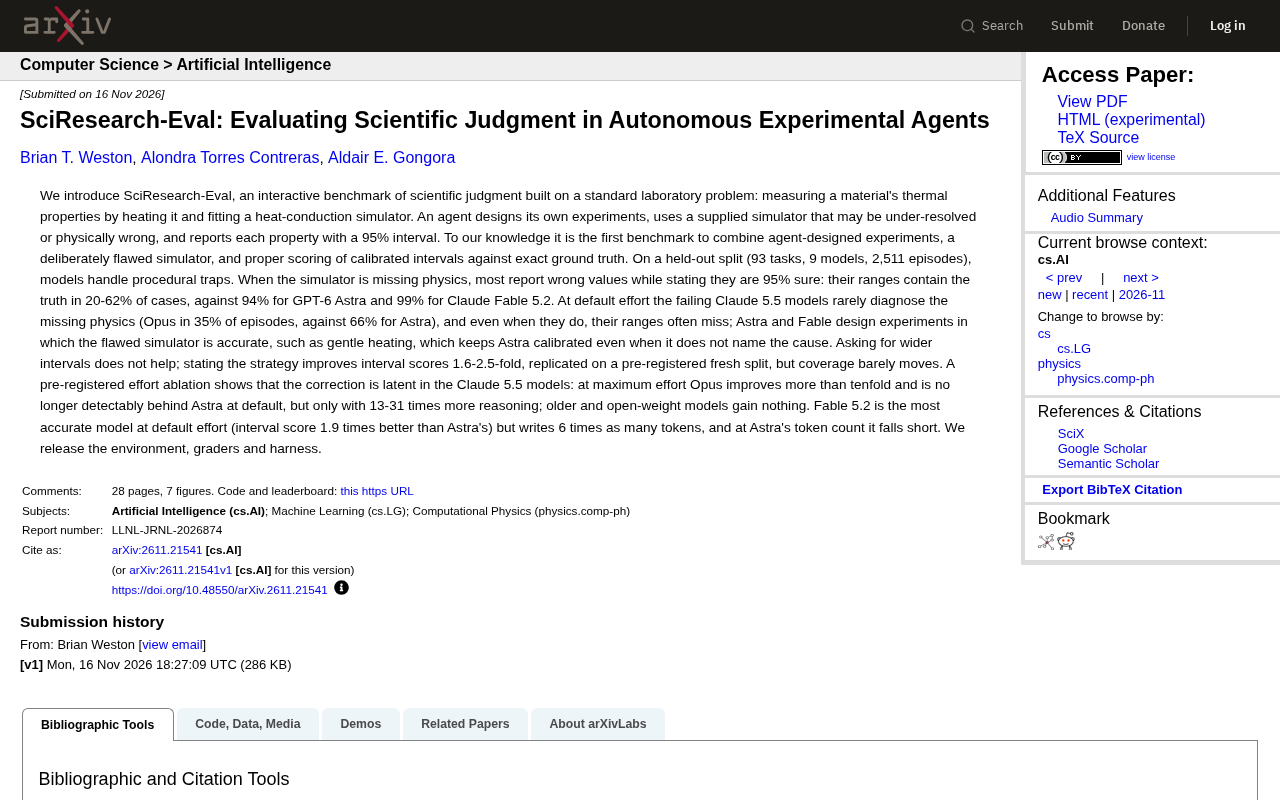
Unlike conventional benchmarks, agents here must plan experimental steps themselves, use a simulator that may have insufficient resolution or physical defects, and provide a 95% confidence interval for each property. According to the authors, this is the first benchmark to combine "agent-driven autonomous experiment design," "a simulator with deliberately planted defects," and "scoring of calibrated intervals against precise ground truth."
Benchmark Design: When the Simulator Lies
The brilliance of this benchmark lies in the fact that its "traps" are not procedural errors but missing physics. Across 93 held-out tasks, 9 models, and 2,511 total turns, models performed robustly on procedural operations. But once the simulator lacked a key physical term, the problem surfaced: most models gave wrong values while simultaneously claiming 95% confidence.
Specifically, these models' 95% intervals covered the true value only 20% to 62% of the time. By contrast, GPT-6 Astra reached 94% interval coverage, and Claude Fable 5.2 reached 99%. This confident "calibration failure" is fatal in scientific settings—an experimenter who doesn't know where they went wrong is more dangerous than one who refuses to experiment.
Calibration of 95% confidence intervals is the key to understanding this benchmark's scoring logic. In statistics, a 95% confidence interval is said to be "well calibrated" if, over many repeated experiments, it covers the true parameter value 95% of the time. Calibration and "precision" are a pair of metrics that must be traded off: making the interval extremely wide (say, claiming thermal conductivity lies between 0 and 1000) will almost always cover the truth, but such an interval carries no scientific information; conversely, a narrow interval is precise but frequently misses the truth. SciResearch-Eval scores intervals against "precise ground truth" precisely to penalize both failure modes at once—it requires intervals narrow enough to be practically useful while also requiring coverage close to the nominal level. The models' prevailing 20%–62% coverage means they systematically underestimate their own uncertainty, which is statistically termed "overconfidence."
The Divide in Diagnostic Ability
Even with a physically defective simulator, diagnostic ability varies markedly across models. At default reasoning effort, the underperforming Claude 5.5 series models rarely identified the missing physical term: Opus detected it in 35% of turns, while Astra's figure was 66%.
More subtly, even when models detected the anomaly, their intervals often missed the true value. Astra and Fable took a different path: they designed experimental conditions under which the defective simulator remains valid—for example, using mild heating rather than intense heating—so that the defect was "bypassed" through experimental design. This explains why Astra maintained good calibration even without being able to articulate the reason. This strategy of "using experimental design to circumvent model error" is precisely how seasoned experimental physicists think.
The Limits of Prompts and Strategies
Intuitively, since intervals are too narrow and coverage is insufficient, simply asking the model to "give wider intervals" should solve the problem. But experiments showed this barely helps.
In contrast, having models state their strategy (for example, asking them to first explain why they chose a particular experimental condition) boosted interval scores by 1.6 to 2.5 times. This result was reproduced on a pre-registered, entirely new data split. However, although strategy statements improved scores, interval coverage barely budged—indicating that models merely became better at the numerical level without genuinely fixing their understanding of uncertainty.
Why "stating strategy" improves scores but doesn't fix coverage can be understood through the distinction between "procedural knowledge" and "metacognitive calibration." Asking a model to first explain the rationale for its choice of experimental conditions amounts to giving it an explicit reasoning scaffold, prompting it to organize experimental design and numerical estimation more systematically, so interval scores (a composite metric weighing precision and coverage) improve markedly. But coverage reflects the strength of the model's belief about "where it might be wrong," which is an uncertainty representation at the metacognitive level, often already entrenched within the model and hard to change through prompting alone. In other words, the model learned to "compute the answer more accurately" but not to "report the boundaries of uncertainty more honestly." This also suggests that genuine calibration ability may need to be acquired through training objectives (such as an explicit calibration loss) rather than inference-time prompting.
Reasoning Effort: Potential and Cost
A pre-registered reasoning-effort ablation experiment revealed a key fact: the Claude 5.5 series models actually have "latent" correction ability. At the highest reasoning effort, Opus's performance improved more than tenfold, and at default effort it already shows no detectable gap with Astra—but at the cost of 13 to 31 times the inference compute. Earlier models and open-weight models could not benefit from increased reasoning.
That said, Fable 5.2 is the most accurate model at default effort, with an interval score 1.9 times better than Astra's, but it consumes 6 times Astra's token count. If Fable's token usage were constrained to Astra's level, its performance would actually fall behind. This shows a real trade-off between accuracy and computational efficiency; benchmark scores cannot be interpreted divorced from cost.
Reasoning-effort ablation refers to varying the "test-time compute" on the same model—for example, allowing it to generate longer chains of thought or engage in more rounds of internal reflection—to observe how performance changes with the compute budget. The value of such experiments lies in distinguishing two possibilities: whether the model is "incapable" (no amount of extra compute will make it right) or "underutilized" (given enough compute, it can correct itself). Opus's more-than-tenfold improvement at the highest effort shows that its correction ability is indeed "latent" within the model, just not invoked under the default budget. But the 13-to-31-fold compute cost makes such improvement not necessarily economically viable in real experimental settings. The fact that earlier models and open-weight models cannot benefit from increased reasoning suggests that this "trading compute for calibration" ability may be a characteristic that only newer models acquired during training.
Implications for Autonomous Experimental Agents
SciResearch-Eval sends a clear signal: evaluating autonomous experimental agents cannot rely solely on final numerical error; it must also examine whether their expression of uncertainty is trustworthy. A model with only 20% coverage within its 95% confidence intervals is, in essence, systematically misleading its users.
The research team has released the environment, scorer, and runtime framework, providing a reproducible testbed for future research. For teams building scientific agents, this benchmark points to three actionable directions: introduce calibration objectives in training rather than optimizing only point estimates; encourage models to actively circumvent known model defects through experimental design; and weigh inference budget against calibration quality at deployment.
The core of scientific judgment may be precisely the ability to "know what you don't know." And that is exactly what most current models have yet to learn.
Pre-registration is an important methodological arrangement in this study for ensuring the credibility of conclusions. It means publicly locking down the research hypotheses, experimental design, and analysis plan before analyzing the data, thereby avoiding the post-hoc selection bias of "picking hypotheses after seeing the results." The article mentions that the gain from strategy statements was "reproduced on a pre-registered, entirely new data split," and that the reasoning-effort experiment was a "pre-registered ablation experiment"—both emphasizing that these findings are not the result of repeatedly tuning parameters on existing data until something happened to work, but robust conclusions that withstand independent verification. For benchmark research, pre-registration is especially important, because benchmark designers and model developers often have overlapping information, and a lack of pre-registration can easily lead a benchmark to inadvertently "cater" to certain models.
One-line Summary
A new benchmark uses a defective simulator to test whether AI agents "know what they don't know"; most models are overconfident.
Paragraph Summary
SciResearch-Eval is an interactive benchmark that turns the classic experimental problem—"heating a material and fitting a thermal conduction simulator to measure thermophysical parameters"—into a touchstone for testing AI agents' scientific judgment. Agents must autonomously design experiments, use a defective simulator that may lack physical terms, and provide 95% confidence intervals. Across 93 tasks, 9 models, and 2,511 turns, models were robust on procedural operations, but once the simulator lacked a key physical term, most models gave wrong values while claiming 95% confidence, with interval coverage of only 20%–62%, far below Astra's 94% and Fable's 99%. Astra and Fable bypassed the defects by designing experimental conditions such as mild heating, maintaining calibration even without explicit diagnosis. Asking models to state their strategy improved scores by 1.6–2.5 times but left coverage essentially unchanged; increasing reasoning effort let Opus improve more than tenfold, at the cost of 13–31 times the compute.
Related articles

Gemini 4 Helium Coming Soon? Signals of Google Loosening Subscription Restrictions
Google team member hints releases will continue; community speculates Gemini 4 Helium (Flash Lite) may be next. Subscription ban controversy gets a response as product lead says "Soon," suggesting restrictions may be lifted. This article covers Gemini developments, OpenAI Coding Agent and risk management, Doubao real-time audio-video API, and compute business dynamics.

AI-Assisted React Development in Practice: Optimizing a Video App and Handling Errors
A 14-year veteran developer demonstrates AI-assisted React video app optimization: compressing video from 80MB to 5MB (~94%) via ImageKit, plus reliable error handling and retry mechanisms. Includes planning, code understanding, and verification methods for working with AI.

Incident Response in the Age of AI Attackers: A 6-Month Retrospective and the Four Pillars
AI attackers are making attacks on AI infrastructure more frequent. This article explains MarkTechPost's four-pillar incident response playbook based on a 6-month retrospective, with Fireworks AI and Klue case studies on implementation.