Scribd Data Breach: Partial Payment Information Exposed, Users Warned to Watch for Phishing Attacks

Scribd confirms data breach exposing user emails and partial payment data, warns of phishing.
Scribd, Inc. confirmed a security incident potentially exposing user data from Scribd, Slideshare, Everand, and Fable. Notification emails indicate attackers may have accessed email addresses, last four credit card digits, issuers, expiration dates, and payment history—but not full card numbers or CVVs. Scribd secured affected systems, notified law enforcement and data protection authorities, and engaged third-party cybersecurity experts. The company warned users about phishing attacks impersonating Scribd and its brands, stressing it will never request passwords via email or SMS. The notification was sent by third party Epiq, without disclosing the number of affected users, discovery timeline, or attack vector, sparking community discussion on transparency and multi-brand data centralization risks.
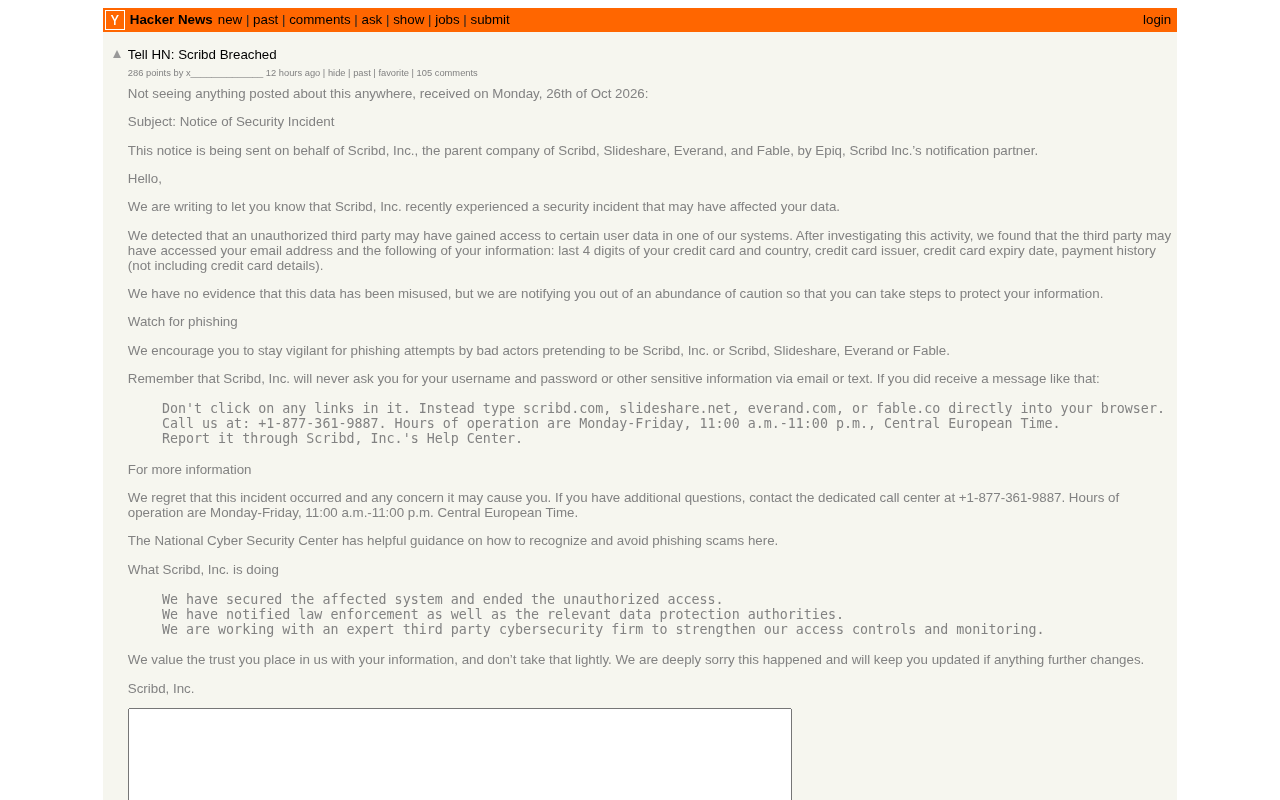
Scribd, Inc. recently confirmed a security incident in which user data from its Scribd, Slideshare, Everand, and Fable brands may have been accessed by an unauthorized third party. According to a user post on Hacker News (titled "Tell HN: Scribd Breached," which received 278 points and 103 comments), users received a security incident notification email on October 26, 2026, sent by Scribd's notification partner Epiq.
What Was Leaked: Partial Exposure of Payment Information
According to the notification email, attackers may have accessed users' email addresses along with the following information: the last four digits of credit card numbers and country/region, credit card issuers, credit card expiration dates, and payment history (excluding full credit card details). Scribd emphasized that there is currently no evidence that this data has been misused, but it is notifying users as a precaution.
One detail worth noting: although the leaked scope includes payment-related fields, full card numbers and CVVs were not mentioned, meaning the risk of direct card fraud is relatively contained. However, the combination of the last four digits, issuing bank, and expiration date could still be used in social engineering attacks.
Credit card last four digits, issuing institutions, and expiration dates are often regarded as "low-sensitivity" payment data, but they have real value in social engineering attack chains. Scammers can use issuing bank information to infer a user's region and bank type, combine it with the expiration date to forge phishing emails claiming "your card is about to expire, please update your payment method," and the last four digits are often used as the first hurdle in customer service identity verification. The U.S. Federal Trade Commission and security guidelines from multiple banks recommend that cardholders never disclose the last four digits of their card number to any unsolicited call or email, even if the other party already possesses partial information. In addition, payment history itself may expose a user's subscription habits and spending capacity, providing context for targeted fraud.
Scribd's Response Measures
In its notification, Scribd listed three actions already taken: it has secured the affected systems and terminated unauthorized access; it has notified law enforcement and relevant data protection authorities; and it is working with third-party cybersecurity experts to strengthen access controls and monitoring.
The company said it deeply regrets the incident and promised to provide timely updates if there are further developments.
Primary Risk for Users: Phishing Attacks
The core warning in the notification email is to guard against phishing attacks. Attackers may impersonate Scribd, Inc. or its brands (Scribd, Slideshare, Everand, Fable) to send fraudulent messages. Scribd explicitly stated that the company will never request usernames, passwords, or other sensitive information via email or text message.
If users receive such messages, they should: not click any links within them, but instead type scribd.com, slideshare.net, everand.com, or fable.co directly into their browser; report through the official help center; or call the dedicated call center number provided in the notification at +1-877-361-9887 (available Monday through Friday, 11:00 to 23:00 Central European Time).
Comparison with Industry Practice and Community Reaction
This incident's use of Epiq for notifications aligns with common practice under U.S. state data breach notification laws—many companies engage third-party notification service providers to handle bulk mailings. However, the notification did not disclose the specific number of affected users, the timeline of incident discovery, or the attack vector; the absence of this information may raise user concerns about transparency.
In the Hacker News discussion, some users pointed out that multiple Scribd brands share the same notification channel, suggesting potential centralized data infrastructure risks. Other comments reminded that even a leak of just the last four credit card digits, combined with email addresses, could become material for targeted phishing.
Epiq is a third-party organization that provides bulk notification services for legal and compliance scenarios, commonly seen in data breach class action settlements, bankruptcy notices, and regulatory-required user notification processes. U.S. state data breach notification laws (such as California Civil Code Section 1798.82) generally require companies to notify affected residents "in a timely manner" after discovering an incident, but do not set a uniform specific deadline. In practice, companies often engage service providers like Epiq to handle postal and email notifications to reduce operational costs and maintain delivery records. However, third-party sending can also make it easier for users to misjudge the authenticity of emails, increasing the risk of confusion with phishing emails. Therefore, notifications typically include a dedicated call center number or unique reference number for users to verify.
What Users Should Do
For users who receive the notification, the following steps are recommended: check credit card statements for unusual transactions; be vigilant about any emails claiming to be from Scribd, especially those asking users to click links or provide information; consider enabling two-factor authentication on accounts; and pay attention to phishing prevention guidelines published by local cybersecurity agencies.
In its notification, Scribd cited recommendations from the National Cyber Security Centre to help users identify and avoid phishing scams. Although the payment information leaked in this incident is limited, security awareness remains the first line of defense.
Takeaways from the Incident
This incident once again reminds subscription-based content platforms: centrally managing data across multiple brands means the impact of a single point of failure is broader. Scribd's four brands share a user system, so if any one system is compromised, users across brands may be affected. For users, regularly reviewing account security settings and maintaining skepticism toward unsolicited communications are necessary habits for responding to such incidents.
Background Note
Two-factor authentication (2FA) is a method of adding an extra layer of verification beyond a password, commonly including SMS codes, one-time codes generated by authenticator apps, or hardware security keys. For subscription platforms like Scribd, enabling 2FA can significantly reduce the risk of attackers using leaked email addresses and partial payment information for account takeover. Users should also note that even if the platform itself does not mandate 2FA, they should ensure that the primary email account linked to that email address has 2FA enabled, because attackers often start with email to reset passwords for other services. The National Cyber Security Centre (NCSC) recommends prioritizing app-based or hardware-key-based 2FA over relying solely on SMS codes to prevent SIM-swapping attacks.
One-line Summary
Scribd confirms data breach; user emails and partial payment information may have been accessed, and officials warn of phishing.
Related articles

Qwen 3.8 Beats Opus at Coding—But Can Your Mac Run It?
Open-source Qwen 3.8 beats Opus 4.6 at coding at just 18GB, but how much Mac memory do you need? 24GB crashes; 32GB is the sweet spot. Full config guide inside.

Claude Code + Agent: Building a Fully Automated AI Testing Loop
Bilibili course breakdown: how test developers can use Claude Code terminal-based Agents to build a fully automated AI testing loop. Compares permission boundaries of terminal vs. device Agents, explains why enterprise projects choose Claude Code over Open Claude-type tools, and outlines the Node.js environment setup and DeepSeek model integration path.

Working with AI Agents Requires Nerves of Steel
The more autonomous AI agents become, the heavier the user's psychological burden. Drawing from a Hacker News discussion, this article analyzes black-box anxiety, behavior drift, and monitoring fatigue in agent collaboration, and offers practical approaches like sandbox isolation, permission control, and task granularity management to reduce cognitive load.