sdk/shared/v0.0.91 Release Notes Explained

@cline/shared releases v0.0.91 via CI/CD automation with no detailed changelog provided.
The `@cline/shared` module from the Cline AI coding assistant ecosystem has been published at v0.0.91 via an automated GitHub Actions workflow. Since the version remains in the `0.0.x` range, the module's API is still unstable and any version bump may introduce breaking changes. No changelog was included in the release record, so developers need to review commit history directly. Projects depending on this SDK should pin an exact version number and verify compatibility in a test environment before deploying to production.
About This Release
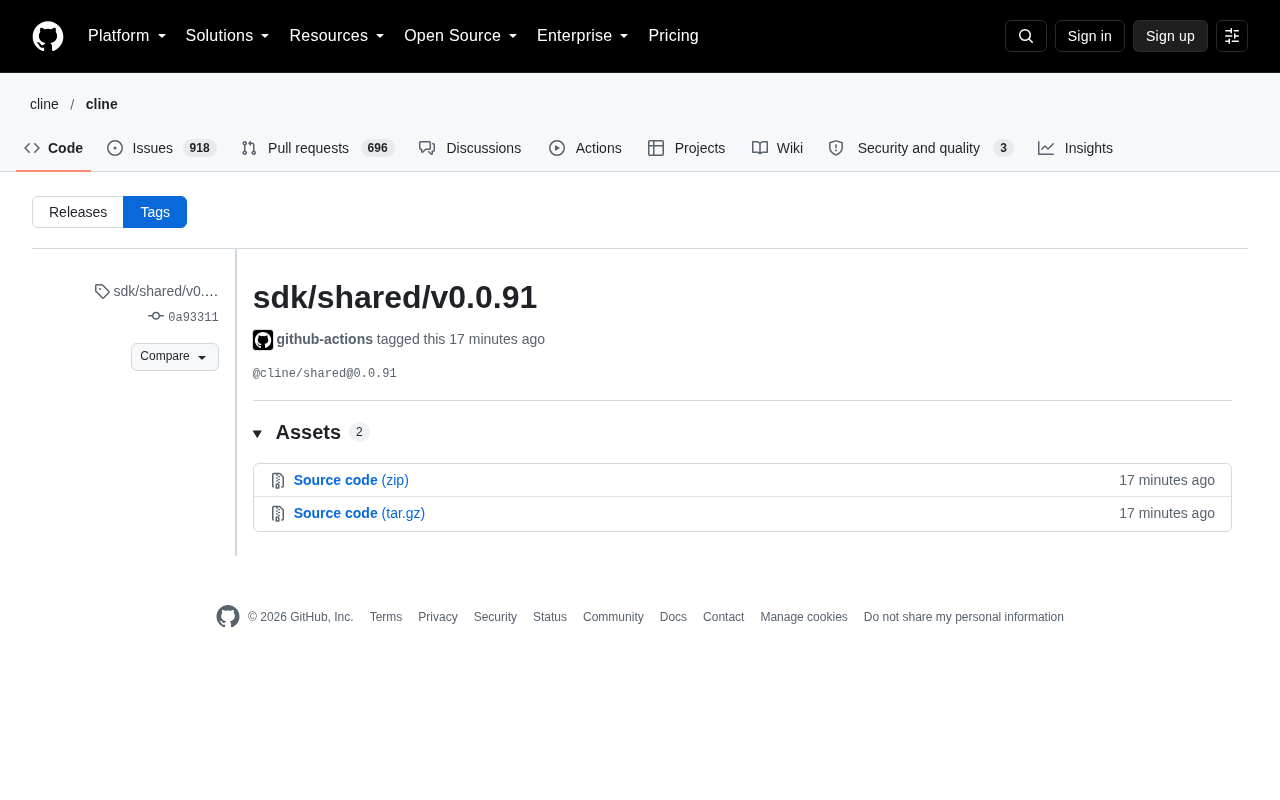
A release record from a code hosting platform shows that the @cline/shared package has been updated to v0.0.91, tagged and published automatically via a GitHub Actions workflow. The corresponding commit hash is 0a93311, with a release date of October 7.
The tag name sdk/shared/v0.0.91 indicates this is a continuous iteration of the SDK's shared module. The version number is still in the 0.0.x range, meaning the module is in early development and its APIs and features may still be subject to frequent changes.
Limited Details Available from the Release
The original release page provides fairly minimal substantive information. What can be confirmed includes:
- The package name is
@cline/shared, a shared dependency module within the Cline project - The version number is
0.0.91 - The release was triggered automatically via CI/CD (GitHub Actions)
- Two build artifacts (Assets) are attached
The page does not include a detailed changelog, so it's not possible to determine from this record alone what was specifically fixed or added compared to the previous version. Developers following the Cline ecosystem who need to understand the specific changes will still need to consult the commit history or the project's full version history.
GitHub Actions is GitHub's built-in CI/CD (Continuous Integration/Continuous Deployment) automation platform, allowing development teams to automatically execute build, test, and release workflows — triggered by events like code pushes or PR merges — through YAML workflow files. The fact that this release was completed by the github-actions account indicates that @cline/shared uses an automated release process, eliminating the need for manual npm publish or GitHub Release creation. This pattern is very common in modern open-source projects, as it ensures consistency between version tags, build artifacts, and source commits while reducing the risk of human error. The 2 attached Assets typically include compressed source archives (.tar.gz and .zip) for use in scenarios where installation via npm is not possible.
What This Means for Developers
Cline is an AI-powered coding assistant ecosystem, and its shared package typically carries utility functions, type definitions, and common logic that are reused across modules. Frequent minor version updates to foundational modules like this often reflect active upstream development.
For projects that depend on this SDK, a 0.0.x version means potential breaking changes need to be watched carefully. Before upgrading to v0.0.91, developers are advised to review the full commit diff, verify API compatibility, and validate in a test environment before applying the update to production dependencies.
It's worth noting that this article is based on a single RSS release record, and the depth of analysis is limited by the source material. For authoritative release change descriptions, the project's official repository Release Notes should be treated as the definitive reference.
Under the Semantic Versioning (SemVer) specification, 0.0.x represents the earliest development stage, with the version format being major.minor.patch. When the major version is 0, it signals that the public API is not yet stable; when the minor version is also 0, it further indicates that even the basic functional boundaries may be redefined at any time. Unlike stable releases at 1.x.x and beyond, any version bump during the 0.0.x phase — even a patch increment — may introduce breaking changes. Therefore, it is not recommended to use loose version range specifiers like ^ (compatible with major) or ~ (compatible with minor) in package.json. Instead, use an exact version number (e.g., "0.0.91") to avoid automatically pulling in incompatible updates.
Related articles

Random Pruning of the DPO Computation Graph: 1.4x Training Speedup and Lower Peak Memory
DPO training too slow and memory-hungry? This paper proposes a random pruning framework for the DPO computation graph, sampling independently across position, sequence, and branch dimensions; branch pruning achieves a 1.426x step-time speedup and cuts training time by about 30%, with in-depth attribution of memory and time gains.

Why Does JEPA Underperform MLM in Longitudinal EHR Representation Learning?
New study compares JEPA and MLM for longitudinal EHR representation learning on MIMIC-IV: three JEPA variants train stably without collapse but underperform MLM; target size, not heterogeneity, drives prediction error.

Transfer Learning + Visible Light Communication: A New Approach to Energy-Efficient Indoor Positioning
A study proposes a transfer learning-based visible light communication indoor positioning method, achieving 47% accuracy improvement on the BOSCH factory dataset, 67.5% model efficiency under high noise, and introducing the ME composite metric for energy-efficient positioning in energy-constrained industrial IoT scenarios.