Seagate FireCuda Forge: How Hybrid Storage Intelligently Allocates Data
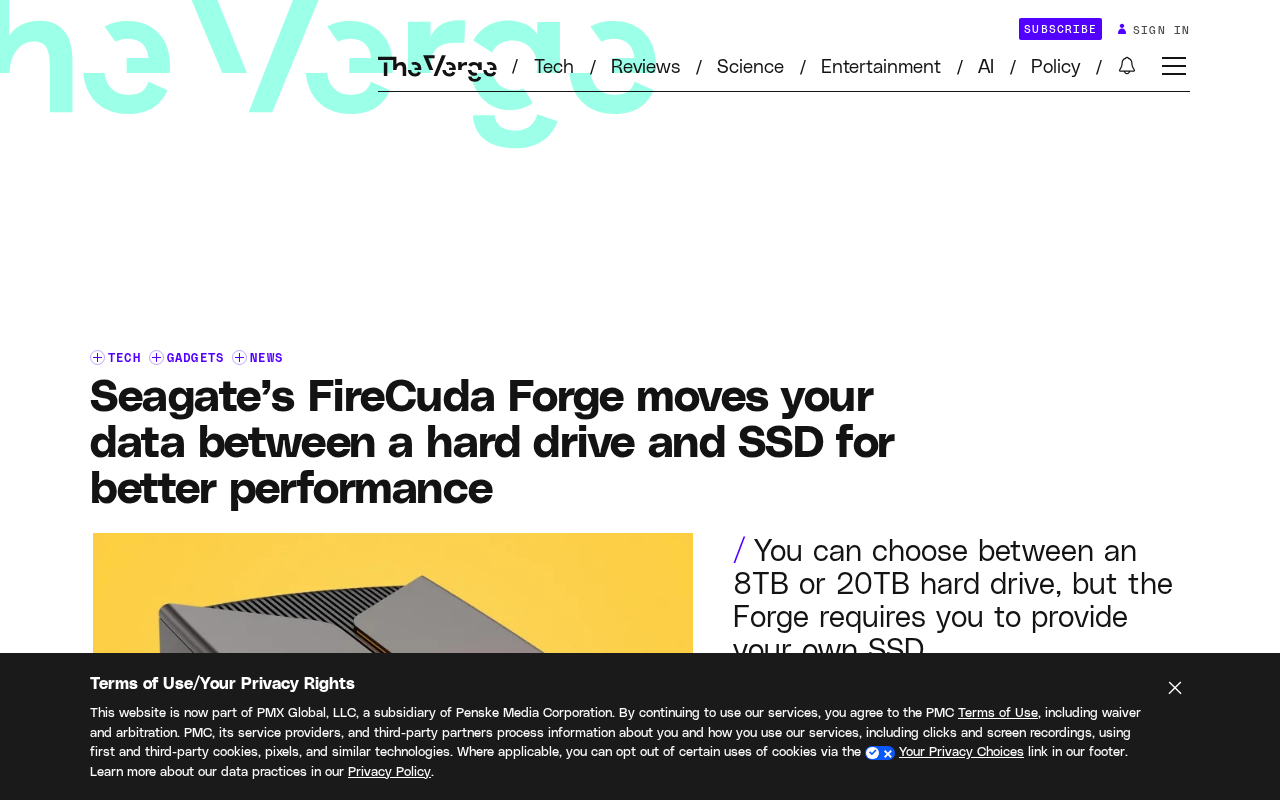
Seagate FireCuda Forge uses Alkemi to auto-migrate data between SSD and HDD, balancing speed and capacity cost.
Seagate has launched the FireCuda Forge external storage device, featuring the Alkemi intelligent storage platform that automatically migrates data between SSD and mechanical hard drive, placing frequently accessed files on SSD and cold data on HDD transparently to the user. This brings enterprise-grade tiered storage to consumer external drives, aiming to deliver an SSD-like hot data experience at close to HDD prices. However, Seagate has not disclosed SSD capacity, migration algorithms, interface specs, or pricing, so the actual speed gain and value remain unclear. Software maturity and data security will be long-term tests, and current information is insufficient to judge its suitability for everyone.
When a Hard Drive Learns to "Think": The Hybrid Logic of FireCuda Forge
Seagate recently launched an external storage device called FireCuda Forge. Its core selling point is neither larger capacity nor faster interfaces, but an intelligent storage platform called Alkemi. This platform enables Forge to automatically migrate data between SSD and mechanical hard drive, attempting to simultaneously address two seemingly contradictory needs: the speed of SSD and the cost-effectiveness of HDD.
According to the official description, Alkemi learns users' data usage habits, moving frequently accessed files to the SSD while keeping cold data on the mechanical hard drive. This process is transparent to users, requiring no manual partitioning or folder dragging. For content creators who need to store large amounts of assets on an external drive while hoping to quickly open commonly used projects, this approach has clear practical value.
Alkemi Platform: Consumer-Level Implementation of Tiered Storage
Tiered storage has long been a mature technology in enterprise data centers, but performing real-time data migration in consumer-grade external hard drives still requires balancing latency, migration strategies, and hardware lifespan. Seagate calls Alkemi an "intelligent storage platform," emphasizing that it "learns" data usage patterns rather than relying on simple fixed rules.
This means Forge is positioned not as a simple hard drive, but as a device with storage management logic. What users see may just be a drive letter, but behind the scenes a layer of software continuously determines which files deserve to occupy SSD space. This design reduces the burden on ordinary users of configuring caches or manually organizing files, but it also raises a key question: whether the migration strategy is smart enough, and how the system decides which files to evict when SSD space fills up.
Seagate did not disclose specific SSD capacity, cache replacement algorithms, or migration trigger conditions in the launch information. These details will directly affect the actual experience—if migration is too aggressive, SSD lifespan and write amplification could become hidden risks; if too conservative, users will barely feel any speed improvement.
Tiered Storage is an architecture that places data on different performance media based on data access frequency. In enterprise scenarios, it is typically divided into hot, warm, and cold tiers, corresponding to high-speed SSD, large-capacity HDD, and even tape libraries, with storage controllers automatically migrating data blocks according to policies. Its core value lies in using a small amount of high-speed media to carry high-frequency access and cheap media to carry massive cold data, thereby achieving a balance between performance and cost. Implementing this mechanism in consumer-grade external drives requires handling more stringent constraints: limited controller computing power, no independent cache layer, and restricted power supply and cooling. Additionally, Write Amplification is a key indicator of SSD lifespan—when the system frequently moves data, the actual write volume can be multiple times higher than the user data volume, accelerating flash wear. Therefore, consumer-grade tiering strategies must carefully weigh migration frequency against SSD lifespan, typically adopting more conservative thresholds and longer observation windows.
Is the Trade-off Between Speed and Capacity Worth It
The selling point of FireCuda Forge can be summarized as "getting an SSD-like hot data experience at close to HDD prices." For gamers, video editors, and users who frequently run large projects on external drives, the loading speed of commonly used files does affect workflow. Putting the operating system, project files, or game assets on the SSD and the asset library on the mechanical drive is a manual approach many people take; Forge attempts to automate this step.
However, the actual bottleneck of external storage is often not just the media itself. Interface protocols, controller performance, and host-side USB bandwidth all affect final speed. Seagate did not disclose Forge's interface specifications and sequential read/write metrics in the announcement, making it difficult to judge whether the SSD portion's speed advantage can be fully realized. If the device is still limited by the USB interface's bandwidth ceiling, then the improvement from the hybrid architecture may be more reflected in small files and random access rather than large-file sequential transfers.
Price is also a key variable. The hybrid solution costs more than pure mechanical hard drives but less than pure SSDs of the same capacity. Seagate has not yet announced Forge's pricing and capacity combinations, making it difficult to assess its price-performance range. If priced close to mid-to-high-end pure SSDs, consumers might simply choose all-flash solutions; if priced close to large-capacity mechanical hard drives, Forge's appeal would be significantly enhanced.
USB bandwidth ceiling is the actual speed ceiling of external storage. Currently, mainstream USB 3.2 Gen 2 has a theoretical bandwidth of 10Gbps (about 1.25GB/s), Gen 2x2 is 20Gbps, and Thunderbolt 3/4 can reach 40Gbps. Even if the internal SSD's sequential read/write exceeds 2GB/s, if the interface only supports 10Gbps, actual transfer is still limited to about 1GB/s. However, random access (small files, databases, project file loading) is less affected by interface bandwidth and depends more on the media's own IOPS and latency. This is precisely the potential advantage of the hybrid architecture: the SSD portion can significantly improve random read/write experience, while large-file sequential transfer improvement is limited by the interface protocol. Therefore, when evaluating Forge's actual value, interface specifications and media performance must be considered together; looking only at SSD capacity or sequential read/write metrics can easily lead to misjudgment.
The Next Step for Intelligent Storage
FireCuda Forge is the first product on the Alkemi platform, and Seagate clearly hopes to make "intelligent tiering" a reusable technology brand rather than just a feature of a single product. From an industry trend perspective, storage devices are evolving from passive containers to active devices with data management capabilities, consistent with the automatic tiering approach common in NAS and cloud storage, just compressed into an external hard drive enclosure.
The real test lies in software maturity. Data migration strategies require long-term use to validate, and users' sensitivity to data security far exceeds their pursuit of speed. Any automatic migration mechanism must ensure file integrity and predictability; otherwise, a single misjudgment could cause users to lose trust in the product. Seagate needs to prove that Alkemi is stable enough over long-term use and will not interfere with normal read/write operations due to background migration.
For consumers interested in external storage, FireCuda Forge is worth watching, but current information is insufficient to determine whether it suits everyone. Once more details about capacity configurations, interface specifications, migration strategies, and pricing are announced, the true value of the hybrid solution will become clear.
One-line Summary
Seagate FireCuda Forge uses the Alkemi platform to automatically migrate data between SSD and HDD, aiming to balance speed and capacity cost.
Paragraph Summary
Seagate has launched the FireCuda Forge external storage device, featuring the Alkemi intelligent storage platform that automatically migrates data between SSD and mechanical hard drive, placing frequently accessed files on SSD and cold data on HDD transparently to the user. This approach brings enterprise-grade tiered storage down to consumer external drives, attempting to provide an SSD-like hot data experience at close to HDD prices. However, Seagate has not disclosed SSD capacity, migration algorithms, interface specifications, or pricing. Actual speed improvements are affected by USB bandwidth and migration strategy, and the price-performance range remains unclear. Software maturity and data security will be long-term challenges, and current information is insufficient to determine whether it suits everyone.
Related articles

VP ≠ VNP: A Major Breakthrough in Computational Complexity Theory
A study claiming to prove VP ≠ VNP over every field sparks heated discussion on Hacker News. This article analyzes the algebraic complexity background of VP and VNP, the proof approach, community controversy, and its potential impact on computational complexity theory.

Developer Naming Woes: The Technical Names That Drive Us Crazy
Why is technical naming so maddening? From Nginx and Vite to Qt and Sudo, a YouTube creator rants about the chaos of developer naming and pronunciation, revealing the tug-of-war between creators' intentions and community habits, and the cultural roots behind spelling traps like PyPI and GNOME.

Figma Workplace Scandal: Employee Sues CEO for Forcing Confrontation with Harasser
Figma and its CEO are sued by a current employee alleging sexual harassment and discrimination, and forcing the victim to confront her harasser. This article outlines the background, potential impact, and industry reflection.