Seedream 5.0 Pro In-Depth Review: A Complete Analysis of Its Chinese-Language Image Generation

Seedream 5.0 Pro review: ByteDance's best image model yet, closing in on GPT Image 2.
Seedream 5.0 Pro from ByteDance marks a major leap in Chinese AI image generation, excelling in Chinese text-image layout, artistic detail, and complex UI design. Tested across five scenarios and benchmarked against GPT Image 2 and Nano Banana Pro, it earns a clear "world number two" ranking — with generation speed and text rendering stability as the remaining gaps to close.
Article
ByteDance's Seedream series has received a major upgrade with the official launch of Seedream 5.0 Pro. Dubbed "the first Chinese image generation model to truly surpass Nano Banana," it marks a significant breakthrough across UI design generation, artistic style rendering, prompt comprehension, character consistency, and Chinese text-image layout. According to first-look tests by Bilibili creators, it has become one of the very few domestic models capable of going head-to-head with GPT Image 2 on its home turf.
This article presents an objective evaluation of Seedream 5.0 Pro's real-world capabilities and limitations across five distinct scenarios using five different prompt structures, with side-by-side comparisons against GPT Image 2 and Nano Banana Pro.
Pricing & Core Specs
On the Volcengine platform, Seedream 5.0 Pro is priced at ¥0.30 per 1,000 images, with a maximum supported resolution of 2K — meaning each 2K image costs roughly ¥0.60. For high-frequency creators, this pricing is on the steep side.
Speed is another factor worth noting. Compared to the 5.0 Lite version, which delivers results in just seconds, the Pro version is noticeably slower — an artistic image can take two and a half minutes, while a complex game UI design may take up to four. Two likely explanations: the model just launched and compute capacity hasn't fully scaled up yet, causing significant queuing; and the model itself has far more parameters, requiring substantially more computation per inference.
Diffusion Model Architecture & the Pro/Lite Capability Gap: Today's leading AI image generation models — including the Seedream series — are built on Diffusion Model architecture. Diffusion models emerged as the dominant paradigm around 2020, with a core mechanism based on two stages: a forward noising process and a reverse denoising process. During training, the model learns to reconstruct clean images from Gaussian noise step by step; during inference, it starts from pure noise and iterates through dozens to hundreds of denoising steps to produce the final output. Compared to earlier GANs (Generative Adversarial Networks), diffusion models offer clear advantages in detail fidelity, stylistic diversity, and training stability. The fundamental difference between Pro and Lite versions lies in larger parameter counts (often in the billions to tens of billions), more refined sampling schedulers (such as DDPM, DDIM, and DPM-Solver), and higher CFG guidance scales — all of which contribute to higher output quality at the cost of longer generation time. This is the standard trade-off in today's Pro-tier models: compute for quality.
Five Scenario Tests: From Art to Commercial Design
Artistic Expression: Four-Season Eye Close-Ups
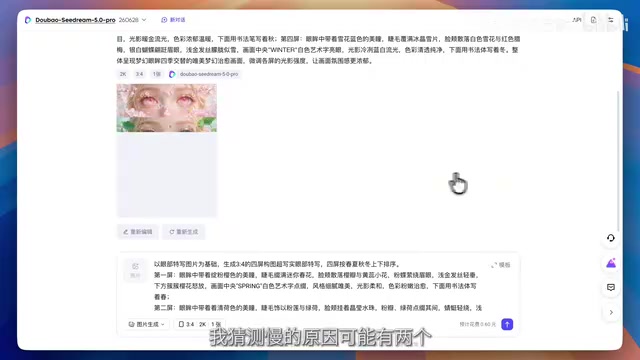
The first test asked the model to generate "four-season eye close-ups — spring, summer, autumn, and winter" — weaving seasonal elements into the irises, lashes, and lighting while maintaining hyper-realistic detail and a unified artistic style. This scenario demands exceptional aesthetic understanding, fine-grained control, and compositional skill.
The results were impressive: maple leaves, butterflies, dragonflies, and lotus flowers were rendered with remarkable artistic finesse, and at 2K resolution, the textures and layering of even the smallest elements were richly detailed. Compared to GPT Image 2 on the same prompt, 5.0 Pro achieves a comparable level of artistic detail — though GPT Image 2 still edges it out in overall composition and visual impact.
Chinese Text-Image Layout: JSON Structured Prompt Test
The second test used a JSON-structured prompt to generate a "handwritten-style notebook." JSON structured prompting is one of the prompt engineering techniques that has gained traction in AI image generation in recent years. Compared to natural language descriptions, JSON format allows multi-dimensional information — layout, colors, text content, element positioning — to be conveyed to the model precisely as key-value pairs, reducing ambiguity. It's especially well-suited for complex, multi-layer scenes like notebook layouts and UI mockups, enabling the model to interpret creative intent the way it would parse structured data.
Historically, most image generation models fall apart badly when faced with Chinese text-image layout. The root causes are well-known: mainstream diffusion models rely on text encoders like CLIP (Contrastive Language-Image Pre-training) or T5, which were primarily trained on Latin-script data. Visually similar Chinese characters (e.g., 己/已/巳) are nearly indistinguishable in the feature space. On top of that, the stroke complexity of Chinese characters — each containing far more pixel-level detail than a Latin letter — places significantly higher demands on the model's spatial attention mechanisms. Chinese typographic rules (line spacing, character spacing, horizontal/vertical layout switching) also constitute a complex visual grammar that requires layout understanding, not just character rendering. This is precisely why 5.0 Pro's performance here is particularly noteworthy: zero text errors, clean and composed notebook layout, consistent style — a core advantage over most international models. This likely reflects ByteDance's targeted investment in Chinese corpus training and character rendering optimization.

Simple Prompt Comprehension & Intelligent Expansion
The third test shifted to the "one-sentence generation" mode most commonly used by everyday users. Leading image generation models typically include a built-in small language model (SLM/LLM) for semantic understanding, expansion, and style inference — a mechanism known as Prompt Expansion. The underlying architecture is a cascaded "large model + small model" pipeline: the user's brief natural language input first enters a lightweight language model (such as a fine-tuned model based on LLaMA, Qwen, or similar), which draws on pre-trained knowledge of art, photography, and design to expand the user's intent into a comprehensive prompt — complete with lens focal length, lighting type, color tone, material description, compositional principles, and more — before passing it to the diffusion model for image generation. For example, a user typing "gongbi painting bookmark" would have the built-in LM automatically add compositional suggestions, color style, traditional patterns, and other professional elements. This mechanism dramatically lowers the barrier for casual users. GPT Image 2, Midjourney v6, and other top-tier products all use similar designs — and it's also a key differentiator between Pro and Lite versions in terms of "intelligence."
The test prompt — "generate a series of gongbi painting bookmark designs" — revealed the model's expansion capabilities clearly. The results went far beyond the input: traditional motifs like plum, orchid, bamboo, and chrysanthemum, along with bird-and-flower and landscape scenes, were paired with material textures, traditional patterns, and tassel craftsmanship details — producing what looked like a complete commercial design package. This means even users who aren't skilled at writing detailed prompts can describe a rough idea and receive near-professional design output.
Professional Scenarios: Character Sheets & Commercial UI Design
Character Three-View Sheet: Visual Consistency Test
The fourth test entered professional territory. 5.0 Pro supports image input, so the test used a costume reference photo of a novel's female protagonist to generate a character design sheet, with a focus on visual consistency and layout comprehension.
Character three-view sheets (front, side, and back views) originate from traditional animation and game art "design sheet" standards and serve as critical input assets for 3D modeling, skeletal rigging, and AI video generation. In conventional production, concept artists draw complete character sheets as a unified reference standard for the entire team. As generative video tools like Sora and Seedream AI Video become more widespread, maintaining cross-frame character visual consistency has emerged as a core challenge in AI animation. Relevant technical approaches include ControlNet, IP-Adapter, FaceID, and others, each with different strengths. An image generation model capable of producing high-consistency three-view sheets from a single reference image is essentially creating a "digital character ID card" for AI animation pipelines — directly embeddable into production workflows to eliminate large amounts of manual touchup. The commercial value of this capability in fast-growing sectors like short video, gaming, and virtual influencers is enormous.
The results showed solid overall completeness, with good consistency in hairstyle, clothing texture, headpiece, and the sword on the character's back across different viewing angles. The one shortcoming was a slight overlap between the large portrait at the bottom and the full-body views above — the layout still has room for improvement. As the tester noted, though, "the flaw doesn't overshadow the merit" — it's fully usable as a character reference.
Commercial-Grade Mobile Game Main Interface Design
The final test was the most demanding: generating a complete, commercial-grade anime-style mobile game main interface mockup. The prompt involved not just worldbuilding and scene construction and character design, but simultaneous control over UI layout, functional modules, text information, button states, and overall visual style — a test of the model's ability to understand and integrate complex product requirements.
A complete mobile game main interface actually involves four coordinated layers: visual narrative (worldbuilding scenes, character illustrations), information architecture (functional module zoning, navigation logic), interaction design (button states, tap zones), and brand visual identity (typography, color system, icon style). A traditional design workflow would require UI designers, concept artists, and an art director working collaboratively — a process that can take weeks. The breakthrough significance of AI models in this scenario is that even if the generated result isn't production-ready, it functions as a high-fidelity prototype sketch that can dramatically compress the time spent in early creative exploration.
After a four-minute wait, the design was successfully generated. The model demonstrated impressive comprehension of complex interface requirements: a fully realized steampunk worldbuilding scene, character resource bar, functional buttons, event entrances, and numerous other UI elements were organically unified — achieving the visual quality of a commercial mobile game main screen.

Weaknesses were also evident: garbled text appeared in the player nickname field at the top left, indicating that Chinese text rendering stability still needs work; the mechanical wrench in the character's hand — ostensibly a core weapon design — lacked mechanical detail and complexity; and only a side profile of the character was rendered, leaving something to be desired in terms of visual impact.
Overall Comparison: A New Benchmark for Chinese AI Image Generation
After running all five prompt sets on Seedream 5.0 Pro, GPT Image 2, and Nano Banana Pro, the conclusion is clear: in most scenarios, Seedream 5.0 Pro surpasses Nano Banana Pro, but still trails GPT Image 2 in composition quality and output consistency.
Based on real-world usage, 5.0 Pro earns a solid "world number two" designation. Its core competitive strengths lie in three areas: Chinese text-image layout capability, intelligent expansion of simple prompts, and artistic detail rendering rarely seen in domestic models. Its main weaknesses are slower generation speed, inconsistent Chinese text rendering in complex interfaces, and overall compositional impact that still falls short of GPT Image 2.
For Chinese creators, Seedream 5.0 Pro's significance goes beyond performance catch-up — it fills a critical gap in "native Chinese text-image capability" that international models have long overlooked. As the early-launch compute bottlenecks are resolved, its value in real production workflows is poised to grow considerably.
Key Takeaways
Related articles
What Is Vibe Coding? The AI Programming Skill Every Developer Needs
What is Vibe Coding? Learn how AI programming is reshaping dev teams, why traditional programmers face displacement, and why Cursor & Claude Code matter.
Making Rocks Think: A Philosophical Exploration of Generative AI and Information Compression
From a viral Reddit post to deep AI theory: why compression equals understanding, the Library of Babel thought experiment, semantic compression, and the Hutter Prize.

Irregular Warns: Four AI Lab Security Breaches Traced to the Same Root Cause
Irregular reveals four AI lab security breaches share a single root cause, exposing systemic risks from technology stack homogeneity across the AI industry.