seendiff: A Diff Review Tool Built for AI-Generated Large-Scale Code Changes

seendiff helps developers efficiently review massive AI-generated code diffs with progress tracking and AI explanations.
seendiff is an open-source, local-first diff review tool built for the AI coding era. It tackles the growing challenge of reviewing massive code changes generated by AI coding agents through three core features: progress tracking, chunked review, and the ability to have AI explain its own changes. Launched on Product Hunt with strong traction, it represents a pragmatic approach to the human-AI collaborative review bottleneck.
A New Pain Point in the AI Coding Era: Who's Going to Read All This Code?
As AI coding agents grow rapidly in capability, developers face an unprecedented problem: these intelligent tools can generate hundreds or thousands of lines of code changes in minutes, but someone still has to review it all line by line. When a single diff spans dozens of files and thousands of lines, traditional code review approaches quickly fall short.
Recently launched on Product Hunt, the open-source tool seendiff targets exactly this pain point. Positioned as a "code diff viewer with progress tracking," it earned 93 upvotes on its first day, landing at #4 on the daily leaderboard across categories including Open Source, Software Engineering, and GitHub.
What Problem Does seendiff Actually Solve?
The Review Dilemma with Large-Scale Diffs
seendiff's product description hits the nail on the head: "Coding agent can create huge code diffs. Someone still has to read it."
In an era where AI-assisted programming has gone mainstream, this statement resonates with countless engineers. When you ask an AI agent to refactor a module, fix a batch of bugs, or implement a new feature, it might return a massive change spanning the entire codebase. Faced with such a diff, developers often find themselves caught between two bad options:
- Accept everything wholesale: Extremely risky, potentially introducing hard-to-spot bugs
- Review line by line: An enormous workload where it's easy to "lose your place" midway through and forget where you left off
seendiff's core approach is to make the process of "reading code" systematic and manageable.
seendiff's Three Core Features
According to the official description, seendiff serves as a local diff tool with three key capabilities:
-
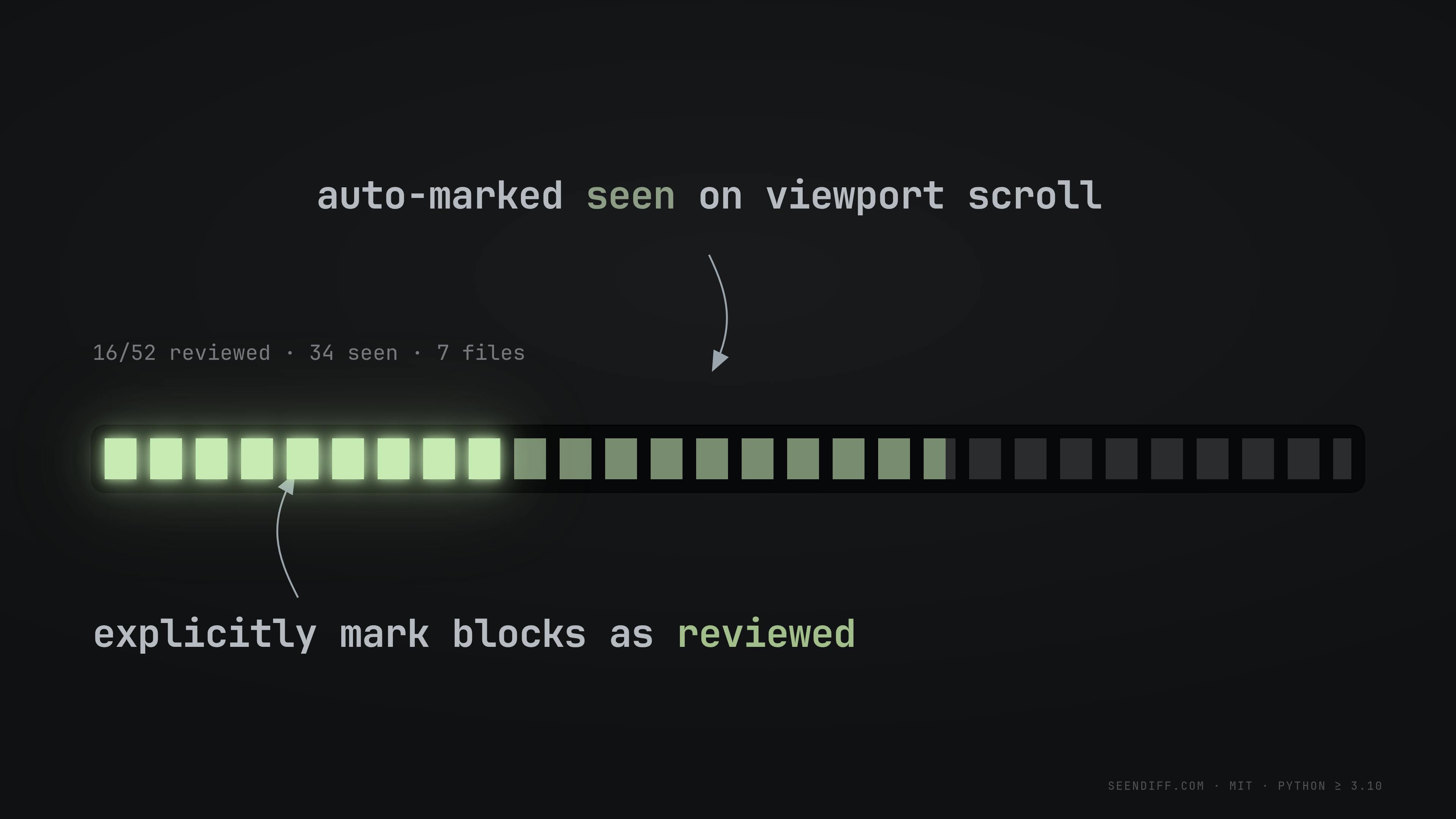
Progress Tracking (Track what you've seen): It records which changes you've already reviewed, so large-scale code reviews never "black out" on you. Think of it as adding a "read" marker to code review — you can pause and resume at any time.
-
Chunked Review (Review in chunks): It breaks massive diffs into digestible pieces that you can work through section by section, reducing cognitive load.
-
Let AI Explain Its Own Work (Pull the coding agent in to explain its own work): This is seendiff's most era-defining feature — when a particular change confuses you, you can directly call the AI agent that generated the code to explain its intent and logic.
Why This Direction Deserves Attention
From "AI Writing Code" to "Human-AI Collaborative Review"
The emergence of seendiff signals that the AI programming toolchain is maturing. Over the past two years, the industry has focused primarily on how to get AI to write more and better code. Now, an increasing number of tools are turning their attention to what happens after code generation — review, verification, and comprehension.
This is a natural evolution. When AI code output grows exponentially, human review capacity becomes the new bottleneck in the entire development workflow. seendiff doesn't attempt to replace human review with AI (which isn't advisable in safety-critical scenarios). Instead, it chooses to enhance human review efficiency — a pragmatic and wise positioning.
The Clever Design of "Let AI Explain Itself"
Among the three features, "letting the coding agent explain its own work" is particularly noteworthy. It creates a closed loop: AI generates code → humans review code → when questions arise, AI explains on the spot → humans make the final judgment.
This design acknowledges a reality: AI-generated code doesn't always align with human intuition. Sometimes a change looks strange but is actually a reasonable optimization; other times it's genuinely an error born from hallucination. Having the generator itself participate in the explanation significantly reduces the reviewer's comprehension cost and accelerates decision-making.
Local-First and Open Source: Security and Extensibility Combined
seendiff specifically emphasizes that it is a local diff tool released as open source. Both attributes carry significant weight in today's context.
Local-first means code never needs to be uploaded to third-party servers — a major plus for enterprise teams concerned about code privacy and security. In a landscape where AI programming tools overwhelmingly rely on cloud APIs, a local-first design eliminates concerns about data leakage.
Open source means transparency and extensibility. Developers can audit the tool's logic themselves and customize it to fit their own workflows. Given that seendiff's target users are developers who heavily use AI coding tools, an open-source strategy helps rapidly build community trust and attract contributors.
Conclusion: Code Review Tools Are Due for an Upgrade
seendiff may not be a feature-heavy heavyweight product, but it precisely captures a real gap in the AI coding wave. When code generation becomes this cheap, understanding and verifying code becomes the new scarce capability.
As AI agents take on an ever-growing share of coding work, we can expect more tools like seendiff to emerge — ones focused on the "review side" of the equation. Their mission isn't to make humans read less code, but to help humans read code more intelligently — maintaining a sense of control and judgment amid the information flood.
For every developer currently pair-programming with AI, this category of code review tools is well worth keeping an eye on.
Related articles

How Fast Do AI Models Iterate? 10 Hours Is Already a 'Bear Market'
AI model iteration is so fast that a model can go from state-of-the-art to outdated in hours. Learn why this happens and how to cope with AI's breakneck pace.
Agent Memory Systems in Practice: Designing and Implementing Long-Term Memory Architecture
Deep dive into Agent memory system architecture: covering context vs. memory, short-term and long-term memory layering, dynamic injection, and summarization strategies for building AI agents that truly remember users.
Duplicate Label Blunder in an AI Product's UI: Why Detail Quality Can't Be Overlooked
An AI product listed Claude Sonnet 5 twice in its UI. We analyze why this happens under rapid iteration pressure and share practical tips for AI product UI quality control.