Seldon: Using Behavioral QA Agents to Simulate Real Users Testing Your Product
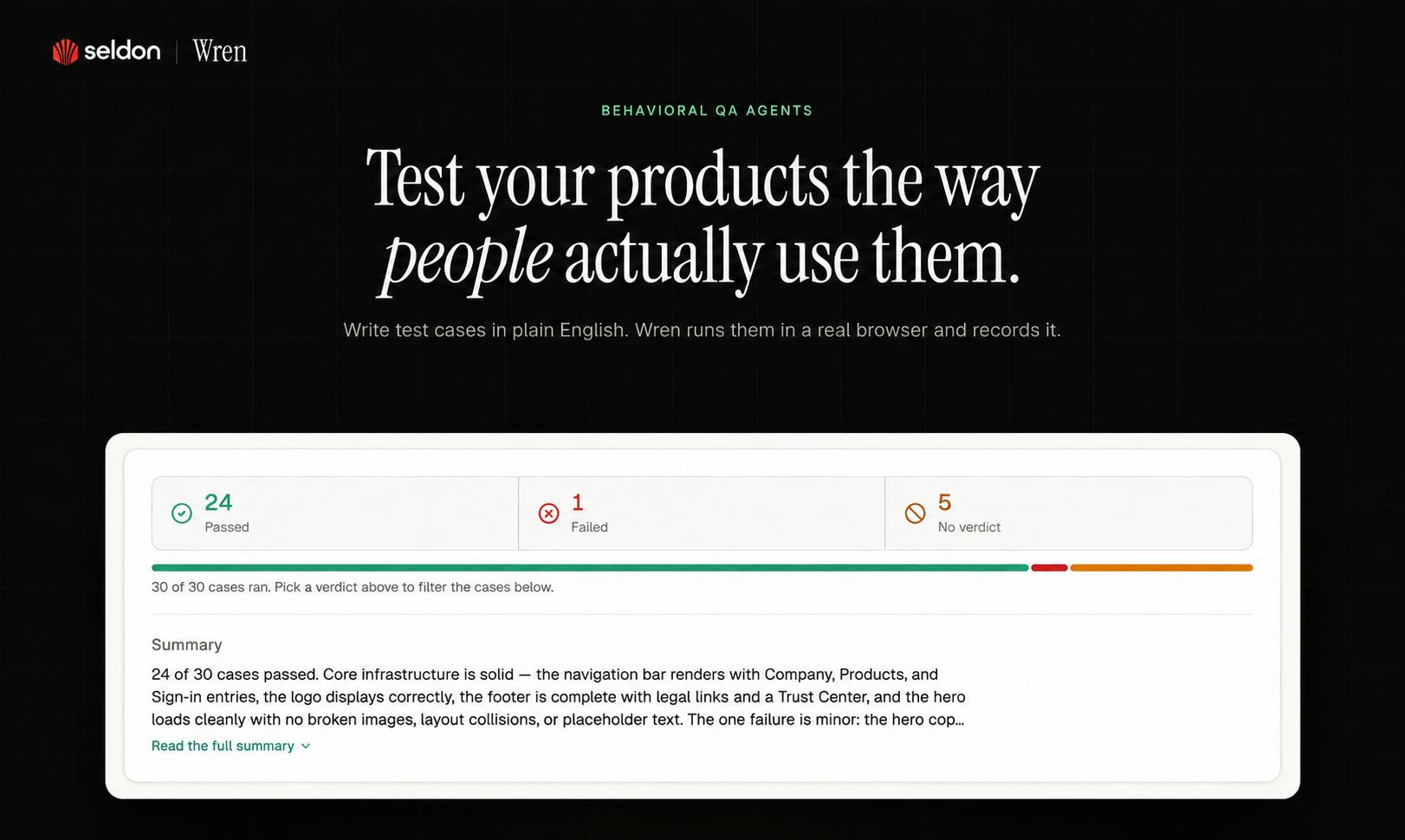
Seldon uses AI agents to simulate customer behavior, driving exploratory testing with natural language.
Seldon is a Product Hunt new product ranked fifth, using Behavioral QA agents to simulate real customers using a product and uncover scenarios missed by traditional testing. Users describe expected behavior in natural language, and the agent automatically explores multi-step paths, providing replays and reproduction steps when errors occur. It lowers the barrier versus scripted tests and adapts better to UI changes, but has uncertainties like unstable exploration. First 10 runs free; 91 votes and 17 comments.
In software development, testing often lags behind feature iteration, and users' actual interaction paths are far more complex than unit tests. Seldon, a new product ranked fifth on Product Hunt, attempts to fill this gap with Behavioral QA agents: letting AI use the product like a real customer and discover test scenarios you never anticipated.
What Are Behavioral QA Agents?
The core idea of Seldon is to have AI agents simulate customer interaction behavior. You simply tell it in natural language "what should work normally," such as "users should be able to change their address during checkout" or "they should be able to retry after a payment failure." The agent will then try to walk through these paths instead of relying on pre-scripted tests.
According to the Product Hunt page, these agents attempt paths customers commonly take, such as going back to change an address mid-checkout or retrying a failed payment. When something goes wrong, you get a replay and the steps to reproduce the bug. This is essentially automating exploratory testing and focusing on real user behavior rather than technical edge cases.
Exploratory Testing is a software testing approach that does not rely on pre-scripted tests. Testers simultaneously learn, design, execute, and evaluate results, dynamically adjusting test paths to find defects. It emphasizes the tester's cognition and judgment and is often used to supplement scenarios that scripted tests struggle to cover. Seldon's AI agents essentially automate this human tester's exploratory behavior, simulating user actions through semantic understanding rather than fixed steps, thereby reaching long-tail paths that traditional automation struggles to reach.
How It Works: Natural Language-Driven Testing
Traditional automated testing requires writing code to simulate clicks and inputs, which has high maintenance costs and makes it difficult to cover long-tail paths. Seldon's approach lets users describe expected behavior in plain English, and the agent executes exploration accordingly.
The advantage of this model is that it lowers the testing barrier—product managers or designers can directly express acceptance criteria without waiting for QA engineers to write scripts. At the same time, the agent can try multiple path combinations and discover those tests "you didn't know to write." The official value proposition is exactly "Find the tests you didn't know to write."
Seldon currently offers the first 10 runs free, making it suitable for small teams to try out.
LLM-powered Agent refers to a software entity with a large language model as its core decision engine, capable of understanding natural language instructions, planning multi-step operations, and calling tools (such as browsers and APIs) to execute tasks. Unlike rule- or script-based automation, LLM agents have a certain degree of semantic generalization and can dynamically adjust behavior based on page content. In testing, such agents can parse intents like "the user should be able to change the address," autonomously break them down into actions such as clicking, inputting, and verifying, and try alternative paths when encountering surprises rather than failing mechanically.
Use Cases and Potential Value
Seldon is particularly suitable for web applications and API-driven products, especially multi-step flows such as checkout, payment, and form filling. For fast-iterating teams, behavioral QA agents can automatically explore critical paths before each release and reduce regression defects.
Compared with traditional record-and-playback tools, Seldon's agents emphasize "behavior" rather than "operation sequences," and can understand goals and flexibly adjust steps. For example, when page element positions change, the agent may still complete the task through semantic understanding, whereas scripted tests would fail outright.
However, this flexibility also brings uncertainty: the agent's exploration may not be stable enough, or its understanding of complex business logic may be limited. The support of 17 comments and 91 votes on Product Hunt shows that early users are interested in the concept, but its actual effectiveness still needs more validation.
Record & Playback tools are a common form of traditional automated testing: recording user actions to generate scripts, then replaying them in fixed steps, relying on element selectors (such as XPath and CSS) to locate interface controls. Once the UI structure changes, scripts often break, resulting in high maintenance costs. Seldon's agents do not rely on hard-coded steps but instead execute flexibly based on semantic goals, so they may still complete tasks when element positions change—but the tradeoff is uncertainty in execution results, requiring more robust validation and fault-tolerance mechanisms.
Early Feedback and Competitive Landscape
In Product Hunt's categorization, Seldon is classified under APIs, developer tools, and artificial intelligence. There are already many test automation platforms in this space, but most focus on script recording or selector-based assertions. Seldon's differentiation lies in using LLM-powered agents to simulate human behavior, which aligns with the recent trend of applying AI Agents to software testing.
Judging by the number of comments, community discussion is not yet heated, but ranking fifth shows considerable attention. For teams seeking to reduce test maintenance costs, Seldon offers a noteworthy new option.
Conclusion
Seldon packages behavioral QA agents into an easy-to-use natural language interface, letting teams describe testing intent the way they describe user stories. Its value lies in discovering unknown test paths and providing reproducible replays. Although its maturity remains to be seen, its direction aligns with the trend of AI empowering software quality. The first 10 free runs lower the barrier to trying it, making it suitable as a supplement to existing testing systems.
One-line Summary
Seldon uses AI agents to simulate customer behavior, driving exploratory testing with natural language.
Paragraph Summary
Seldon is a new product ranked fifth on Product Hunt. Its core is using Behavioral QA agents to simulate real customers using a product and discover scenarios not covered by traditional testing. Users only need to describe expected behavior in natural language, and the agent automatically explores multi-step paths (such as checkout and payment), providing replays and reproduction steps when errors occur. Compared with scripted testing, it lowers the barrier and adapts better to UI changes, but it has uncertainties such as unstable exploration and limited understanding of complex logic. It currently offers the first 10 runs free and has received 91 votes and 17 comments, showing strong early interest, though its actual effectiveness still needs validation.
Related articles

Multi-Agent Collaborative Development: Task Card-Driven Practices for Medium-to-Large AI Projects
A Bilibili creator shares a task card-driven, PM-orchestrated multi-Agent collaboration model with local-first repository state, so any Agent tool can take over a project anytime.
Cursor vs Copilot vs Claude Code: How Laravel Developers Should Choose
Compare Cursor, GitHub Copilot, and Claude Code for Laravel development: an AI-first editor, a plugin for existing editors, and a terminal agent for multi-file tasks and testing — plus workflow-based recommendations.

AgentScope Java Edition: A Practical Guide to Enterprise-Level Agent Frameworks
An in-depth analysis of Alibaba's AgentScope Java enterprise agent framework: contrasting client-side AI and server-side AI, explaining Java's natural advantages in high concurrency and distributed state management, and outlining a complete learning path from core principles to multi-agent collaboration.