Self-Healing Software Is on the Rise—Is the Engineer's Role About to Be Redefined?
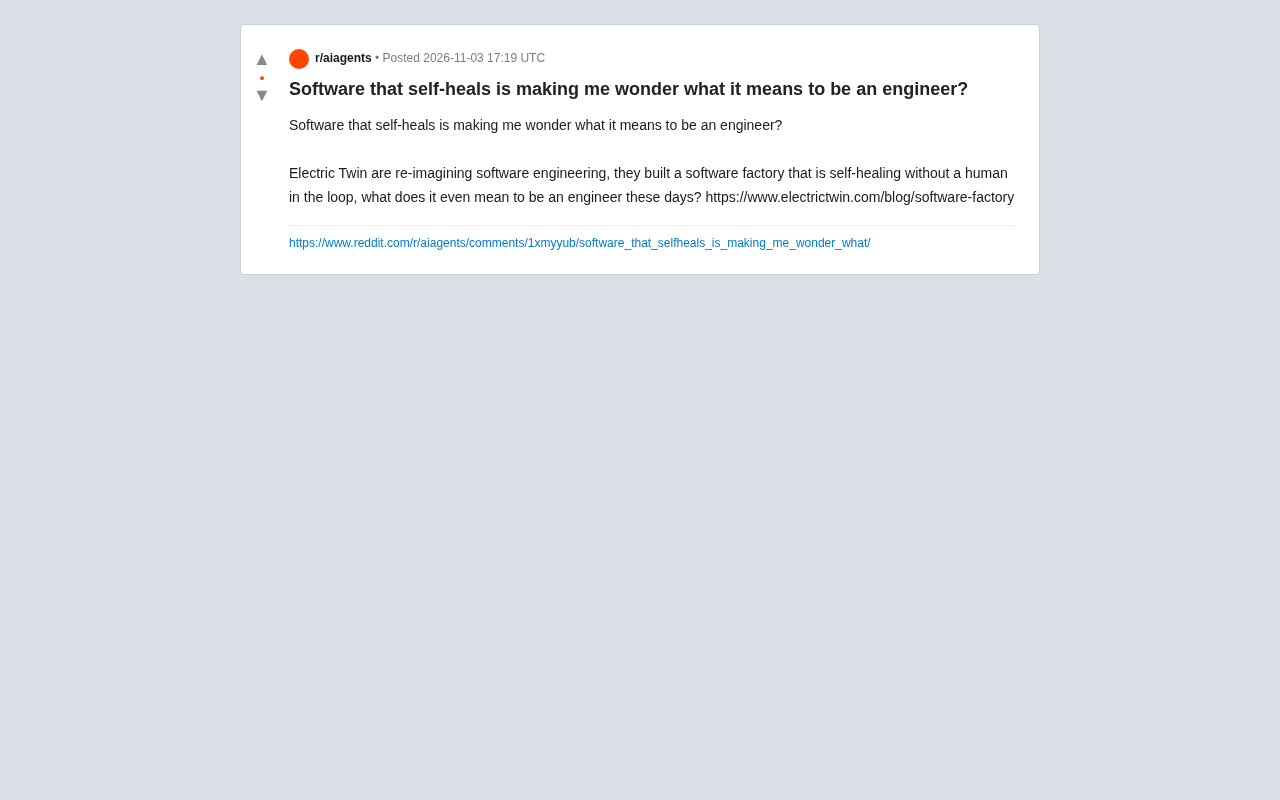
Self-healing software reshapes the engineer's role: from code writer to rule definer and system governor.
Starting from a Reddit discussion about Electric Twin's "software factory," the article explores the impact of self-healing software on the meaning of the engineering profession. Self-healing systems attempt to complete the full loop of monitoring, diagnosis, repair, and deployment with no human in the loop, and repetitive firefighting is the first thing to be automated. The article traces three shifts in engineer responsibilities: from hand-written code, to architecture and service orchestration, to problem definition, constraint design, and quality judgment. It also points out the boundaries of self-healing systems: they are good at handling known failure patterns but struggle with unknown interactions and architectural flaws, and they raise accountability challenges. Automation also narrows the path for junior engineers to gain experience through troubleshooting.
When software starts to "self-heal," where does the engineer's value lie?
A recent discussion on Reddit has drawn considerable attention: after seeing the "software factory" built by Electric Twin, one developer posed a soul-searching question—when software can heal itself, and the entire process requires no human intervention, what does the engineering profession even mean anymore?
Behind this question is the evolution of AI coding tools from "assisted code writing" toward "autonomous system operations." The software factory described by Electric Twin in its blog has self-healing as its core selling point: the system can automatically detect and fix problems without relying on human engineers. This goes beyond the familiar Copilot-style code completion and touches the most human-dependent link in the software lifecycle—incident response and maintenance.
What does "self-healing" actually mean?
To understand the weight of this discussion, we first need to unpack what "self-healing software" actually entails.
Based on Electric Twin's public description, its software factory emphasizes an automated closed loop that operates without a human in the loop. Traditionally, the chain for handling an online incident roughly goes: monitoring alert → engineer intervention → root cause identification → writing a fix → testing and validation → deployment. A self-healing system attempts to hand multiple links in this chain over to machines, with humans retreating from "operator" to "bystander" or even "designer."
The direct impact is this: the large amount of repetitive firefighting in engineers' daily work may be the first thing to be automated away. But the original Reddit poster was clearly looking further ahead—what concerns him is not whether the job will disappear, but that the meaning of the "engineer" identity is being rewritten.
Human out of the loop is a classic concept in human-computer interaction and automation, usually contrasted with "human in the loop." In the human-in-the-loop model, an automated system needs human confirmation or approval before executing an action; human out of the loop means the system can autonomously complete the full loop of detection, decision-making, and execution. This concept was first widely discussed in aviation autopilot and industrial control, and is now being transplanted to software operations scenarios. It is worth noting that human out of the loop is not equivalent to "unsupervised"—mature self-healing systems usually still retain the ability for humans to set rules at the policy level and step in as a fallback at the exception level, only compressing response time from minutes to seconds.
The three shifts in the engineer's role
Looking back at the development of software engineering, the core responsibilities of engineers have actually been shifting all along.
In the early days, it was the era of hand-written code, when an engineer's value was reflected in mastery of languages, algorithms, and system details. Then came the era of frameworks and cloud services, when a large amount of infrastructure was abstracted away and engineers shifted toward architecture design and service orchestration. Now, with the spread of AI coding tools, the barrier to writing code itself is being rapidly lowered, and engineers' differentiating advantages are beginning to shift toward problem definition, system constraint design, and quality judgment.
Self-healing software pushes this trend to its extreme. When a system can fix bugs on its own, engineers' focus naturally moves upward to: defining "what counts as fixed," setting the boundaries and safety guardrails of the self-healing system, and making fallback decisions when the system cannot handle something. In other words, from "the person who writes code" to "the person who defines the rules and judges the results." This is not a weakening of the engineer's value, but a redistribution of it.
The boundaries and concerns of self-healing systems
However, promoting "human out of the loop" as the ultimate goal also deserves some calm reflection.
The premise for a self-healing system to automatically fix problems is that the problem pattern falls within its recognition and handling scope. For known types of failures—such as service timeouts or resource exhaustion—an automated closed loop does have advantages. But many serious incidents in software systems come precisely from unknown interactions, boundary conditions, and architectural design flaws, and such problems often require human engineers' cross-domain judgment and creative reasoning.
Another concern is accountability. When a self-healing system autonomously makes a repair decision that triggers secondary problems, who is responsible? This requires engineers to embed observability, rollback mechanisms, and audit capabilities at the system design stage. Engineers are not being replaced; rather, they are being asked to possess a higher level of system governance capability. Some in the Reddit discussion said outright that this shift may not be friendly to the growth path of junior engineers—the channel through which they used to accumulate experience by troubleshooting large numbers of incidents is being narrowed by automation.
Observability refers to the ability to infer a system's internal state from the outside through three types of data: logs, metrics, and distributed tracing. It is the prerequisite for a self-healing system to "see" problems: if failure signals cannot be collected and correlated, automated repair is impossible. The accompanying rollback mechanism ensures that self-healing actions are reversible—when an automated fix produces a secondary failure, the system can quickly revert to the previous stable version. Audit capability records the input, basis, and result of every automated decision, serving both as an evidence chain for after-the-fact accountability and as a data source for training and improving self-healing strategies. Together, the three form the safety guardrails of a self-healing system in engineering terms, and none can be missing.
Conclusion: the question is more valuable than the answer
Whether Electric Twin's software factory is the starting point of a paradigm shift or just another overhyped concept is still hard to say. But the question on Reddit itself already shows one thing: the engineering community is actively reflecting on its own role and positioning, rather than passively waiting to be changed.
Self-healing software will not make engineers disappear, but it will redraw "which work is worth having humans do." Continued discussion of this question may be more meaningful than the success or failure of any single product.
Related articles

Qwen 3.8 Beats Opus at Coding—But Can Your Mac Run It?
Open-source Qwen 3.8 beats Opus 4.6 at coding at just 18GB, but how much Mac memory do you need? 24GB crashes; 32GB is the sweet spot. Full config guide inside.

Claude Code + Agent: Building a Fully Automated AI Testing Loop
Bilibili course breakdown: how test developers can use Claude Code terminal-based Agents to build a fully automated AI testing loop. Compares permission boundaries of terminal vs. device Agents, explains why enterprise projects choose Claude Code over Open Claude-type tools, and outlines the Node.js environment setup and DeepSeek model integration path.

Working with AI Agents Requires Nerves of Steel
The more autonomous AI agents become, the heavier the user's psychological burden. Drawing from a Hacker News discussion, this article analyzes black-box anxiety, behavior drift, and monitoring fatigue in agent collaboration, and offers practical approaches like sandbox isolation, permission control, and task granularity management to reduce cognitive load.