Self-Hosting Survey 2026 Launches: Community's Favorite Self-Hosted Tools

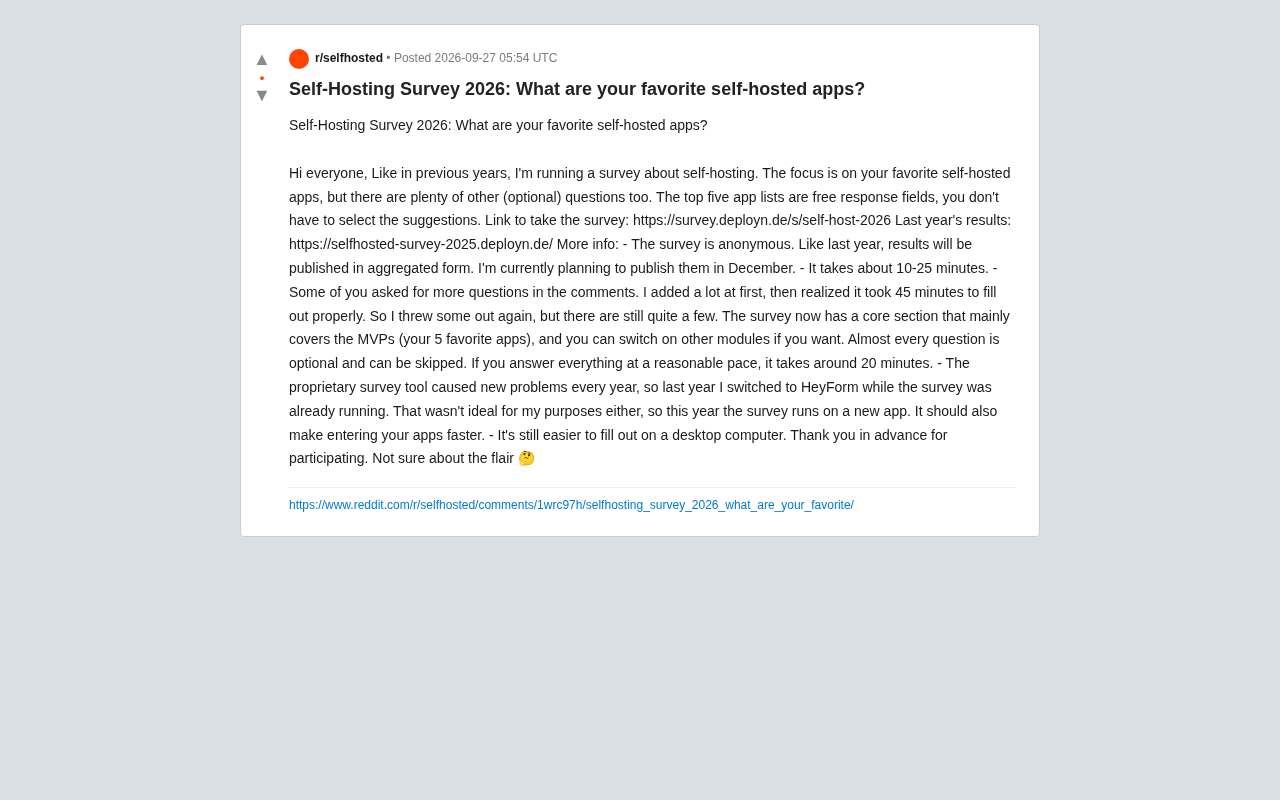
The 2026 self-hosting community survey is live, collecting users' top five favorite self-hosted apps.
The 2026 Self-Hosting Survey, organized by a developer on deployn.de, asks users to name their five favorite self-hosted applications. Using open-ended questions and a modular design, the core section takes about 20 minutes with most questions optional — balancing data quality with low participation friction. The survey is fully anonymous, with aggregated results to be published at year's end. The organizer also switched to a new survey tool this year to improve the experience. For self-hosting enthusiasts, the results offer valuable insight into community tool preferences and serve as a practical reference for future tool selection.
Self-Hosting Survey 2026 Goes Live
The annual self-hosting community survey is back. Organized by a developer on the deployn.de platform, this survey centers on one simple yet remarkably valuable question: What are your favorite self-hosted applications?
The survey is fully anonymous. Participants can freely list up to five self-hosted tools they use most. Unlike typical closed-form questionnaires, all five core questions are open-ended — no forced selection from a predefined list — which more accurately reflects real-world usage. The organizer plans to compile and publicly release the aggregated results at year's end for the entire community to reference.
For users who care about digital sovereignty, privacy, and the open-source ecosystem, this kind of annual survey is a rare source of cross-sectional data — clearly revealing which tools are gaining community traction and which emerging projects are on the rise.
Survey Design Trade-offs: Modularity vs. Completion Time
Also worth noting is the thought that went into the survey's design. According to the organizer, community members had previously requested more questions in the comments, so he initially packed in a large number of options — only to find that a full run-through took up to 45 minutes. That would obviously deter most participants.
The final approach was a modular design: the survey retains one core section covering the "MVP" — each user's five favorite apps — while the remaining questions are split into optional modules that users can enable or skip as they choose.
Almost every question is optional and can be skipped. At a normal pace, the survey takes about 20 minutes; a full completion falls between 10 and 25 minutes.
This design strikes a pragmatic balance between data completeness and participation threshold. The core five-app data ensures the sample's baseline value, while optional modules leave room for deeper analysis — avoiding the high drop-off rates caused by overly long surveys.
The "Drop-off Rate" in survey design is a key metric in user experience research, referring to the proportion of participants who abandon a survey before completing it. Research consistently shows that once a survey exceeds 10–15 minutes, drop-off rates rise sharply; beyond 20 minutes, more than half of participants may quit, and those who do finish tend to be skewed in their demographic makeup (e.g., highly enthusiastic early adopters are overrepresented). Modular survey design addresses this by compressing required questions to the shortest possible path, while preserving optional extended modules for users willing to engage more deeply — a common solution for balancing data quality with sample representativeness. For community-organized surveys with no mandatory participation mechanism, this trade-off is especially critical.
What Tool Choices Reveal About the Self-Hosting Ecosystem
The value of this kind of survey goes beyond simple "voting" — it reveals the technical evolution of the self-hosting community. Historical results show that media management, password management, note syncing, home automation, and file synchronization have consistently been among the most common self-hosting use cases. By comparing rankings across different years, you can observe shifts in project popularity and the arrival of new tools.
The organizer also mentioned the iteration challenges with the toolchain itself. Over the past few years, the proprietary survey tool used each year brought new headaches. Last year, the team had to switch to HeyForm mid-survey, which still wasn't ideal. This year, an entirely new application was adopted — one that reportedly makes the process of "entering apps" much faster. This detail is very much in the spirit of the self-hosting community: even the tools used to run the survey are subject to continuous tinkering and optimization.
Self-hosting refers to users deploying and running software services on hardware or servers they control themselves, rather than relying on third-party cloud providers. Common self-hosting scenarios include: running Nextcloud on a home NAS as a Google Drive replacement, using Vaultwarden instead of Bitwarden's cloud service, managing smart home devices with Home Assistant, or building a private media library with Jellyfin. The core motivations behind self-hosting typically fall into three categories: data sovereignty (data stored on devices you control), privacy protection (avoiding third-party data analysis or leaks), and long-term cost control (one-time hardware investment replacing ongoing subscription fees). The trade-off is that users must take on the responsibility for maintenance, updates, and troubleshooting — which is exactly why community tool recommendations and shared experiences carry such weight, and why annual surveys like this one have genuine value.
How to Participate
A few practical tips for taking part:
- Platform: The survey is hosted at survey.deployn.de. Last year's full results were published on a separate site and are worth reviewing as a reference.
- Device: The organizer explicitly recommends using a desktop computer — the experience is better than on mobile.
- Privacy: Fully anonymous; results are only released in aggregated form.
- Time: Budget around 20 minutes for a comfortable run-through.
For self-hosting enthusiasts, spending twenty minutes on a community-driven survey like this is both a contribution to the ecosystem's data and an opportunity to take stock of your own tool stack. The aggregated results released at year's end could well become an important reference for the next round of tool selection.
Closing Thoughts
At its core, self-hosting is about returning control of data and services to the user. This kind of annual community survey embodies exactly that spirit: grassroots organization, anonymous participation, and openly shared results. It carries no backing from any commercial entity, yet holds unique value precisely because it reflects real-world usage so closely. If you're running your own server, NAS, or home lab, consider taking part — and let your tool choices become part of the community's data.
Related articles

Gaussian Process Bandit Optimization: Exploration Strategies and Inference Regret Guarantees
Cumulative regret guarantees in Bayesian optimization fail to reflect final recommendation quality. This article examines a new study that provides inference regret guarantees for Gaussian process bandit optimization through exploration query strategies and fill distance analysis, validated on hyperparameter optimization and control tasks.

The Most Detailed Codex Guide on Bilibili: From Installation to Real-World Practice
The most detailed Codex guide on Bilibili: from app store installation to daily work mode configuration, with a real coffee shop project demonstrating file organization, data extraction, dashboard creation, and other practical tasks. Learn to use Plan Mode and desktop pets to leverage Codex efficiently.

Appearance Compensation in Volume Rendering: Why RGB Accuracy Cannot Guarantee Density Correctness
Volume rendering research reveals that volumetric data perfectly reproducing external RGB views may still contain density errors: appearance compensation can double central density and keep external rays unchanged even when L2 error exceeds 14.52%. Density recovery depends on appearance capacity, spatial resolution, and measurement design.