Sell to State: Search Government Procurement Data from 64 Countries in One Place

Sell to State lets businesses search 3M+ government contracts across 64 countries before committing to cross-border compliance costs.
Sell to State is a newly launched government procurement search engine on ProductHunt that aggregates over 3 million contracts from 64 countries, covering tenders, suppliers, and agencies. Its core design philosophy decouples market research from cross-border compliance: users can browse freely to assess opportunities before paying a one-time flat fee to unlock the full dataset, REST API, and MCP interface. MCP support enables direct integration into AI workflows, making it a potential backbone for automated sales intelligence. For SMEs, the value lies in moving decisions to the lowest-cost research stage — though data freshness under a one-time payment model remains an open question.
A Search Engine Targeting the Global Government Procurement Market
Government procurement is one of the largest — and most impenetrable — markets in the world. Layers of approvals, language barriers, and cross-border registration requirements often exhaust small and mid-sized suppliers before they even figure out whether an opportunity exists. Sell to State, which recently ranked seventh on ProductHunt, is built to address exactly this pain point: it aggregates over 3 million government contracts from 64 countries into a structured, searchable resource, allowing businesses to assess whether a market is worth entering before committing real resources.
According to its product page, Sell to State covers three core data dimensions: tenders, suppliers, and agencies. Users can search what governments around the world are buying, which agencies are driving procurement, and which suppliers have historically won contracts — helping them identify potential sales opportunities. On launch day, the product received 97 upvotes and 11 comments, reflecting genuine demand for cross-border government sales intelligence.
Core Value: Validate the Opportunity Before Spending the Money
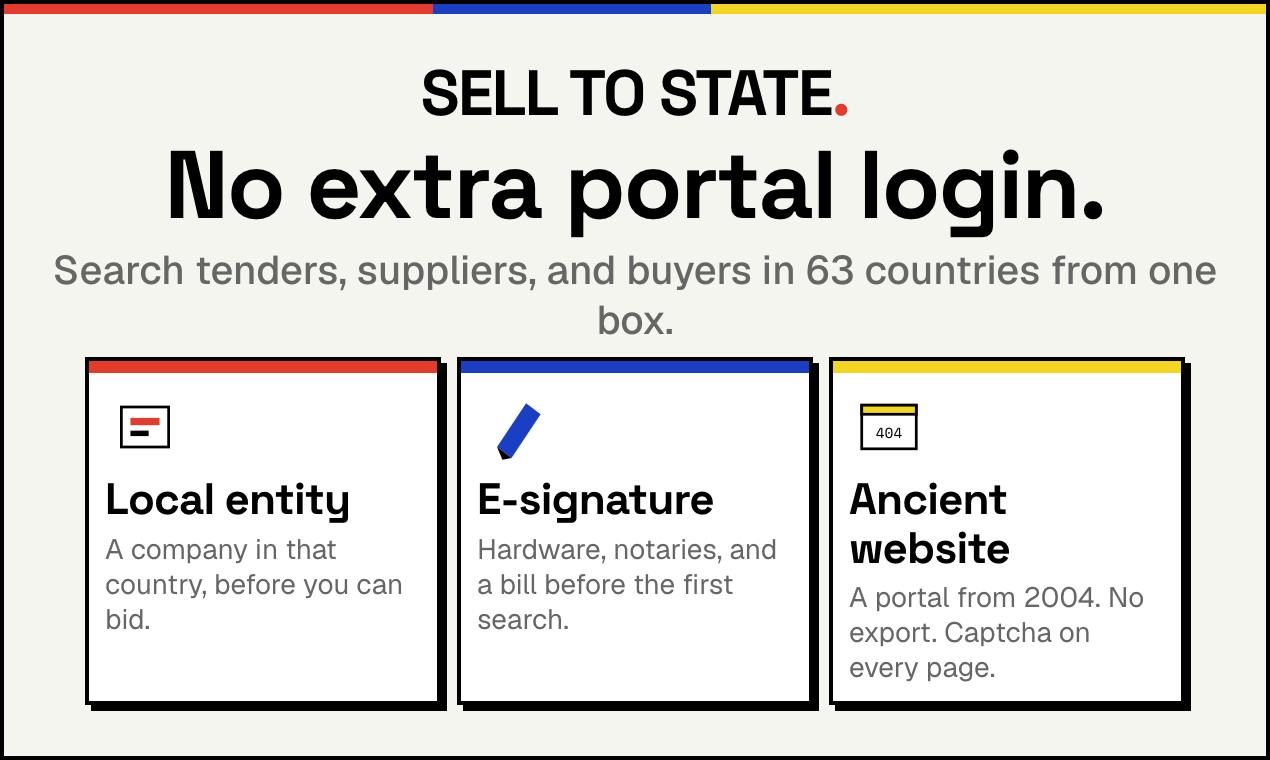
The most notable design philosophy behind this product is its effort to reduce the "upfront sunk cost" of cross-border government sales. In the traditional workflow, companies often need to register a foreign entity, obtain digital signatures, and meet other compliance requirements in a target country just to access a full tender platform or submit a bid. That preparation alone is a significant investment — and it comes before anyone has confirmed whether there's money to be made.
Sell to State decouples the "market research" step from that cumbersome compliance process. The product offers free browsing, allowing users to do preliminary research without any cross-border credentials. Only when a genuine opportunity is confirmed — and deeper data access is needed — does the user pay a one-time flat fee to unlock the full dataset. This "look before you leap" model offers a more rational decision-making path for sales teams evaluating unfamiliar overseas markets.
Data Infrastructure for Developers
Beyond the search interface aimed at salespeople, Sell to State also positions itself as a layer of data infrastructure. After paying for access, users gain three advanced capabilities: saved searches, a REST API, and an MCP interface.
The MCP (Model Context Protocol) support is particularly worth noting. MCP is a standard interface protocol that has gained rapid traction in the AI application ecosystem, enabling large language models and AI Agents to call external data sources in a standardized way. By offering an MCP interface, Sell to State allows developers to pipe global government procurement data directly into AI workflows — for example, letting an AI assistant automatically monitor tender activity in a specific sector, generate market analysis reports, or query a country's historical procurement records in real time during a conversation. This design transforms the product from a manual search tool into a potential data backbone for automated sales intelligence systems.
MCP (Model Context Protocol) was released and open-sourced by Anthropic in late 2024 and has since been adopted by major AI tools including Claude, Cursor, and Windsurf. It is on track to become the de facto standard for AI Agents connecting to external tools and data sources. The core idea is analogous to the unification logic of USB-C: previously, each AI application had to build custom integration code for every external data source. MCP defines a universal "server/client" protocol so that any compliant data source only needs to be integrated once and can then be called by any MCP-compatible AI application. For Sell to State, offering an MCP interface means its government procurement database can be invoked directly as a "tool" by AI Agents — no manual record-by-record searching required. The key distinction from a REST API alone is that MCP aligns more closely with the contextual reasoning of large language models, enabling AI to dynamically decide when and what to query within a conversational flow.
Pricing and Business Model
Based on publicly available information, Sell to State follows a classic "free acquisition + one-time paid unlock" model. The free tier allows open browsing to attract users and lower the barrier to entry; the paid tier unlocks the full dataset, saved searches, API access, and MCP integration for a one-time flat fee rather than a recurring subscription.
For teams that need to conduct a one-off research exercise on an overseas government market, a one-time payment may be more appealing than a monthly subscription, since it avoids long-term commitment. However, this model raises an important question: government procurement data is highly time-sensitive, with tender notices, supplier changes, and agency structures in constant flux. How a one-time payment model ensures ongoing data freshness is something this type of product needs to address over the long run. The product page currently does not disclose specific details about data update frequency.
What This Means for Cross-Border Sales Teams
The emergence of Sell to State reflects a broader trend of data-driven transformation in the B2G (Business-to-Government) space. Historically, cross-border government procurement information has been scattered across official portals in different countries — with inconsistent languages, formats, and search experiences — making systematic tracking feasible only for large multinationals and specialized intermediaries. Consolidating data from 64 countries into a structured, searchable, API-accessible resource fundamentally lowers the information barrier for small and mid-sized enterprises seeking to enter global public procurement markets.
For sales teams, the core value of tools like this is not "helping you win a contract" — it's "helping you decide whether it's worth trying." It moves the decision point earlier in the process, to the lowest-cost stage of research, letting companies filter for genuinely promising overseas markets with fewer resources. That said, the completeness and accuracy of the data coverage, along with the real-world barriers to participating in cross-border tenders, still need to be validated through actual use. As a product that just launched on ProductHunt, Sell to State points in a direction worth watching — but it isn't a mature, complete solution just yet.
The B2G (Business-to-Government) market is enormous by global standards. According to OECD estimates, government procurement spending accounts for roughly 12–15% of GDP in most countries, with a global total exceeding $10 trillion. Yet this market has long been considered the domain of large enterprises — not just because of compliance thresholds, but due to extreme information asymmetry. Procurement platforms vary wildly by country: the EU has TED (Tenders Electronic Daily), the US has SAM.gov, the UN system has UNGM, and in many developing countries, tender notices are still scattered across individual ministry websites or even published in print. The technical challenges of the structured aggregation that Sell to State has undertaken lie primarily in multilingual parsing, data format normalization, and cross-border agency entity recognition — which is precisely where the core barrier lies for any similar product claiming credible coverage across 64 countries.
Related articles

Amphibious Transforming Drone: Beyond 100x Power Savings, What Are the Real Needs?
Is the amphibious transforming drone just a gimmick? Starting from the 100x power difference of the M4 Morphobot, explore real application scenarios and thesis topic ideas, analyzing boundary conditions where pure drones and pure ground robots both fail.

Warhound Raises $200 Million: Genetically Engineered "War Dogs" Paired with Anduril Gear
Warhound raises $200M, backed by Ben Lamm and Palmer Luckey, to genetically engineer dogs for military and law enforcement use and equip them with Anduril gear. This article analyzes its technology direction, funding logic, and ethical controversy.

Claude API Comes to Google Cloud: IAM Integration and SDK Access Guide
Anthropic hosts the full Claude API on Google Cloud with IAM-controlled permissions and unified billing. This guide covers the Vertex AI and Anthropic-hosted entry points, IAM role configuration, and SDK access.