Semantica: Weaving Scattered Data into a Traceable Knowledge Network

Semantica turns scattered enterprise documents into a traceable, AI-powered knowledge graph.
Semantica combines knowledge graphs with large language models to transform scattered enterprise documents—PDFs, reports, historical records—into visual relationship networks. It enables AI-assisted reasoning, preserves decision records, and provides full traceability back to original sources and page numbers. Real-world cases include drug research direction discovery and Australian power company OSGrid, which reduced regulatory query response times from days to under 3 seconds.
From Digging Through Files to Querying Relationships: The Pain Point of Enterprise Knowledge Management
Many enterprises face the same challenge: years of accumulated information scattered across thousands of pages of PDFs, reports, and historical records. Industry research estimates that roughly 80% of enterprise data exists in unstructured forms—PDFs, Word documents, emails, scanned files—containing vast amounts of high-value information that machines struggle to process directly. When an analyst needs to verify a historical issue, it often takes days of combing through documents, draining both human resources and time. As the original material puts it—"spending the money twice, doing the work twice"—repetitive document retrieval is dragging down enterprise efficiency.
Sematica aims to solve exactly this problem. Its core approach is straightforward: "connect" scattered data, let AI automatically organize it into a visual relationship network, and on that foundation enable assisted reasoning, preserve decision records, and ultimately achieve a complete chain from conclusions all the way back to original evidence.
Semantica Drug Research Case: From Scattered Data to Candidate Research Directions
In the demo, the presenter ran a drug research case with a clear objective: find research directions worth pursuing from existing materials.
After importing the data, previously scattered and isolated information is automatically organized by the system into a relationship network. This process involves multiple technical steps: the system first parses and segments unstructured documents, then uses natural language processing to extract entities (such as drug names, targets, mechanisms of action) and relationships (such as "inhibits," "activates," "associated with"), and finally assembles these triples into a knowledge graph. In this network, the connections between knowledge nodes are clearly presented. When given "one piece of existing information + one judgment criterion," the system can quickly filter out a new candidate research direction.
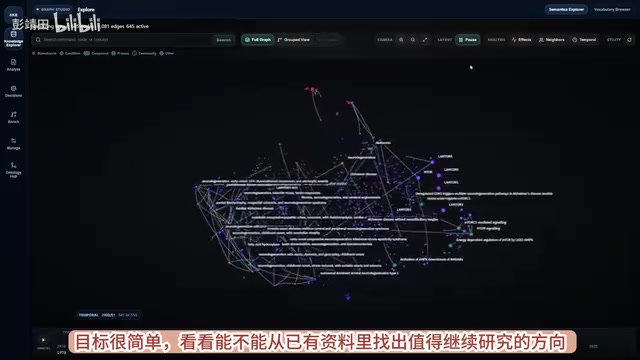
The value of this workflow lies in handing the traditionally experience-dependent task of "knowledge linking" over to AI. In drug research, a new therapeutic hypothesis often lies hidden in the cross-references of dozens of papers—one paper mentions a new function of a target, another discovers that target's association with a certain disease, and a third reports a compound that can act on that target. Human researchers might need weeks to complete this cross-literature "information puzzle," while a structured knowledge graph can perform multi-hop reasoning in seconds, revealing these potential association pathways.
Four Core Capabilities: Connection, Reasoning, Recording, and Traceability
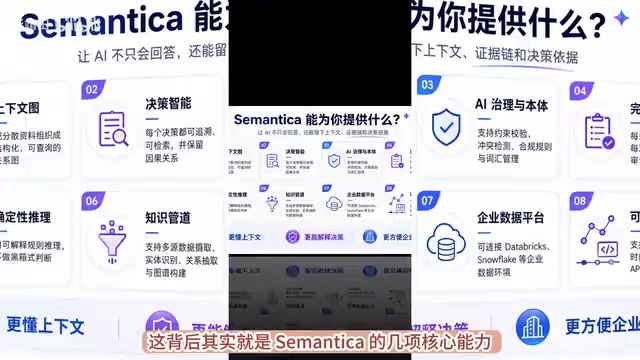
Sematica's demonstrated capabilities can be summarized in four points: connecting data, assisting reasoning, preserving decision records, and tracing back to original evidence.
Traceability Is Semantica's Key Differentiator
In AI-assisted decision-making scenarios, the most commonly challenged question is "how was this conclusion reached?" This isn't just a matter of user trust—it's a hard compliance requirement. The EU's AI Act explicitly requires high-risk AI systems to provide transparency and traceability; the U.S. FDA is also paying increasing attention to the completeness of evidence chains in AI-assisted decisions during drug approval. This means that in regulated industries, AI tool explainability is no longer a "nice-to-have" but a barrier to entry.
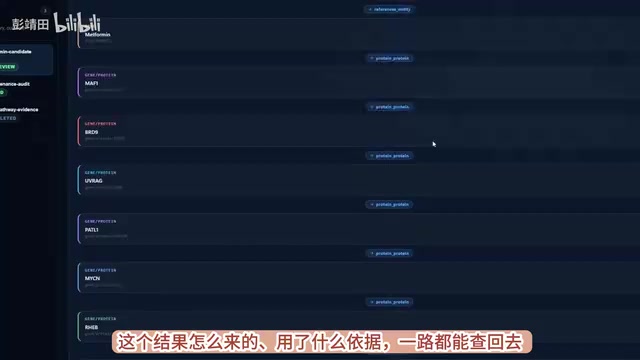
Sematica's approach is to fully record every decision. When users click on a decision, they can see how the result was derived, what evidence was used, and can trace all the way back to the original data source.
For fields with extremely high credibility requirements—such as regulatory compliance, scientific research, and auditing—this "traceability" capability is especially important. It means AI is no longer a black box, but an assistive tool that can provide an evidence chain. This is also the direction widely emphasized in current enterprise AI applications—explainable, verifiable, and auditable. Specifically, auditors can follow the system's recorded reasoning chain, tracing layer by layer from the final conclusion back through intermediate reasoning steps, supporting document passages, and even to the specific page numbers of the original PDFs, thereby judging whether the conclusion is reliable and whether the reasoning contains logical leaps.
OSGrid Real-World Case: Answering 10 Years of Regulatory History in 3 Seconds
The original material mentions an even more compelling commercial deployment case: Australian power company OSGrid.
The company had accumulated 10 years of regulatory history, with large amounts of critical information scattered across thousands of pages of PDF files. In the energy industry, regulatory compliance is an ongoing, high-frequency task: power companies must regularly submit operational reports to regulators, respond to compliance reviews, and provide complete historical decision evidence when disputes arise. Before adopting Semantica, analysts investigating a historical regulatory issue would spend enormous amounts of time and multiple rounds of analysis just browsing through documents.
After adopting Semantica, response times for similar questions were reduced to "under three seconds," with the system returning results along with original sources and specific page numbers. This magnitude of efficiency improvement means real savings in human resources and time costs for industries that frequently handle historical materials (such as energy, finance, legal, and pharmaceutical). From an ROI perspective, a senior compliance analyst's annual salary can reach hundreds of thousands of dollars—if 10-15 hours of document browsing can be saved each week, the ROI from that alone is significant.
Technical Deep Dive: The Knowledge Graph + LLM Fusion Approach
From a technical standpoint, Semantica follows a "knowledge graph + large language model" fusion approach. A Knowledge Graph is a technology paradigm that organizes information in a graph structure, first proposed and applied to search engine optimization by Google in 2012. Its core is expressing world knowledge through "entity-relationship-entity" triples. Unlike traditional relational databases, knowledge graphs are naturally suited to expressing multi-hop relationships and implicit associations, giving them a unique advantage in scenarios that require "connecting scattered information."
Sematica doesn't rely solely on the generative capabilities of large models. Instead, it first structures unstructured data into a relationship network, then performs reasoning and retrieval on that network. This approach can be seen as an evolved version of the current mainstream RAG (Retrieval-Augmented Generation) architecture. Traditional RAG works as follows: user asks a question → relevant document fragments are retrieved from a vector database → fragments are fed as context to a large model to generate answers. While effective, this approach often falls short when dealing with complex questions requiring cross-document, multi-hop reasoning. Semantica introduces a knowledge graph layer on top of RAG, enabling the system to perform structured reasoning along relationship edges and discover deep associations that text-similarity-based retrieval alone cannot capture.
This fusion approach has two clear advantages:
First, it reduces hallucination risk. "Hallucination" in large language models refers to the model generating seemingly plausible but actually incorrect content without factual basis—a problem that is especially fatal in enterprise applications, where an incorrect regulatory conclusion could trigger serious compliance risks. By anchoring all conclusions to specific original documents and page numbers, Semantica structurally constrains the model's ability to "generate from thin air."
Second, it improves explainability. The visual relationship network allows human experts to intuitively understand AI's reasoning path, rather than passively accepting an isolated conclusion. Experts can verify every step in the reasoning chain—from whether entity recognition is accurate, to whether relationship judgments are reasonable, to whether the final conclusion has sufficient support.
Of course, the actual effectiveness of such knowledge management tools is highly dependent on the quality of the source materials and the degree of domain adaptation. Converting unstructured documents into high-quality knowledge graphs typically involves multiple steps—OCR recognition, layout analysis, paragraph segmentation, entity recognition, and relationship extraction—each of which can introduce errors. Although advances in multimodal large models and document understanding models in recent years have significantly lowered the technical barrier, in professional domains with high precision requirements (such as legal contract analysis or drug patent analysis), domain expert involvement in verification and rule supplementation is still necessary. While the demo cases are impressive, enterprises should still assess the standardization of their own data and the model's ability to understand domain-specific terminology when deploying such solutions.
Overall, Semantica represents a pragmatic direction for enterprise AI applications: not aiming to replace human experts, but freeing them from tedious document retrieval so they can focus their energy on real judgment and decision-making. For enterprises sitting on large volumes of historical documents that are difficult to effectively utilize, this kind of "knowledge linking" tool is worth paying attention to.
Key Takeaways
Related articles

Amphibious Transforming Drone: Beyond 100x Power Savings, What Are the Real Needs?
Is the amphibious transforming drone just a gimmick? Starting from the 100x power difference of the M4 Morphobot, explore real application scenarios and thesis topic ideas, analyzing boundary conditions where pure drones and pure ground robots both fail.

Warhound Raises $200 Million: Genetically Engineered "War Dogs" Paired with Anduril Gear
Warhound raises $200M, backed by Ben Lamm and Palmer Luckey, to genetically engineer dogs for military and law enforcement use and equip them with Anduril gear. This article analyzes its technology direction, funding logic, and ethical controversy.

Claude API Comes to Google Cloud: IAM Integration and SDK Access Guide
Anthropic hosts the full Claude API on Google Cloud with IAM-controlled permissions and unified billing. This guide covers the Vertex AI and Anthropic-hosted entry points, IAM role configuration, and SDK access.