SemMask: How Semantics-First Progressive Masking Reshapes Diffusion Language Models

SemMask identifies semantic tokens through gradients and progressively masks them, letting diffusion language models decode content words first and improving global planning and parallel generation efficiency.
Diffusion language models (DLMs) theoretically support globally parallel generation but often fall into a "pseudo-autoregressive" trap: decoding function words before content words that carry core semantics, hurting tasks that require global planning such as text writing and code generation. A new paper proposes the SemMask fine-tuning paradigm, which uses gradient information to identify semantic tokens and a progressive masking strategy to decode semantic tokens first while weighting their loss. Experiments show SemMask matches strong autoregressive baselines in quality on text writing and code generation, with better semantic coherence, and achieves higher accuracy with significantly fewer decoding steps, improving the accuracy-efficiency trade-off. The method reveals how semantic priors can redesign masking order to unlock DLM parallel potential, though the overhead of gradient identification and cross-language/task consistency need further validation.
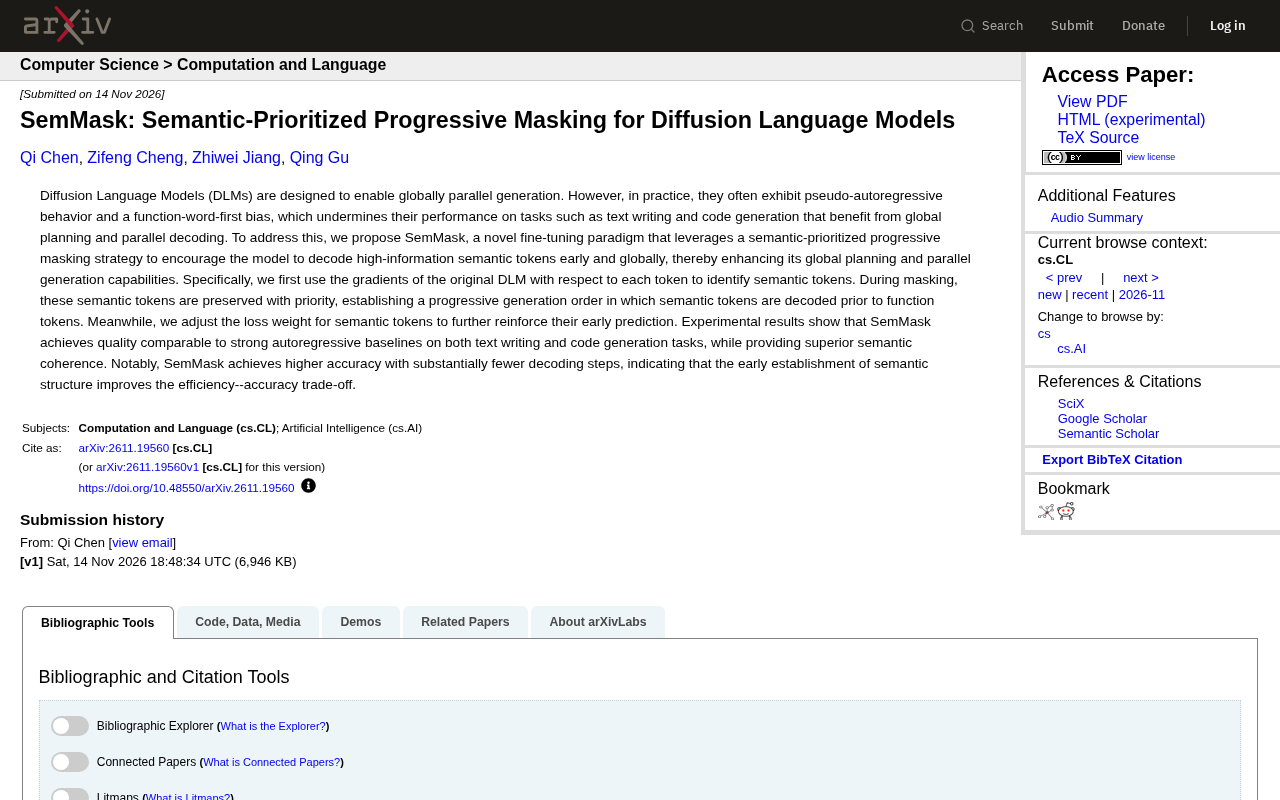
Diffusion Language Models (DLMs) are often held in high regard because they theoretically support globally parallel generation. But in practice they often fall into the "pseudo-autoregressive" trap: the model tends to decode function words first rather than the content words that carry core semantics, leading to poor performance on tasks that require global planning (such as text writing and code generation). A new paper proposes the SemMask fine-tuning paradigm, which attempts to use a semantics-first progressive masking strategy to make the model decode high-information semantic tokens first, thereby improving global planning and parallel generation capabilities.
Root of the Problem: Function-Word-First Bias and Pseudo-Autoregression
The paper points out that existing DLMs often exhibit a "function-word-first" bias during parallel decoding: function words such as articles, prepositions, and conjunctions are generated first, while semantic tokens such as nouns and verbs are delayed. This order may seem locally grammatical, but it undermines the early establishment of global semantic structure. As a result, although the model is nominally parallel, it actually degrades into autoregressive-like word-by-word generation, and the potential of parallel decoding is severely wasted.
More critically, this bias is especially fatal in text writing and code generation tasks. Both types of tasks depend on advance planning of the overall structure—first determining the core concepts and logical relationships, then filling in the details. Function-word-first does exactly the opposite.
Basic principles of diffusion language models: Diffusion language models borrow the diffusion idea from image generation, treating text generation as a process of gradually denoising and recovering from complete masking (or noise). Unlike autoregressive models, which generate word by word from left to right, DLMs can simultaneously predict tokens at multiple positions at each step, theoretically supporting parallel decoding in any order. However, in actual training the model often learns some implicit preference for decoding order, which depends on the masking strategy and the design of the loss function. When the model tends to decode in some fixed order (such as left to right), it degrades into autoregressive-like behavior, i.e., "pseudo-autoregression." Understanding this background helps explain why SemMask intervenes in the decoding order.
Distinguishing function words and content words: In linguistics, function words refer to parts of speech such as articles, prepositions, conjunctions, and pronouns that mainly serve grammatical functions, while content words include nouns, verbs, adjectives, and other parts of speech that carry the main semantic information. Function words are limited in number and appear frequently, while content words carry a large amount of information and determine the core meaning of a sentence. The phenomenon of DLMs decoding function words first may stem from the stronger statistical regularity of function words in training data, making them easier for the model to predict. SemMask identifies semantic tokens through gradients precisely in order to break this statistical bias.
SemMask's Core Mechanism: Gradient Identification and Progressive Masking
SemMask's design idea is straightforward: since semantic tokens are more important, let the model decode them first. The specific implementation is divided into two steps.
The first step is to identify semantic tokens using gradients. The paper uses the gradient information of the original DLM for each token to determine which tokens carry high-information semantic content. The larger the gradient, the more significant the token's influence on the model output, and the more "semantic" it is.
The second step is progressive masking and loss weighting. During masking, semantic tokens are retained preferentially, while function words are masked earlier. This establishes a progressive generation order: semantic tokens are decoded before function tokens. At the same time, the paper adjusts the loss weights of semantic tokens to further strengthen the model's ability to predict them early.
The essence of this strategy is to inject an inductive bias into the model: build the skeleton first, then fill in the flesh.
Application of gradient information in token importance assessment: In neural networks, gradients reflect the sensitivity of the output to the input. For language models, the gradient magnitude of a token can measure that token's influence on the final prediction—the larger the gradient, the more information the model relies on when generating that token, and the higher the semantic importance of that token. SemMask uses this principle to compute the gradient of the original DLM for each token during fine-tuning, using it as an identification signal for semantic tokens. This method requires no additional annotation and is a form of self-supervised importance estimation. It should be noted that gradient computation usually requires one backward pass, which brings additional computational cost, but it is performed only during fine-tuning and is no longer needed at inference time.
Progressive masking strategy: In traditional DLM training, the masking ratio and positions are usually sampled randomly or uniformly. SemMask instead designs a progressive masking scheme: during training, semantic tokens have a lower probability of being masked (i.e., are more likely to be retained), while function words have a higher probability of being masked. In this way, during denoising the model is forced to first use context to predict the masked function words, while semantic tokens are decoded earlier. At the same time, the loss function gives higher weight to predictions of semantic tokens, further guiding the model to focus on semantic content first. This strategy is essentially a curriculum learning idea, improving learning effectiveness by controlling the difficulty order of training samples.
Experimental Performance: Quality on Par with Autoregression, Efficiency Significantly Improved
The paper's experimental results cover two types of tasks: text writing and code generation. In terms of generation quality, SemMask reaches a level comparable to strong autoregressive baselines, while performing better in semantic coherence. This means that diffusion language models do not have to compromise on quality relative to autoregressive models.
More noteworthy is the improvement in the accuracy-efficiency trade-off. SemMask achieves higher accuracy with significantly fewer decoding steps. The logic behind this is: after the semantic structure is established early, subsequent decoding does not need to repeatedly correct the global direction, thereby reducing ineffective steps. For deployment scenarios that pursue inference efficiency, this property has practical value.
Accuracy-efficiency trade-off: In generative models, the number of decoding steps directly determines inference latency and computational cost. Autoregressive models require a number of steps equal to the generation length, while diffusion models can theoretically generate multiple tokens in parallel with fewer steps. However, reducing the number of parallel steps is often accompanied by a decline in quality. By optimizing the decoding order, SemMask can maintain high accuracy even with fewer steps, thereby improving the accuracy-efficiency curve. The "significantly fewer decoding steps" in the experiments means faster inference under the same hardware conditions, which is especially important for real-time applications (such as interactive writing assistance and code completion). Note, however, that the fine-tuning overhead brought by gradient identification is one-time and does not affect inference efficiency.
Implications for the Diffusion Language Model Route
The value of SemMask goes beyond a fine-tuning trick. It reveals a key issue for diffusion language models: the potential of parallel decoding needs the right generation order to be unlocked. The default masking strategy is not necessarily optimal; redesigning the masking order through semantic priors can improve both quality and efficiency.
Of course, this method relies on gradient information to identify semantic tokens, which brings additional computational overhead; the paper does not discuss in detail the net benefit between this overhead and inference acceleration. In addition, whether the definition of semantic tokens is consistent across different languages and different tasks also requires more verification. But based on the current results, SemMask provides a noteworthy path toward the practical application of diffusion language models.
One-line Summary
SemMask identifies semantic tokens through gradients and progressively masks them, enabling diffusion language models to decode content words first and improving global planning and parallel generation efficiency.
Paragraph Summary
Diffusion language models (DLMs) theoretically support globally parallel generation, but in practice they often fall into the "pseudo-autoregressive" trap: decoding function words first rather than the content words that carry core semantics, leading to poor performance on tasks requiring global planning such as text writing and code generation. A new paper proposes the SemMask fine-tuning paradigm, which uses gradient information to identify semantic tokens and, through a progressive masking strategy, lets semantic tokens be decoded first while weighting their loss. Experiments show that SemMask matches strong autoregressive baselines in quality on text writing and code generation tasks, with better semantic coherence, and achieves higher accuracy with significantly fewer decoding steps, improving the accuracy-efficiency trade-off. This method reveals a path to unlock the parallel potential of DLMs by redesigning the masking order through semantic priors, but the additional overhead brought by gradient identification and consistency across languages and tasks still require further verification.
Related articles

When AI Becomes the Manor Lord: A Tech Experiment Behind a Murder Mystery
From YouTube interactive mystery video Brindley Manor, analyze how multi-agent AI plays eight roles, maintains information isolation, and generates dynamic murder puzzles, exploring the potential and current technical shortcomings of AI interactive narrative.

From Pulpit to Senate: A Pastor-Senator on What Sin Is
A pastor-senator at Ebenezer Church reflects on how his Senate experience reshaped his understanding of sin and hubris, making his sermons more powerful—even likening Washington to Sodom and Gomorrah.

TechCrunch Mobility: The A/B Test Pitting Robots Against Humans
TechCrunch Mobility spotlights the future of transportation and AI's role, discussing A/B testing robots vs. humans in mobility scenarios, test design challenges, and industry implications.