Semwright: An Open-Source Runtime That Lets AI Agents Actually Operate Desktop Applications

Semwright is a Rust-based open-source runtime enabling AI agents to reliably operate desktop apps via structured operations and permission control.
Semwright is an open-source AI agent runtime written in Rust that replaces fragile screenshot-and-coordinate automation with native application APIs, letting agents operate desktop software by calling interfaces rather than simulating clicks. It includes a built-in broker for permission and approval management, and an Effect Conformance system that actively verifies what operations actually changed — rather than assuming success from a response alone. Supporting both MCP protocol integration and a Native SDK for software vendors, it targets both agent developers and application makers. The project is dual-licensed under MIT/Apache-2.0 and is actively seeking contributors.
When AI Agents Meet Desktop Software
Tools and frameworks for AI agents keep emerging, yet getting an agent to accomplish real work inside existing software remains far more complex than expected — especially when tasks span multiple applications. The developer behind Semwright built the project out of exactly this frustration, deciding to consolidate the agent's "execution layer" into one unified place.
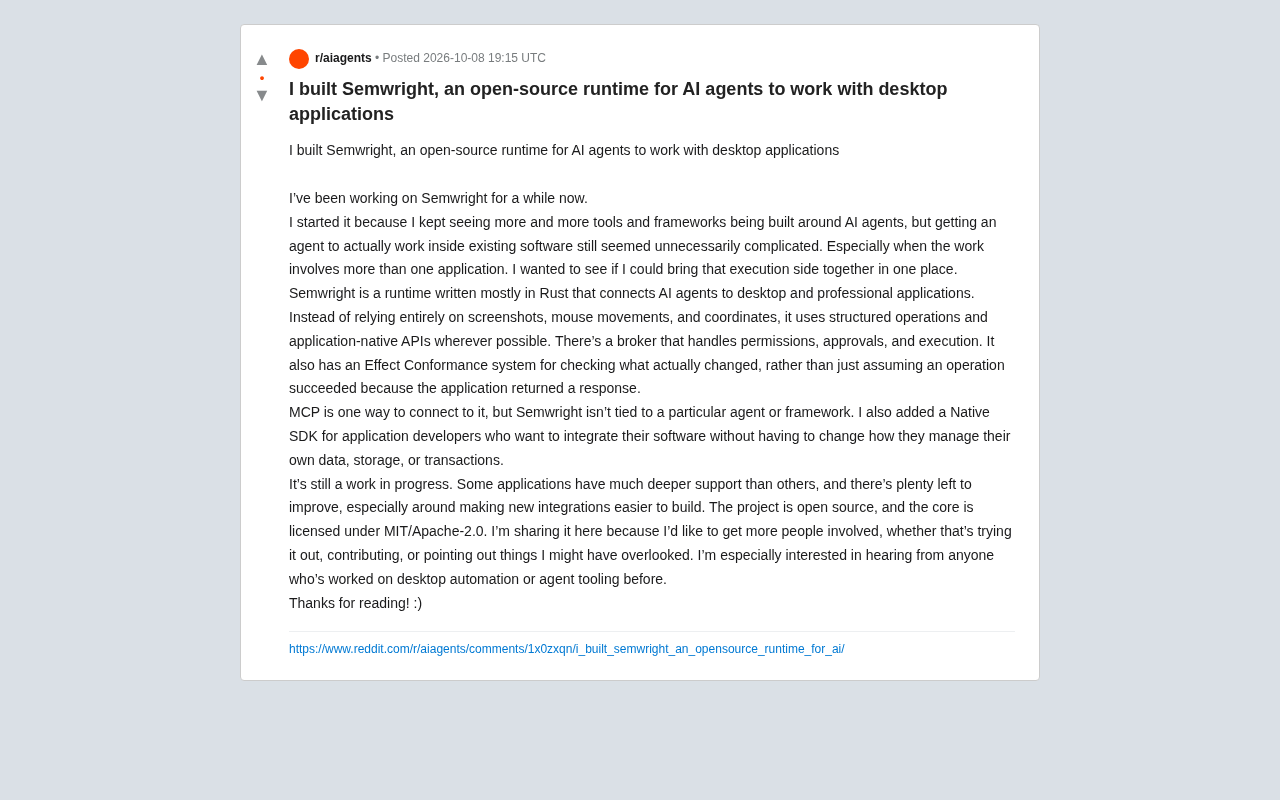
Semwright is an open-source runtime written primarily in Rust. Its core purpose: connect AI agents to desktop applications and professional software so that agents can truly operate software in a reliable way, rather than merely "watching the screen and clicking the mouse."
Structured Operations, Not Screenshots and Coordinates
Most mainstream desktop automation approaches rely heavily on screenshot recognition, mouse movement, and coordinate targeting. These methods are notoriously fragile when faced with UI changes, resolution differences, or complex workflows.
Semwright takes a fundamentally different approach. It uses structured operations and native application APIs to drive software wherever possible, rather than simulating human click behavior. This means the interaction between the agent and the application is closer to "calling an interface" than "guessing pixel positions" — a qualitative difference in terms of stability and predictability.
This design philosophy is especially critical for real production environments, where professional software typically demands high operational precision and data consistency that screenshot-based automation simply cannot deliver.
Structured Operations vs. Screenshot-Based Automation — the essential difference lies in the interaction layer. Screenshot-based approaches (like Computer Use systems built on computer vision) operate at the "pixel layer": the AI sees a screenshot, infers which coordinates to click, then executes via simulated mouse/keyboard input. This pipeline breaks easily when font scaling, theme changes, or window occlusion occurs. Structured operations work at the "semantic layer," directly calling APIs or accessibility interfaces exposed by the application (e.g., Windows UI Automation, macOS Accessibility API), issuing semantic instructions like "write value X into row 3, column 2" — completely decoupled from how the UI looks visually. This is why professional software automation often converges on COM/OLE (e.g., Excel), AppleScript, or proprietary SDKs — all of which are different forms of structured operations.
Permissions, Approval, and "Effect Conformance" Verification
The Semwright architecture includes two particularly noteworthy components.
Broker: A Unified Permission and Execution Hub
The runtime includes a built-in broker responsible for handling permissions, approvals, and execution flow. In other words, when an agent wants to operate an application, it doesn't execute without limits — everything passes through this hub for permission control and approval. This is a necessary prerequisite for controllability and security in enterprise environments.
Effect Conformance: Verifying What Actually Changed
Even more interesting is the Effect Conformance system. Traditional automation often assumes that "if the application returned a response, the operation succeeded" — but in reality, a successful response and an actually correct outcome are frequently two different things. Effect Conformance checks what an operation actually changed, rather than blindly assuming the goal was achieved.
This mechanism directly addresses a core pain point of agent-based automation: reliability. For tasks that require multiple sequential steps across applications, any single "false success" can cause everything downstream to go wrong.
Framework-Agnostic, Built for Two Types of Developers
Semwright stays open and flexible in how it can be integrated.
- MCP (Model Context Protocol) is one way to connect to it, but Semwright is not tied to any specific agent or framework. This makes it more of a general-purpose execution layer than an appendage of any particular ecosystem.
- For application developers, it also offers a Native SDK that lets software vendors integrate their own applications without changing their existing data management, storage, or transaction handling.
This dual-track design serves two distinct audiences: developers building with agents, and software vendors who want their applications to become "agent-friendly."
MCP (Model Context Protocol) is an open protocol proposed and open-sourced by Anthropic in late 2024, designed to standardize how AI models connect to external tools and data sources. Its goal is analogous to a USB interface — allowing different AI applications (Claude, Cursor, etc.) to connect to various "tool servers" through a single specification, without building a custom adapter for each integration. MCP servers can expose three types of capabilities: Tools, Resources, and Prompts, which clients invoke as needed. Semwright's support for being accessed as an MCP server means any MCP-compatible agent framework can seamlessly use it to operate desktop software — the technical foundation behind its "not tied to any specific framework" positioning.
Current Status and Open Collaboration
The author openly acknowledges the project is still under development: support depth varies significantly across different applications, and there is much to improve — particularly in making it easier to build new integrations.
The project is open-source under a dual MIT / Apache-2.0 license, a combination that's quite friendly to both commercial use and community contribution. The author posted to the community primarily to attract more participants — whether to try it out, contribute code, or point out overlooked issues — with a particular interest in feedback from people experienced in desktop automation or agent tooling.
A Brief Observation
Semwright represents a direction that's heating up in the agent toolchain space: shifting from "simulating human actions" to "structured, verifiable execution layers." As concepts like Computer Use and desktop agents grow more popular, the fragility of "watch the screen, click the mouse" approaches is drawing increasing scrutiny — and permission control combined with effect verification are precisely the key pieces needed to push this technology toward production readiness.
Of course, the real value of projects like this depends on ecosystem accumulation — the more applications are integrated and the easier it is to build new integrations, the more pronounced the network effects of the runtime become. For developers focused on deploying AI automation in practice, Semwright at minimum offers an architectural approach worth paying attention to.
Related articles

Random Pruning of the DPO Computation Graph: 1.4x Training Speedup and Lower Peak Memory
DPO training too slow and memory-hungry? This paper proposes a random pruning framework for the DPO computation graph, sampling independently across position, sequence, and branch dimensions; branch pruning achieves a 1.426x step-time speedup and cuts training time by about 30%, with in-depth attribution of memory and time gains.

Why Does JEPA Underperform MLM in Longitudinal EHR Representation Learning?
New study compares JEPA and MLM for longitudinal EHR representation learning on MIMIC-IV: three JEPA variants train stably without collapse but underperform MLM; target size, not heterogeneity, drives prediction error.

Transfer Learning + Visible Light Communication: A New Approach to Energy-Efficient Indoor Positioning
A study proposes a transfer learning-based visible light communication indoor positioning method, achieving 47% accuracy improvement on the BOSCH factory dataset, 67.5% model efficiency under high noise, and introducing the ME composite metric for energy-efficient positioning in energy-constrained industrial IoT scenarios.