SEO Page Builder Enhanced: Breaking Free from Generic AI-Generated SEO Content
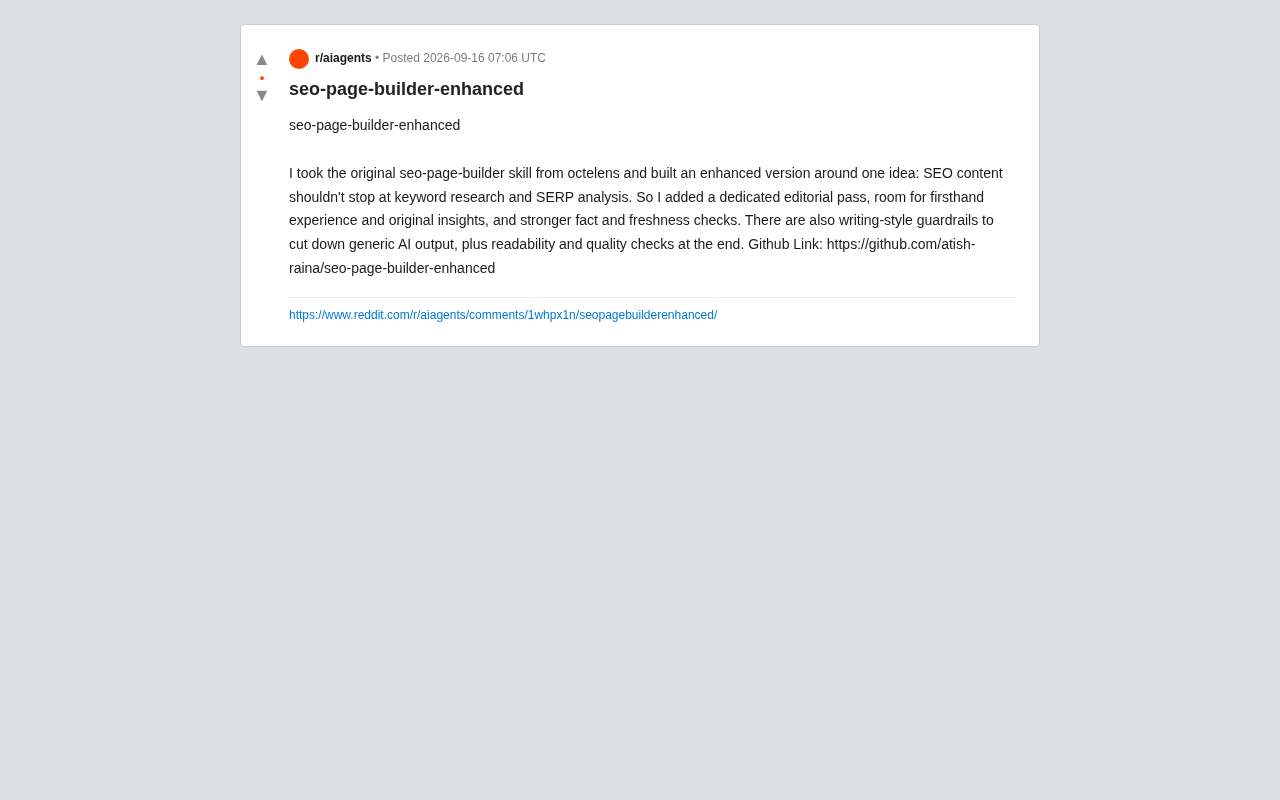
Open-source seo-page-builder-enhanced adds editorial passes, fact-checking, and style guardrails to fight generic AI SEO content.
Most AI-powered SEO tools follow the same formula — keyword research, SERP analysis, competitor-structure article assembly — producing homogenized, AI-flavored content. Developer atish-raina built on octelens's original seo-page-builder to create a quality-focused enhancement. Key additions include a dedicated editorial pass, built-in room for firsthand experience and original insights (aligned with Google's E-E-A-T), stronger fact-checking and freshness verification, and writing-style guardrails to suppress generic AI phrasing. Together these form a complete closed loop from generation to validation, offering content teams a reusable paradigm for embedding editorial quality directly into automated workflows.
The Overlooked Problem: SEO Content Shouldn't Stop at Keywords
Most SEO content generation tools follow strikingly similar logic — conduct keyword research, analyze the SERP, then assemble an article modeled after competitor structures. This workflow ensures content that "looks SEO-compliant," but comes with an obvious side effect: homogenized content, a lack of genuine insight, and that unmistakable AI aftertaste.
A developer (GitHub user atish-raina) took the original seo-page-builder skill from the octelens team and made targeted enhancements around a single premise: SEO content shouldn't stop at keyword research and SERP analysis. He broke this idea down into concrete functional modules, redefining what an AI-assisted SEO writing workflow can look like.
What the Enhanced Version Changes
Compared to the original, seo-page-builder-enhanced focuses its changes on content quality — not merely keyword coverage. The author introduced several key mechanisms.
A Dedicated Editorial Pass
A dedicated editorial pass has been added to the workflow. This means content is no longer "done once generated" — it goes through a simulated human editing stage. For SEO content produced at scale, this step is often what separates quality tiers. It's responsible for catching stiff paragraphs, logical gaps, and repetitive phrasing.
Room for Firsthand Experience and Original Insights
The author deliberately built space into the workflow for "firsthand experience" and "original insights" — directly echoing the "Experience" dimension in Google's E-E-A-T content quality framework. Content synthesized purely by a model inherently lacks real-world experience. Proactively carving out room for it is a pragmatic way to give content differentiated value.
E-E-A-T is a core concept in Google's Search Quality Evaluator Guidelines, standing for Experience, Expertise, Authoritativeness, and Trustworthiness. Originally introduced as E-A-T, Google added the "Experience" dimension in 2022, explicitly factoring in whether a content creator has direct, firsthand knowledge. This change came squarely in response to the rise of AI-generated content — machines can synthesize vast amounts of secondary information into seemingly complete articles, but cannot provide authentic usage experience, firsthand accounts, or practice-based judgment. By emphasizing Experience, Google is effectively setting a ceiling for purely synthetic content: even with comprehensive keyword coverage and compliant structure, content lacking real experiential backing will be limited in quality ratings. This is why proactively leaving room for "firsthand experience" in automated content pipelines — rather than relying entirely on model synthesis — has become standard practice for more and more content teams.
Stronger Fact-Checking and Freshness Verification
The enhanced version adds more robust fact check and freshness check capabilities. The two most common criticisms of AI-generated content are fabricated facts and outdated information. Moving these checks upstream into the generation workflow — rather than leaving them to post-publication manual review — significantly reduces the risk cost of each piece of content.
The "hallucination" problem in AI content refers to language models outputting information that is inaccurate or entirely nonexistent — with high apparent confidence — including fabricated citations, incorrect statistics, or outdated policies and product information. This problem is especially dangerous in the SEO content space: search engines crawl and serve this content to users, and once factual errors propagate, they damage site credibility and can trigger manual review penalties from Google. Freshness checks address a separate but related issue — model training data has a cutoff date, meaning generated content may reference industry data, algorithm rules, or policy information that has since been updated or deprecated. Embedding both checks into the generation workflow rather than relying on post-publication human review fundamentally shifts quality control costs from "after-the-fact remediation" to "upfront interception." In a high-volume content production environment, the value of this shift compounds with scale.
Writing-Style Guardrails Against the "AI Smell"
The most noteworthy aspect of this project is what it calls writing-style guardrails — specifically designed to suppress the generic, formulaic tone that tends to dominate model outputs.
Anyone who has read a lot of AI-generated content can instantly recognize the telltale patterns: hollow transition sentences, templated parallel structures, summary paragraphs that convey nothing new. Readers find this content off-putting, and search engines are increasingly sophisticated at identifying "low-value bulk content." Applying style guardrails to the writing process addresses these problems at the source rather than patching them after the fact.
Combined with the downstream readability check and quality check, the entire workflow forms a closed loop — from generation to editorial review to final validation. This structural completeness is more meaningful than simply stacking features on top of each other.
Where the Value Lies
From an industry trend perspective, SEO content production is experiencing a bifurcation: on one side, unlimited-volume templated content; on the other, search engines that increasingly reward content with genuine value and distinctive perspective. seo-page-builder-enhanced plants its flag on the latter side — rather than chasing higher-speed, higher-volume output, it aims to bring each piece of AI-assisted content closer to the standard of a high-quality human-written article.
For content teams and independent site operators, the significance of open-source tools like this goes beyond the tool itself. It offers a way of thinking: integrating editorial quality, real-world experience, and fact-checking into the automated workflow — rather than treating them as manual overhead that exists outside the AI process.
The project is published as open source on GitHub (atish-raina/seo-page-builder-enhanced). Developers who are interested can further customize their own content production pipeline on top of the original skill.
Summary
This project is modest in scope, but it puts its finger on a widely discussed pain point: the ceiling on AI-generated SEO content isn't determined by how completely keywords are covered — it's determined by whether content quality can hold up under scrutiny from both readers and search engines. By introducing an editorial pass, space for experiential input, fact and freshness checks, and style guardrails, seo-page-builder-enhanced offers a reusable improvement paradigm.
Background Notes
In technical implementation, writing-style guardrails typically take the form of a set of predefined prompt constraints or post-processing rules that intervene in a language model's default generation tendencies. Large language models, during training, develop a tendency toward "highly averaged" language — measured phrasing, symmetrical structure, smooth expression. This is the root cause of the "AI smell." Guardrail mechanisms can intervene along multiple dimensions: restricting specific filler phrases (such as "in conclusion" or "it's worth noting"), requiring a more natural distribution of sentence lengths, mandating specific details or data points within paragraphs, and prohibiting substance-free transitional summaries. These mechanisms are fundamentally different from simply prompting a model to "write more engagingly" — they don't ask the model to "do better," but instead establish verifiable, reusable constraints at the process level, transforming style from a subjective impression into an actionable quality metric.
Related articles

A Linux Satire Skit and the Real Concerns Behind AI Value Alignment
A Linux satire skit uses absurdist comedy to lampoon AI over-alignment and values rhetoric. This piece unpacks the serious questions it raises about AI safety, anthropomorphization, and usability.

Linux yes Command Explained: Practical Tips for Auto-Answering Prompts and Stress Testing
Complete guide to the Linux yes command: auto-answering pacman/apt prompts, batch deletion with rm -i, CPU stress testing with /dev/null, and custom output strings.

Linux nl Command: A Practical Guide to Adding Line Numbers to Files
A complete guide to the Linux nl command: add line numbers to files with control over numbering range (-b), increment (-i), width (-w), format (-n), separator (-s), and regex filtering.