Serve Robotics Opens Its Sidewalk Delivery Robot Platform, Making 2,000 Robots Available to Third Parties

Serve Robotics opens its fleet of 2,000 sidewalk robots, shifting toward platform-based capacity supply.
Serve Robotics launched the AV Delivery Developer Portal, opening its previously proprietary fleet of 2,000 sidewalk delivery robots to third-party software engineers, independent merchants, and even autonomous AI agents. This shift moves it from operating deliveries itself to becoming the underlying provider of sidewalk robot capacity, lowering the barrier for smaller merchants and developers. The core logic resembles cloud computing: improving fleet utilization to amortize high fixed costs, with revenue potentially shifting from service fees to platform capacity sharing or API charges. It signals that hardware and autonomous driving are becoming infrastructure, though safety and liability rules remain unclear.
From a Proprietary Fleet to an Open Platform
Serve Robotics is changing how it operates its sidewalk delivery robots. The company announced the launch of the AV Delivery Developer Portal, opening its autonomous last-mile delivery robots to anyone who wants to use them.
Previously, these robots were more like Serve's own closed fleet, serving specific delivery scenarios. Now, third-party software engineers, independent merchants, and even AI agents can access its fleet of 2,000 sidewalk robots through this portal.
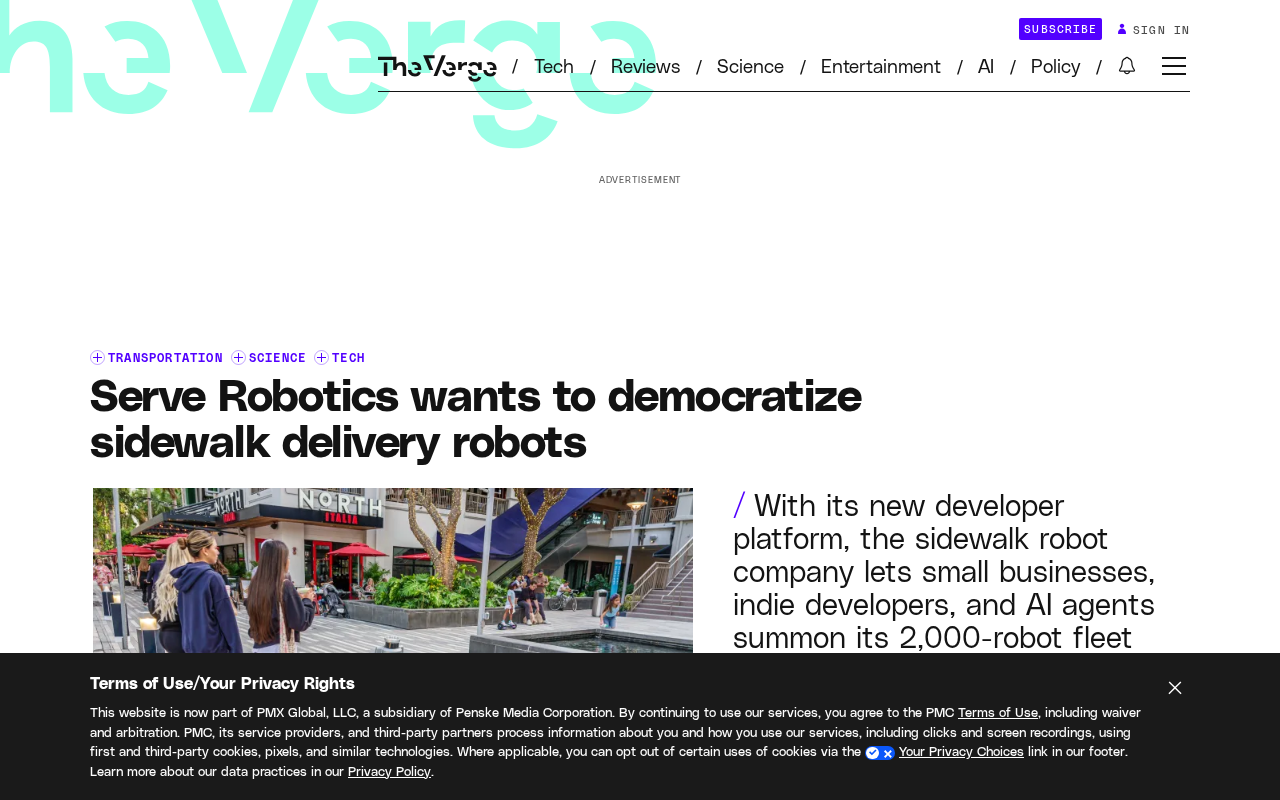
The significance of this shift is that Serve is no longer just "operating deliveries itself" but attempting to become the underlying provider of sidewalk robot capacity. For small and medium-sized merchants and developers with limited resources who cannot afford to build their own robot fleets, this lowers the barrier to entry.
Sidewalk delivery robots are small autonomous vehicles designed to travel on sidewalks, crosswalks, and other slow-speed non-motorized paths. They are typically about the size of a cooler, electrically powered, and usually limited to speeds between walking and jogging. Unlike autonomous delivery vehicles that drive on motorized roads (such as Nuro), these robots must navigate complex, low-structure urban micro-environments involving pedestrians, curbs, steps, and bike lanes, so they rely more on lightweight sensor suites and real-time obstacle avoidance algorithms than on high-definition maps. Serve Robotics originated from Uber's Postmates delivery robot project, later spun off as an independent company with investment from NVIDIA and others. Its fleet primarily provides last-mile delivery for food delivery platforms in select U.S. cities, making it one of the few companies in this niche to reach scaled operations.
What the Developer Portal Can Do
According to official information, the core of the new portal is to provide external developers with access to the fleet. This means third parties can build their own delivery logic, dispatch workflows, or higher-layer applications around these robots without having to start from hardware and underlying autonomous driving capabilities.
Notably, "autonomous AI agents" are also listed as potential users. This suggests the platform's interface may be designed for programmatic calls: AI agents can invoke the delivery capabilities of physical robots much like calling an API. This model of "agents calling physical capacity" is still relatively novel in logistics and robotics.
For independent merchants, the portal offers an on-demand way to access services—no need to purchase robots or maintain an operations team to use sidewalk delivery services in specific scenarios.
The AV Delivery Developer Portal is a collection of open interfaces for third parties, typically including API documentation, sandbox testing environments, key management, call quotas, and billing rules. Its key difference from traditional logistics APIs is that the objects being called are not data or cloud resources but physical robots with physical locations, battery levels, cargo space, and driving states. Therefore, the interfaces need to expose capabilities such as task ordering, capacity availability queries, status callbacks, and exception reporting. The so-called "AI agent access" allows LLM-driven agents to initiate delivery tasks programmatically, which requires interfaces to have machine-readable semantic descriptions, clear failure retry conventions, and idempotency guarantees; otherwise, automated calls can easily lead to duplicate orders or unclear accountability.
Why This Matters
Sidewalk delivery robots have long faced a structural contradiction: delivery demand density within a single city is limited, while the fixed costs of building a proprietary fleet are high. By choosing an open platform, Serve is essentially trying to amortize costs by improving fleet utilization—letting more demand-side participants share the same set of robots.
This approach is similar to the logic of cloud computing platforms: the party that owns the infrastructure opens up its capabilities, and third parties build applications on top. If the model works, Serve's revenue structure will shift from pure delivery service fees to platform-based capacity revenue sharing or API call charges.
Risks also exist. An open platform means establishing clear rules on safety, dispatch priorities, and liability allocation—especially when the callers are automated AI agents rather than human operators, making exception handling and accountability more complex. The information Serve has disclosed so far is insufficient to answer these details.
Fleet utilization refers to the proportion of time or mileage during which vehicles actually perform effective tasks within a statistical period, and it is a core metric for asset-heavy operations. Delivery robots have high per-unit hardware costs and fixed depreciation and maintenance expenses; if they only take orders during lunch and dinner peaks and sit idle the rest of the time, the per-order cost will be amortized very little. An open platform fills low-period gaps by bringing in third-party demand, increasing order density for the same set of robots and thereby lowering per-order fixed costs—this is isomorphic to the logic of cloud computing selling idle compute to multiple tenants to improve server utilization. However, utilization improvements are also subject to physical constraints: robot battery life and charging cycles, urban service radius, and cross-district dispatch costs all impose ceilings, and platformization does not necessarily bring linear amortization.
Industry Signals
Serve Robotics' move reflects a trend in the delivery robot industry: hardware and autonomous driving capabilities are gradually being treated as infrastructure, and the focus of competition is shifting toward platform ecosystems and developer relations. A fleet of 2,000 robots is not large in itself, but as a starting point for an open platform, it provides a testbed for validation.
Whether it can attract enough third-party developers will determine whether this portal becomes a true ecosystem gateway or merely remains at the conceptual level.
One-line Summary
Serve Robotics opens its fleet of 2,000 sidewalk robots, shifting toward platform-based capacity supply.
Paragraph Summary
Serve Robotics launched the AV Delivery Developer Portal, opening its previously proprietary fleet of 2,000 sidewalk delivery robots to third-party software engineers, independent merchants, and even autonomous AI agents. This shift moves it from "operating deliveries itself" to "becoming the underlying provider of sidewalk robot capacity," lowering the barrier for small and medium-sized merchants and developers to use robot delivery. The core logic is similar to cloud computing: by opening the platform to improve fleet utilization and amortize high fixed costs, the revenue structure may shift from delivery service fees to platform capacity revenue sharing or API call charges. At the industry level, this reflects that hardware and autonomous driving capabilities are being treated as infrastructure and the focus of competition is shifting toward platform ecosystems, though rules on safety, dispatch priorities, and liability allocation remain to be clarified.
Related articles

AeroJEPA: A Two-Stage Joint Embedding Predictive Framework Revolutionizes PM2.5 Forecasting
AeroJEPA proposes a two-stage joint embedding predictive framework for regional PM2.5 forecasting: Stage I fuses historical observations and meteorological information to learn future spatial representations, while Stage II uses predicted meteorology to refine states. Compared with PFGNet, gridded RMSE is reduced by 17.23%, independent station RMSE by 7.90%, and 48-hour recursive forecasting outperforms numerical forecasting.

Lazy-CPBS: Making Industrial AGV Fleet Coordination More Efficient
A new study proposes the AGV-MAPF_R-CTC formal framework and the Lazy-CPBS algorithm, significantly reducing the search overhead of continuous-time MAPF in industrial AGV fleet coordination through lazy materialization of high-level nodes, with experiments showing the best robustness/runtime trade-off on industrial road networks.

How Do Random Feature Networks Solve Stochastic Optimal Control? New Theory Reveals Error Trade-offs
New research analyzes objective error of random feature neural networks (RFNNs) as feedback policies in stochastic optimal control, revealing trade-offs between feature width and sample paths, and the improvement of pruning strategy PRFL.