SF Tech Week in Action: The Real Value of In-Person Tech Community Events

A thank-you tweet from SF Tech Week reveals the enduring value of in-person tech community events.
Using a brief tweet posted during SF Tech Week (#SFTechWeek) as a starting point, this article explores the unique role in-person tech events play in today's ecosystem. The post — a simple public thank-you to the @Techweek_ team — points to several core principles of tech community building: in-person events create scarce, high-value spaces for founders, investors, and engineers to connect; the hashtag-plus-mention strategy efficiently amplifies an event's online reach; and public acknowledgments are a standard way for participants to maintain partnerships and build industry credibility.
A Live Update from SF Tech Week
A brief tweet recently captured a participant's enthusiastic experience at San Francisco Tech Week (#SFTechWeek), along with a public shoutout to the organizing team at @Techweek_ for their partnership. The original post was short and to the point:
"We have been having such a fun time at #SFTechWeek! Thanks to the @Techweek_ team for being such great partners!"
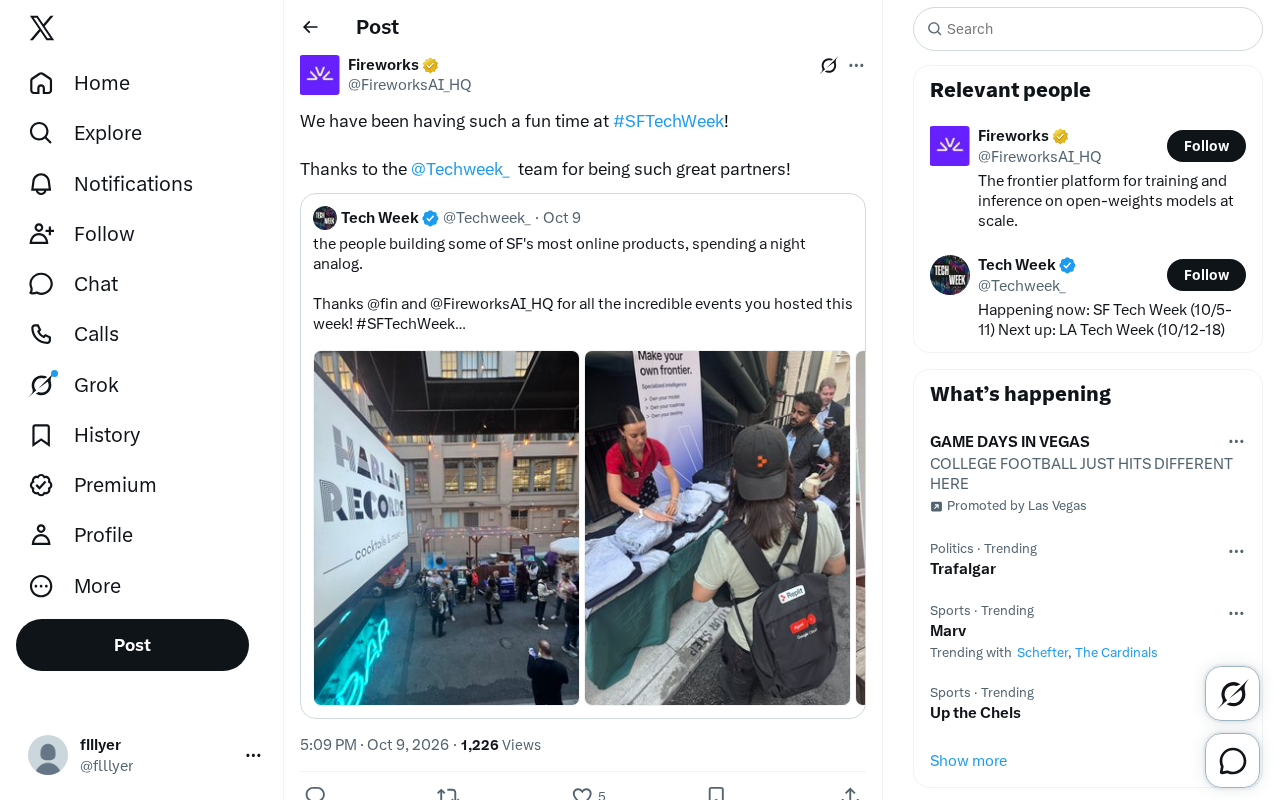
On its own, this post carries limited informational weight — it's more of a social interaction and brand moment during an active event. That said, it offers a small but telling window into the role that in-person tech gatherings continue to play in today's ecosystem.
Why Tech Week Events Still Matter
In an era defined by remote work and online collaboration, in-person gatherings like Tech Week stand out for their distinct value. These events are typically organized through multi-partner collaborations and draw founders, investors, engineers, and journalists — giving industry participants rare opportunities to connect face-to-face, build relationships, and showcase products.
As one of the world's leading hubs for tech innovation, San Francisco's Tech Week consistently attracts a high density of startups and capital. When participants share positive experiences on social media, it's both a genuine expression of enthusiasm and a lightweight form of brand marketing — using the @mention and unified hashtag (#SFTechWeek) to amplify the event's reach across the network.
SF Tech Week typically takes place in the fall and is one of the largest tech industry gatherings in the Bay Area, operated by Techweek. Unlike single-company summits, Tech Week follows a "distributed" model — dozens or even hundreds of side events run simultaneously across the city throughout the week, spanning startup pitches, investor meetups, product demos, and technical workshops, with participants ranging from top-tier VCs to early-stage startups. This decentralized structure lowers the barrier to entry and gives companies of all sizes a relevant stage for visibility. The Techweek brand operates in multiple cities — including New York and Chicago — but the San Francisco edition, given its geographic position and ecosystem density, tends to attract the most attention.
What a Thank-You Tweet Reveals About Community Building
This particular post specifically called out the @Techweek_ team by name, describing them as "great partners." Public acknowledgments like this are a common fixture in tech community culture. They reflect the collaborative relationship between event organizers and participating organizations, and help foster positive, reciprocal engagement across social networks.
For companies looking to boost their visibility through industry events, actively participating and sharing positive feedback on social platforms is a standard practice for maintaining partnerships and building a reputation within the industry. Posts like this may be brief, but they're a routine part of shaping a brand's presence within a professional community.
In social media marketing, the combination of hashtags and @mentions is a low-cost, high-efficiency distribution strategy. A unified hashtag like #SFTechWeek aggregates content from disparate accounts into a searchable, collective narrative around the event. Meanwhile, @mentioning the organizer triggers a notification that increases the likelihood of a repost or like — effectively amplifying reach in both directions. Brands and participants together use this mechanism to build an event's online presence, extending the impact of an in-person gathering to audiences who couldn't attend. In the tech industry, this has become a well-established norm, and serves as one of the key metrics for gauging an event's social momentum.
Closing Thoughts
Given the limited information in the original source material, this tweet is best understood as a real-time snapshot from the event floor — not a deep industry take or product announcement. But it serves as a useful reminder that the tech industry's growth is driven not only by technological breakthroughs, but also by the ongoing work of in-person communities, event partnerships, and professional networks. For anyone tracking the pulse of the tech ecosystem, paying attention to moments like these can offer genuine insight into the industry's culture and rhythm.
Related articles

"Black October": Did AI Uncover 3% of All Critical Vulnerabilities Ever?
A Reddit post claims 3% of all critical software vulnerabilities ever were found in the past month, dubbed 'Black October.' We break down the statistical issues, how AI-assisted code auditing accelerates discovery, and how developers should respond.

Microsoft Project Gecko: Using AI to Bridge Language Gaps for African Farmers
Microsoft's Project Gecko launches PharmaChat, letting African farmers ask questions in their native language and get precise video clips and farming book chapters via AI. The project also releases three interactive manuals to advance inclusive AI.

Musk's Space Dominance: How Starlink Throttling Undermines Ukraine's Defense
SpaceX's Starshield throttling disabled Ukraine's high-speed interceptor drones, exposing how Musk's private control over low Earth orbit communications affects battlefield dynamics and national security, and highlighting the risks of commercial space militarization and space governance dilemmas.