sHAIL-Causal: Discovering True Causal Predictors via the Invariance Staircase

sHAIL-Causal uses cross-environment invariance instead of complexity penalties to provably identify true causal predictors.
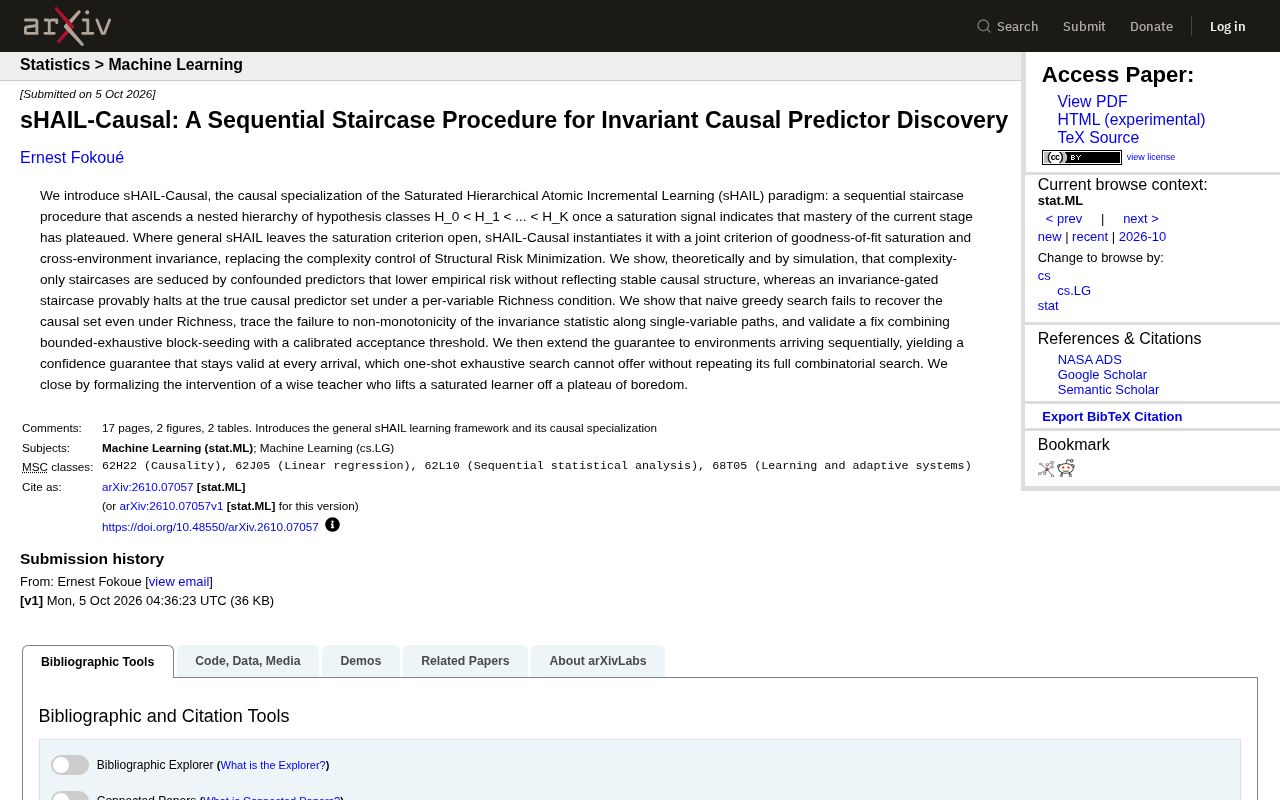
sHAIL-Causal is a machine learning framework designed for causal discovery. Its core contribution is replacing SRM's complexity-based model selection with a joint criterion of goodness-of-fit saturation and cross-environment invariance. The framework ascends a nested hypothesis class hierarchy, halting when the current level saturates and invariance is satisfied. The paper proves that complexity-driven staircases are misled by confounders, while invariance-gated staircases provably stop at the true causal set under a per-variable Richness condition. For greedy search failures caused by non-monotone invariance statistics, block-seeding with calibrated thresholds is proposed as a fix. The framework also extends to sequentially arriving environments, maintaining valid confidence guarantees at each new arrival.
The Core Challenge in Causal Prediction: Avoiding Confounders
In machine learning, predictive accuracy doesn't equal a genuine understanding of causal relationships. A model may identify variables that are highly correlated with a target, yet rely entirely on confounding structure — correlations that collapse the moment the environment changes. sHAIL-Causal, introduced in a recent arXiv paper, directly addresses this pain point: it is a specialized version of the Saturated Hierarchical Atomic Incremental Learning (sHAIL) framework, tailored for causal discovery.
The paper's premise is straightforward: traditional Structural Risk Minimization (SRM) relies on complexity control to select models, but this "complexity-only" strategy can be seduced by confounded predictors. Those variables reduce empirical risk and appear to perform well, yet fail to reflect a stable causal structure. In other words, low risk doesn't necessarily mean you've found the true cause.
Confounding Variables are a classic obstacle in causal inference. When a variable Z influences both a predictor X and a target Y, a statistical correlation arises between X and Y — not because of a causal relationship, but due to a "common cause" creating a spurious association. For example, ice cream sales and drowning incidents are highly correlated, but both are driven by temperature; ice cream doesn't cause drowning. In machine learning, models exploit such correlations indiscriminately, performing well on the training distribution but failing sharply once deployed in a different environment where the confounding structure has changed. Methods like Invariant Causal Prediction (ICP) identify predictive relationships that remain stable across multiple different environments, because true causal mechanisms don't depend on a specific environment, while spurious correlations introduced by confounders disappear as the environment shifts. sHAIL-Causal adopts this "cross-environment invariance" as its core criterion, directly following this causal identification logic.
The Staircase Search: From Saturation Signals to Invariance Gating
The fundamental mechanism of sHAIL is a "sequential staircase": it ascends a nested hierarchy of hypothesis classes H_0 ⊂ H_1 ⊂ ... ⊂ H_K step by step. Whenever the current stage's mastery reaches "saturation" — meaning performance gains stall — the system triggers a signal and moves up to the next, richer hypothesis class.
General sHAIL does not specify what the saturation criterion should be. The key contribution of sHAIL-Causal is to provide a concrete joint criterion: goodness-of-fit saturation + cross-environment invariance. This combination replaces the complexity penalty term in SRM.
The paper argues both theoretically and through simulation that a complexity-only staircase can be "lured" by confounded variables, whereas an invariance-gated staircase — under a per-variable "Richness" condition — provably halts at the true set of causal predictors. This is a remarkably strong guarantee: it realigns "predicts well" with "causally correct."
Structural Risk Minimization (SRM) is a classic framework in statistical learning theory proposed by Vapnik. Its core idea is to trade off empirical risk (training error) against model complexity (typically measured by VC dimension or Rademacher complexity), favoring the simplest model that fits the data adequately. The theoretical basis is that higher-complexity models have looser generalization error bounds, so selecting the simplest sufficiently fitting model controls overfitting. However, SRM's complexity control is "environment-agnostic" — it does not distinguish between stable causal signals and environment-dependent confounded correlations. In a multi-environment setting, a confounded variable might happen to correlate with the target across all training environments, making it impossible for complexity penalties to exclude it. sHAIL-Causal's substitution of cross-environment invariance for complexity as the model selection criterion is a direct response to this limitation.
Why Greedy Search Fails, and How to Fix It
A natural approach is to use greedy search, adding variables one at a time. But the paper shows that even when the Richness condition holds, naive greedy search cannot recover the true causal set.
The root cause is traced to the non-monotonicity of invariance statistics along single-variable paths. That is, along a path that changes only one variable at a time, the invariance measure may rise and fall non-monotonically, causing greedy algorithms to stall in local traps and miss the true causal combination.
The authors' fix combines two elements:
- Bounded-exhaustive block-seeding: exhaustively enumerating candidate blocks within a controllable range, bypassing the traps inherent in single-variable paths;
- Calibrated acceptance thresholds: using statistical calibration to decide when to accept a candidate set.
This combination is validated in the paper as a reliable way to circumvent the failures caused by non-monotonicity.
Sequentially Arriving Environments: Confidence Guarantees That Hold Over Time
Another important extension in the paper is generalizing the guarantees to the setting where environments arrive sequentially. In practice, new observational environments often appear one after another rather than all at once.
sHAIL-Causal provides a confidence guarantee that "remains valid at each arrival" in this setting. By contrast, a one-shot exhaustive search that aims to maintain equivalent guarantees as each new environment arrives would need to repeat its full combinatorial search — at prohibitive computational cost. The sequential framework therefore offers a clear advantage in scalability.
Sequential validity is an important concept in statistical inference, distinct from traditional "fixed-sample" hypothesis testing. A conventional confidence interval is constructed once after data collection is complete; repeatedly examining results and making decisions during data collection inflates the Type I error rate (the "peeking problem"). Sequentially valid methods — such as martingale-based confidence sequences — guarantee that error rates remain controlled at any point in time when conclusions are examined. In the sHAIL-Causal setting, the successive arrival of new environments is analogous to the incremental accumulation of data: each time a new environment arrives, the system must provide a valid confidence guarantee for its current causal set estimate, rather than waiting until all environments are available. The ability to maintain this "valid at any time" guarantee means the framework is practically deployable in open-world settings — no prior knowledge of the total number of environments is needed, and nothing needs to be rebuilt from scratch each time the environment is updated.
The "Wise Teacher" Metaphor: Lifting a Saturated Learner Off the Plateau
The paper closes with an evocative formalization: the intervention of a wise teacher. When a learner stalls on a "plateau of boredom," a wise teacher can lift it to the next level.
This metaphor echoes the core philosophy of sHAIL — learning is a layered, incremental process driven by saturation signals. Saturation is not an endpoint, but an entry point into a higher hypothesis class. Formalizing teacher intervention means the framework not only describes automated staircase ascent, but also provides a theoretical role for external guidance in accelerating the process.
Significance and Limitations
The value of sHAIL-Causal lies in shifting causal discovery from a "complexity regularization" paradigm to an "invariance gating" paradigm, backed by provable stopping guarantees. This carries methodological significance for machine learning systems that prioritize robustness and transferability.
It should be noted, however, that the paper's guarantees depend on fairly strong premises — most notably the per-variable Richness condition, which may not always hold in real-world data. As a newly posted preprint, the adequacy of its simulation validation and its performance on high-dimensional real data remain to be tested by follow-up work. For researchers focused on causal inference and invariant learning, this is a direction well worth tracking.
Related articles

Amphibious Transforming Drone: Beyond 100x Power Savings, What Are the Real Needs?
Is the amphibious transforming drone just a gimmick? Starting from the 100x power difference of the M4 Morphobot, explore real application scenarios and thesis topic ideas, analyzing boundary conditions where pure drones and pure ground robots both fail.

Warhound Raises $200 Million: Genetically Engineered "War Dogs" Paired with Anduril Gear
Warhound raises $200M, backed by Ben Lamm and Palmer Luckey, to genetically engineer dogs for military and law enforcement use and equip them with Anduril gear. This article analyzes its technology direction, funding logic, and ethical controversy.

Claude API Comes to Google Cloud: IAM Integration and SDK Access Guide
Anthropic hosts the full Claude API on Google Cloud with IAM-controlled permissions and unified billing. This guide covers the Vertex AI and Anthropic-hosted entry points, IAM role configuration, and SDK access.