Ship Safe: A Deep Dive into the Open-Source Security Scanner for AI Coding Agents
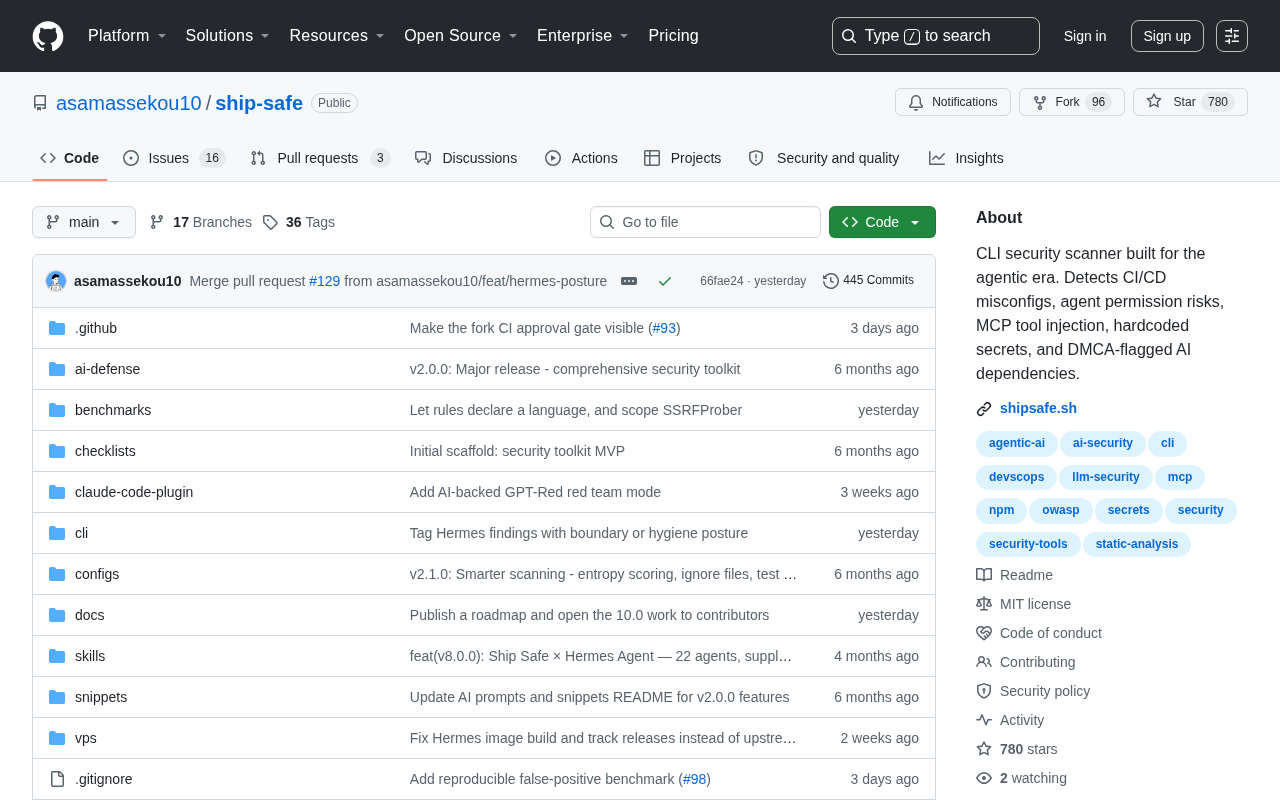
Ship Safe is an open-source security scanner designed to embed safety checks directly into AI coding agent workflows.
As AI coding agents generate code at unprecedented speed, Ship Safe emerges as an open-source security scanner purpose-built for agent workflows. It features incremental diff-based scanning, closed-loop feedback that agents can act on autonomously, and transparent rules via open source. The article explores why traditional SAST/SCA tools fall short for agents, how prompt injection threatens agent security, and offers practical recommendations for teams adopting AI-assisted development.
When Coding Agents Write Code Autonomously, Who's Guarding Security?
As AI coding agents proliferate—from GitHub Copilot to Cursor, Claude Code, and various autonomous Agent frameworks—code is being generated at unprecedented speed. But the flip side of speed is risk: AI-generated code often lacks a deep understanding of security boundaries. It may introduce hardcoded secrets, injection vulnerabilities, insecure dependencies, or even get committed directly to production without any human review.
It's against this backdrop that the open-source project Ship Safe was born—positioned as an "open-source security scanner for coding agents." The name itself is a double entendre: it means both "ship safely" and implies that every line of code delivered by AI should withstand security scrutiny.
New Security Challenges in the AI Coding Era
Traditional security scanning tools (such as SAST and SCA) were mostly designed for human developers and typically intervene late in the CI/CD pipeline, scanning code that's already been written. SAST (Static Application Security Testing) uses techniques like pattern matching, data flow analysis, and control flow analysis to discover potential vulnerabilities in source code—such as SQL injection, cross-site scripting (XSS), and buffer overflows—without running the program. SCA (Software Composition Analysis) focuses on identifying open-source components used in a project and their known vulnerabilities by cross-referencing CVE databases to assess third-party dependency risks. These two categories of tools form the cornerstone of the traditional DevSecOps toolchain, but their design assumes code is written and committed by humans at a relatively slow pace.
However, AI coding agents bring fundamentally different challenges:
- Extremely fast generation speed: Agents can produce hundreds of lines of code in minutes—manual review simply can't keep up.
- Missing context: Agents don't necessarily understand the project's security policies, compliance requirements, or historical vulnerabilities.
- Increased autonomy: More and more agents have the ability to commit directly, execute commands, or even deploy—amplifying the impact of any mistake.
This means security checks need to "shift left" closer to the agent's generation phase, or even be embedded within the agent's work loop. "Shift Left Security" is a core principle of the DevSecOps movement in recent years, advocating for security checks to be pushed as early as possible in the development lifecycle. In traditional CI/CD pipelines, security scanning is typically scheduled after code is merged to the main branch, while shifting left requires real-time detection during code writing—lowering remediation costs and shortening feedback cycles. Ship Safe aims to fill precisely this security gap between "agent generation" and "code commit."
Ship Safe's Core Design Philosophy
From a positioning standpoint, Ship Safe's core approach is to specifically adapt security scanning capabilities to AI coding agents' workflows, rather than simply repurposing existing scanners.
Incremental Scanning Logic Designed for Agents
A key distinction lies in the "scan target." Traditional tools target complete code repositories, while tools like Ship Safe focus more on code snippets (diffs) that agents generate or modify in a single task. Incremental scanning means performing security analysis only on newly added or modified portions of the codebase—typically implemented via diff (difference comparison) in Git workflows, analyzing only the lines that changed between two commits. The advantages of this approach are speed and low noise (it won't re-report known issues), making it ideal for high-frequency commit scenarios. For AI coding agents, the significance of this mechanism is even more pronounced: an agent may modify the same file multiple times during a single conversation, and performing an incremental scan immediately after each modification can return security feedback within seconds—creating an experience similar to "instant compiler error notifications." This incremental, task-level scanning better matches the agent's work rhythm and delivers security feedback faster, enabling the agent to fix issues during the generation phase.
Closed-Loop Security Feedback Mechanism
An even more valuable concept is this: security scan results aren't just reports for humans to read—they can be fed directly back to the agent as input for its next correction step. In other words, the scanner becomes part of the agent's self-correction loop—detecting issues, returning structured alerts, and the agent rewriting code accordingly. This "detect-fix-redetect" closed loop is the form that AI coding security truly needs. This design borrows from the reinforcement learning concept of "environment feedback driving behavioral improvement": the security scanner plays a role similar to reward/punishment signals in the environment, continuously guiding the agent to produce safer output. Structured alert formats (rather than vague natural language descriptions) are crucial for the agent's precise understanding and correction—they need to clearly indicate the line number where the issue occurs, the vulnerability type, severity level, and suggested remediation approach.
Strategic Significance of the Open-Source Approach
Ship Safe's choice of the open-source route is noteworthy. Open-sourcing a security tool means: transparent rules, auditability, community contributions to detection rules, and easy customization for teams based on their specific scenarios. For the security domain, transparency itself is the foundation of trust—it's hard to trust a black-box security scanner, just as Kerckhoffs' principle in cryptography emphasizes: a system's security should not depend on the secrecy of its algorithm, but on the key (in this context, the specific security policy configuration). Additionally, open source lowers the barrier for small and medium teams to adopt security checks, preventing the high license fees of commercial security tools from becoming an obstacle to security practices.
Why Agent Security Tools Will Become Increasingly Important
It's worth noting that Ship Safe is still a very early-stage project. But the direction it points to represents a rapidly forming market segment.
Agent Security Is Becoming an Independent Topic
Security discussions around AI agents are heating up dramatically. People are no longer just asking "how good is AI-generated code quality"—they're beginning to ask deeper questions:
- Are the commands executed by the agent safe?
- Are the dependencies it introduces trustworthy?
- Could it leak sensitive information?
- Could prompt injection manipulate the agent into writing malicious code?
Prompt injection is a highly threatening class of attacks targeting large language model applications. Attackers embed carefully crafted instructions within input data, attempting to override or bypass the system's original prompt constraints to manipulate the model's behavior. In the coding agent scenario, such attacks can be even more covert and dangerous: malicious content may be hidden in code comments, README files, dependency package descriptions, or Issue content. When the agent reads these during its work process, the embedded malicious instructions may induce the agent to generate code containing backdoors, leak secrets from environment variables, or execute unauthorized system commands. Indirect Prompt Injection is particularly difficult to defend against because the malicious payload doesn't come directly from user input, but from third-party content retrieved during the agent's work process.
These problems can't be solved by traditional manual code review—automated, agent-aware tools must intervene. Ship Safe is one product of this trend.
From Auxiliary Tool to Essential Infrastructure
It's foreseeable that as enterprises increasingly use coding agents in production environments, security scanning for agents will gradually shift from "nice to have" to "compliance necessity." Just as no team today would dare ship code without CI tests, in the future no team will dare let AI agents autonomously commit code without security guardrails. From a regulatory perspective, the EU's AI Act and U.S. executive orders have already begun imposing traceability and security requirements on AI systems, which will further push agent security tools from optional to mandatory.
Practical Recommendations for Developers and Teams
Even if you haven't adopted Ship Safe yet, there are some universal practices worth implementing early around AI coding agent security:
- Don't blindly trust agent-generated code: Treat AI output as "intern's code"—assume it needs review by default. AI models may have learned insecure coding patterns from training data (such as using deprecated encryption algorithms or lacking input validation), and they have no awareness of accountability for code consequences.
- Add automated security checks to your pipeline: Whether SAST, secret scanning, or dependency checking, all should serve as mandatory gates for agent-submitted code. It's recommended to configure these checks as "blocking" rather than "alerting"—meaning high-severity issues directly prevent merging rather than merely sending notifications.
- Restrict agent permission boundaries: Especially for agents with command execution or deployment capabilities, follow the principle of least privilege. The Principle of Least Privilege requires that each subject should only be granted the minimum set of permissions necessary to complete its task. Specifically, if an agent's task is only to write code, it shouldn't have the ability to execute shell commands or access the network; file system access should be restricted to the project directory; deployment permissions should be controlled through independent approval processes. Some cutting-edge agent frameworks have already begun introducing sandboxing mechanisms and permission declaration systems, similar to mobile app permission models.
- Follow open-source projects in the agent security ecosystem: Tools like Ship Safe, while early-stage, are worth tracking continuously—early participation also means stronger customization capabilities. Related directions worth watching include agent behavior log auditing, runtime anomaly detection, and security protocols for inter-agent communication.
Conclusion
Ship Safe may currently be just one of many early-stage projects, but it accurately targets a pain point that the industry is increasingly recognizing: when the entity writing code shifts from humans to AI, the security gatekeeper must evolve accordingly. Open source, agent-aware, closed-loop feedback—these keywords together outline the prototype of the next generation of code security tools. For every team embracing AI-assisted programming, now is the time to seriously think about "agent security." We're at a historic turning point: the degree of automation in software development is accelerating rapidly, and the automation of security assurance must keep pace or even stay ahead—otherwise, we face a dangerous situation where code output speed far exceeds security review capacity.
Related articles

CSS Anchor Positioning: A New UI Positioning Approach Without JavaScript
A deep dive into CSS Anchor Positioning: from anchor-name and position-anchor to the anchor() function, position-area shorthand, position-try-fallbacks, anchor-size, and upcoming anchor queries.

New AI Chart Interaction: Continuous Follow-up Questions and Visualization in Conversation
Explore a new AI interaction method for continuously generating charts in conversation. Use the /visualize command to ask follow-up questions and visualize answers in the same chat window, improving data analysis efficiency.

Cursor Merges Into X Subscription: Paid Plans Share Unified Usage Pool, Grok Model Coding Usage Doubled
Cursor joins The X Subscription with a unified usage pool and doubled Grok coding quota. Third-party models shift to API pricing. Existing users can keep or migrate plans.