ShipHQ: Turning Real Subscription Data into an Isometric-Style Startup Office

ShipHQ gamifies subscription data into a living isometric office to motivate indie developers.
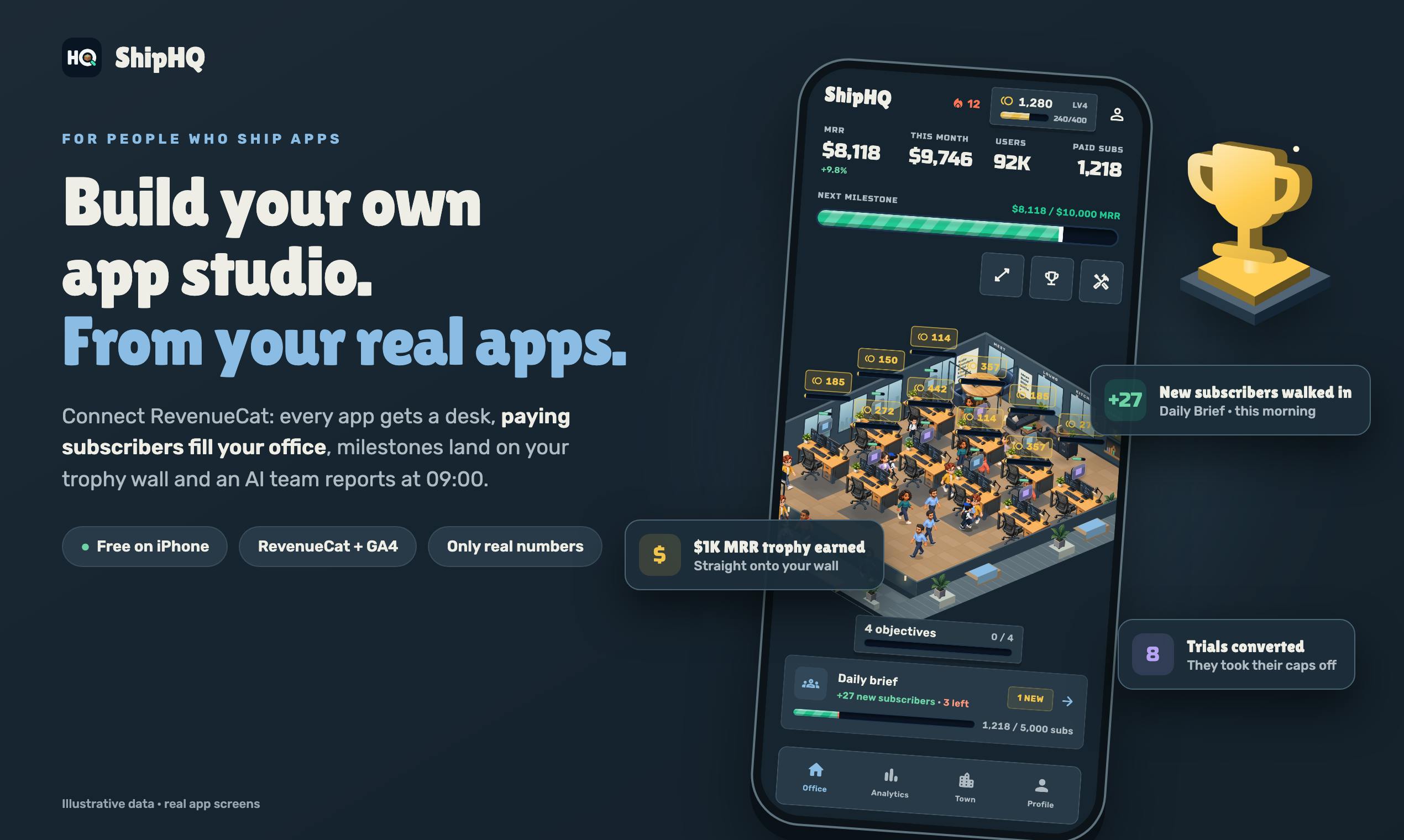
ShipHQ is a free iPhone app for indie developers and early-stage teams that connects to RevenueCat to transform subscription data into an isometric virtual startup office — each paying user becomes an office character, and growth is visualized spatially. Its Daily Brief replays overnight events each morning with personified scenes, milestone trophies can only be earned through real achievement, and AI managers run a structured standup at 09:00 every day covering growth, reviews, and competitors. The product reflects a broader trend toward emotional and gamified utility software.
Redefining the App Dashboard with Gamification
Developers and founders spend their days staring at dashboards: new subscriptions, trial conversions, churn rates, revenue curves. These cold numbers are critical, yet rarely deliver meaningful emotional feedback. ShipHQ — which ranked fifth on Product Hunt — takes a radically different approach: it transforms your app's real data into a living, breathing isometric-style startup office.
Built by developer Rıdvan Uyan, the app is currently free on iPhone. It launched to 104 upvotes and 7 reviews, sitting at the intersection of productivity, analytics, and gaming. That cross-genre positioning says everything about its core philosophy: make data analysis as engaging as a management sim.
Every Paying User Is a Person in Your Office
ShipHQ's core mechanic is built on its integration with RevenueCat — the widely adopted mobile subscription management service. Once connected, ShipHQ converts each paying subscriber into a virtual character inside your office scene, appearing at a desk beside you. The abstract concept of a "subscriber count" becomes something tangible: team size you can actually see.
This design cleverly harnesses the power of concreteness. When your paying users grow from 10 to 100, you're not watching a number tick upward — you're watching desks fill up. For indie developers and early-stage founders, that kind of visual growth feedback may be more motivating than a traditional line chart.
Founded in 2018, RevenueCat has become the de facto infrastructure standard for mobile subscription monetization, supporting iOS, Android, and cross-platform frameworks. It helps developers unify subscription logic across the App Store, Google Play, and other platforms, while providing real-time Webhook pushes and APIs for subscription status, revenue data, and user lifecycle events (trial starts, renewals, cancellations, etc.). Because RevenueCat is already standard kit for a large number of indie developers and small teams, ShipHQ's choice to use it as its sole data source dramatically lowers the integration barrier — no additional instrumentation or configuration required. An existing RevenueCat account is all it takes to power the entire virtual office's data layer.
Daily Brief: A Morning Replay of Last Night's Growth
ShipHQ's most distinctive feature is the Daily Brief. Every morning, the app replays all the key events from the night before, giving each one a personalized narrative:
- New subscribers walk into the office to applause
- Trial users make their entrance wearing a hat
- Churned users receive a proper send-off
This storytelling approach to data turns dry metric shifts into small, emotionally resonant moments. For founders who need to stay the course over the long haul, this kind of daily ritual may ease data anxiety and make it easier to face volatility with a lighter mindset.
Milestone Trophies: Earned, Never Bought
ShipHQ also features a milestone trophy system. When your app hits specific achievements, trophies appear on the office wall. The product explicitly emphasizes that these are "earned, never bought, never retroactive" — they can only be won through real achievement, cannot be purchased, and won't be backdated for past results. This detail reflects the product's commitment to authentic growth, avoiding the hollow sense of accomplishment that plagues many gamified products.
The AI Manager: A Virtual Standup Every Day at 09:00
Beyond data visualization, ShipHQ introduces AI manager characters. Every morning at 9:00, they run a standup covering three dimensions: growth, user reviews, and competitor activity.
This feature reframes AI from a pure analysis tool into a "virtual colleague." For solo indie developers, it fills a gap left by the absence of a real team — not quite the same, but it offers the companionship of having someone to debrief with every day.
The standup originates from the Daily Scrum practice in agile development: a fixed-time, under-15-minute team sync typically structured around three questions — what did you do yesterday, what are you doing today, and what's blocking you? For teams, it's a critical mechanism for alignment and risk detection. For indie developers, this rhythm is naturally absent, making it easy to fall into execution inertia without regular reflection. By anchoring the AI standup to a specific time (09:00) and limiting it to three defined dimensions (growth, reviews, competitors), ShipHQ deliberately simulates the cadence of team collaboration — using structured external triggers to replace personal discipline and help solo developers build a consistent review habit.
Thinking About Product Positioning
ShipHQ reflects a broader product trend worth watching: the emotionalization and gamification of utility software. Traditional SaaS dashboards optimize for information density and accuracy. ShipHQ does the opposite, prioritizing emotional feedback and engagement.
This approach has a clear target audience — indie developers and early-stage founders who are often isolated and anxious, and who need sustained positive reinforcement to stay motivated. Wrapping real business data in the format of a "management game" is, at its core, providing a psychological support tool for this group.
Of course, this kind of product invites scrutiny: does over-gamifying data erode the rational judgment needed for serious decision-making? A character walking in to applause is delightful, but meaningful growth analysis still requires a clear-eyed read of the numbers. The fact that ShipHQ preserves its AI managers' analytical capabilities around growth, reviews, and competitors suggests it hasn't abandoned its utility roots — it's trying to find a balance between "fun" and "useful."
Gamification of utility software isn't a new concept, but it remains rare in developer tooling. Earlier examples include GitHub's contribution heatmap (using visual density to incentivize consistent commits), Duolingo's streak and leaderboard mechanics, and the habit-tracking visualization in Streaks. The shared lesson from these products is that gamification works best when "users already believe in the goal but struggle with sustained motivation" — a situation that maps closely onto indie developers facing the long grind of subscription growth. That said, gamification has well-documented failure modes: once the novelty fades, if the product lacks sufficient informational depth, users tend to drift back to spreadsheets or traditional dashboards. Whether ShipHQ can overcome this decay curve depends largely on whether the AI standup's analysis is genuinely useful in practice.
Closing Thoughts
ShipHQ is a genuinely fresh take on a familiar problem. By combining an isometric virtual office, a personified Daily Brief, and an AI standup, it transforms cold subscription data into a growth experience with real emotional texture. For indie developers struggling with data anxiety, it may be a tool worth trying. It's currently free on iPhone — connect RevenueCat and you're ready to go. Whether it can grow from a clever idea into a tool developers actually rely on day-to-day is something only time and real-world use will tell.
Related articles

macOS Is No Longer UNIX: Apple Didn't Renew Certification, But the Technology Is Unchanged
Apple did not renew macOS's UNIX certification, and the Open Group has removed Apple's entry. This article analyzes the technical reality behind the expiration, Apple's possible intentions, and the practical impact on developers.

Building Stateful Multi-Agent Systems with Azure Cosmos DB
Based on the official Azure Cosmos DB tutorial, this article explains how to use the Agent Memory Toolkit to add shared persistent memory to a multi-agent travel planner, covering short-term, long-term, episodic, and semantic memory plus cross-session state continuity.

Production AI Agent Operations: A Three-Step Framework for Observing, Evaluating, and Optimizing
Azure Cosmos DB team proposes a three-step framework for production AI Agent operations: observe trace tracking, evaluate with LLM as a judge and regression testing, optimize cost across RU, retrieval, memory, and LLM layers.