Shipyard: One-Click Full-Stack Infrastructure for AI Coding via MCP
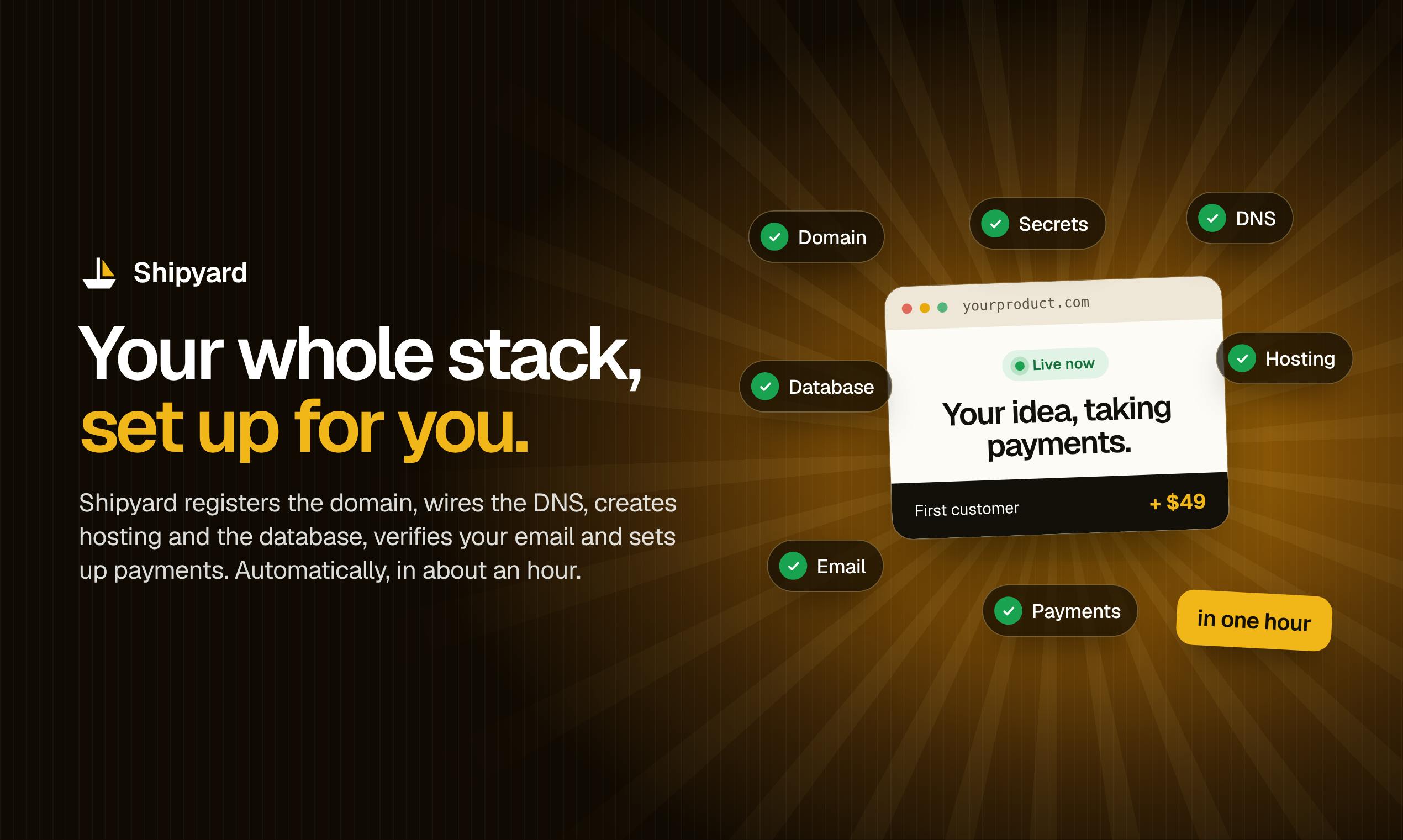
Shipyard uses a local CLI plus MCP to automate infrastructure configuration, turning vibecoding into vibeshipping.
Shipyard is a product on Product Hunt positioned as "infrastructure automation for the vibecoding era," taking the form of a local CLI plus MCP server, targeting Claude Code, Cursor, and Codex. It doesn't write code for users but automates the configuration of release steps like domains, DNS, hosting, databases, email, and payments. The official claim is that each new project can be set up in about an hour, and it generates build prompts tailored to the specific tech stack for AI. The product emphasizes that keys stay on the user's local machine to alleviate trust concerns about connecting to sensitive services like payments and databases. The article argues that it captures a new bottleneck exposed after the spread of AI coding—writing code has become faster, but the release process hasn't; however, its actual value depends heavily on integration coverage and configuration reliability, and current Product Hunt data (68 votes, rank 12, only 1 comment) shows it is still in an early exposure stage.
From "Vibecoding" to "Vibeshipping": What Shipyard Is Solving
A product called Shipyard has appeared on Product Hunt, positioned as "MCP for Claude, Cursor and Codex to Automate Integrations." Its starting point comes from a development scenario that is becoming increasingly common: with AI assistance, one person can write an app in a single evening, but what really slows down the pace is everything outside the app—domains, DNS, hosting, databases, email, and payments, each of which requires separate registration, configuration, and integration.
Shipyard describes itself as "built for the vibecoding era." It doesn't write code for you; instead, it automates the process of "getting your app out the door." The official workflow is: connect your accounts once, and every subsequent new product can have the above infrastructure set up automatically in about an hour, and your AI will receive a build prompt tailored to the specific tech stack.
Vibecoding is a term coined by OpenAI co-founder Andrej Karpathy in early 2025, referring to developers who barely write code line by line but instead describe intent in natural language, let AI generate the complete implementation, and only review and guide. Under this model, the barrier from idea to runnable app has been greatly lowered, and it's no longer rare for one person to build a prototype in an evening. But a new problem follows: finished code doesn't equal a launched product. Domain registration, DNS resolution, hosting deployment, database initialization, email services, and payment integration still require developers to register, configure, and connect credentials on each platform individually—becoming a new bottleneck. Shipyard's proposed "Vibeshipping" targets exactly this gap—handing the "shipping" step over to automation and AI collaboration, so that the output of vibecoding can truly become an accessible product, rather than just a prototype that runs locally.
Local CLI + MCP: Keys Never Leave Your Machine
Shipyard takes the form of a local CLI and an MCP server, targeting the three AI coding entry points: Claude Code, Cursor, and Codex. The role of MCP (Model Context Protocol) here is to expose the capabilities of external services to AI assistants in a standardized way, so the model can call them directly in conversation without the user switching back and forth between browser and terminal.
One design worth noting is "local-first": the official emphasis is that "Your keys never leave your computer." For tools that need to connect to sensitive services like payments and databases, whether credentials leave the local machine is a core concern for many developers, and Shipyard makes this a selling point, indicating it has a clear judgment of the trust threshold of its target users.
MCP (Model Context Protocol) is a standard open-sourced by Anthropic in late 2024, used to establish a unified connection method between AI assistants and external tools and data sources. You can think of MCP as "the USB-C port of the AI world": in the past, every AI coding tool that wanted to connect to an external service (such as a database, cloud platform, or GitHub) needed its own custom integration; with MCP, the service provider only needs to offer an MCP server, and any client supporting the protocol (Claude Code, Cursor, Codex, etc.) can directly call its capabilities. An MCP server typically runs as a local process or remote service, exposing a set of structured "tools" that the model can autonomously choose to call during conversation. The significance of this protocol is that it decouples "model capability" from "external system access," so that context supply no longer depends on developers manually copying and pasting, but is completed automatically through standardized interfaces.
One-Hour Full-Stack Setup: Where the Automation Boundary Lies
According to the product description, Shipyard covers domains, DNS, hosting, databases, email, and payments. These happen to be the minimal set for a SaaS product from zero to launchable, and also the parts most prone to repeated configuration. For indie developers who frequently build small products, going through these processes again for each new project adds up to a considerable time cost.
However, the "about one hour" claim describes the configuration process, not the quality of the product itself. Automation can solve the wiring problem, but it can't decide which database to use or how to design the payment flow for you. Shipyard's real value lies in reducing context switching, letting developers keep their attention on product logic rather than copying and pasting API keys across multiple consoles.
How It Works with AI Coding Tools
Shipyard generates "a build prompt tailored to the exact tech stack" for each project, and this point deserves elaboration. When AI coding tools generate code, if they don't know the actual hosting environment, database type, and payment service, they can easily produce code that doesn't run directly. Putting infrastructure information into the prompt upfront is equivalent to supplying the model with deployment-side context, reducing the amount of subsequent manual patching.
This approach also reflects a trend in the AI coding tool ecosystem: beyond model capability, context supply around the model is becoming a new competitive point. As a connection layer, MCP allows tools to feed structured environment information to the model, rather than relying on developers to describe it verbally.
Who Should Use It, and Who Can Wait
Judging from Product Hunt data, Shipyard received 68 votes, ranked 12th, and has only 1 comment, indicating it is still in an early exposure stage with limited community discussion. The value of such tools depends heavily on the breadth and stability of integrations—which domain registrars, hosting platforms, and payment services are supported directly determines whether it is usable for you.
For indie developers and small teams who frequently start new projects with a relatively fixed tech stack, the repetitive process automation offered by Shipyard has real appeal. For teams whose infrastructure is already standardized, or who have strict compliance requirements for credential management, the local CLI design alleviates some concerns but still requires evaluating whether its integration scope matches existing workflows. Currently, public information is not sufficient to judge the depth of its integrations, so it's advisable to confirm whether your commonly used services are on the supported list before trying it out.
Summary
What Shipyard captures is a new bottleneck exposed after the spread of AI coding: writing code has become faster, but the release process hasn't. Using MCP to bring infrastructure configuration into AI coding tools is a product idea with a clear direction. Whether it succeeds depends on integration coverage and configuration reliability, not on the concept itself.
One-line Summary
Shipyard uses a local CLI plus MCP to automate infrastructure configuration, turning vibecoding into vibeshipping.
Paragraph Summary
Shipyard is a product on Product Hunt positioned as "infrastructure automation for the vibecoding era," taking the form of a local CLI plus MCP server, targeting Claude Code, Cursor, and Codex. It doesn't write code for users but automates the configuration of release steps like domains, DNS, hosting, databases, email, and payments. The official claim is that each new project can be set up in about an hour, and it generates build prompts tailored to the specific tech stack for AI. The product emphasizes that keys stay on the user's local machine to alleviate trust concerns about connecting to sensitive services like payments and databases. The article argues that it captures a new bottleneck exposed after the spread of AI coding—writing code has become faster, but the release process hasn't; however, its actual value depends heavily on integration coverage and configuration reliability, and current Product Hunt data (68 votes, rank 12, only 1 comment) shows it is still in an early exposure stage.
Related articles
GPT-6 Designs Proteins, Claude Creations Become Apps with One Click, DeepMind Releases New Benchmark
OpenAI says GPT-6 can design protein 3D structures, Anthropic lets Claude creations install as desktop apps, DeepMind's HIP benchmark tests stability on simple questions, Google Workspace opens agent MCP interfaces.
OpenAI Weekly Roundup: GPT-6.2 Rolls Out to ChatGPT, GPT-6 Designs Proteins
OpenAI's week: GPT-6.2 rolls out to ChatGPT, GPT-6 claims independent protein design, agent research share surges, perplexity proposed as a shared metric, and internal safety concerns surface.

Is the Crypto Industry About to "Turn Blue"? The Truth Behind Tech and Politics' Shifting Allegiances
Vergecast discusses whether the crypto industry will shift from the right to the Democrats, revealing the pragmatic nature of tech's politics and the costs of a crypto pivot.