Short Drama Agent Tested: Is AI One-Click Video Production Actually Feasible?

A hands-on breakdown of AI short drama agents — impressive efficiency gains, but high costs and visual inconsistency remain real barriers.
Short Drama Agents chain together scriptwriting, character design, scene generation, storyboarding, and final video output into a single AI pipeline. Field tests show genuine efficiency gains — especially for simple cute-style content — but three pain points persist: high per-clip generation costs, the inability to make localized edits without full regeneration, and cross-frame visual inconsistency that requires ongoing human intervention.
Short Drama Agents Are Exploding: AI Is Reshaping Short Video Creation
Recently, a wave of sweet girl and cat-themed short videos quietly went viral on Bilibili — one creator gained 430,000 followers with just 26 videos. These cute-style clips look simple on the surface, but behind them lies a complete AI short drama production pipeline, powered by a feature that's been the talk of the short video creator community: the "Short Drama Agent."
A Short Drama Agent is essentially an all-in-one AI production line built for short drama creators. It's not a single AI model, but an orchestration system where multiple specialized AI models work in concert. Its underlying architecture draws from the "Pipeline Pattern" in software engineering, breaking the workflow into independent nodes — script generation (typically handled by large language models like GPT-4 or Claude), image generation (Stable Diffusion, FLUX, and other diffusion models), and video generation (Kling, Wan, Sora, etc.) — all coordinated by a workflow engine. The core value of this Multi-Agent architecture is that each node can be iterated and upgraded independently, and the output of one node can serve as conditional input for the next, enabling cross-modal transfer of semantic information. This means it's no longer just a "text-to-image" or "image-to-video" tool — it chains together the entire pipeline from scriptwriting and character design to scene generation, storyboarding, and final output, positioning itself as the creator's "dedicated AI film crew."
From a product positioning standpoint, tools like the one demonstrated in the video (Xiaoyunque Short Drama 2.0) have evolved from simple AI agents into full-fledged creative platforms. For individual creators who lack a professional team or have limited budgets, this "cost-reduction and efficiency-boosting" production model is genuinely compelling.
Three Steps to a Finished Video: The Cute-Style Production Workflow
Using the viral sweet girl and cat videos as an example, the entire production process can be broken down into three steps — the learning curve is surprisingly low.
Step 1: Generate Video Prompts
Creators can adapt prompts from popular videos or use a large language model to generate "copycat" prompt templates. Prompt quality directly determines the visual output quality and is the foundation of the entire workflow.
Step 2: Generate Character Three-View Sheets
In the Short Drama Agent's free canvas interface, add an image node and input a character description prompt. The AI first generates a front-facing image of the sweet girl, then expands it into a three-view sheet (front, side, and back), which is used to maintain character consistency across subsequent frames. The same process applies to the cat character — generate it based on a popular internet cat reference and fill in the required scene images.
The "three-view sheet" isn't just for aesthetics. Its core function is to provide the AI with multi-angle reference images, using techniques like IP-Adapter, ControlNet, or character LoRA to lock in the character's visual features. When diffusion models generate images, they're essentially performing denoising sampling in a high-dimensional latent space. Without multi-angle constraints, the same character's facial structure, clothing, and hair color can easily drift across frames. By providing front, side, and back anchor points, three-view sheets significantly improve character consistency across frames and scenes — this is the primary technical approach to solving the "visual inconsistency" problem, and one of the central research challenges in video generation today.
Step 3: Generate the Video
Add a video node, connect the character three-view sheet and scene images, input the video prompt, and the AI automatically generates the final output. The core logic of this pipeline is: maintain visual continuity across multiple clips through a combination of "character assets + scene assets + prompts."

This modular design is worth noting: it abstracts the traditional film production concepts of "casting, set design, and shooting" into reusable digital assets, freeing creators to focus on the creative content itself.
Short Drama Agent Field Test: The Full Pipeline from Script to Finished Video
Beyond cute-style short clips, the Short Drama Agent's bigger ambition is generating complete narrative short dramas. The video creator tested a full run-through using a "Chinese fantasy xianxia revenge drama" as the case study.
Intelligent Script and Asset Planning
Users can upload a script directly or simply provide a brief concept and let the AI generate a script outline. Once the outline is confirmed, users choose a visual style and aspect ratio, and the AI outputs the complete script. When moving into the character and scene design phase, the system automatically maps out which scenes correspond to which episodes, and which characters appear in each episode.
For example, the female lead has multiple forms — "past life divine maiden," "returned divine maiden," and "awakened divine maiden" — and the AI plans all of these in advance, even generating voice tone descriptions for each character. This system-level asset management capability is something ordinary patchwork tools simply can't match.
Storyboarding and Video Generation
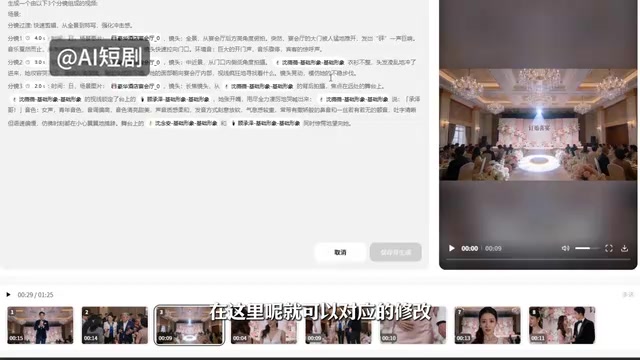
Once assets are ready, the system generates a storyboard first, then produces video clips segment by segment. A storyboard is the critical bridge in film production between the written script and actual shooting — traditionally hand-drawn by a professional storyboard artist, covering shot types, camera angles, character actions, and transition styles. The challenge of AI-generated storyboards lies in the fact that large language models naturally excel at semantic logic, but the visual grammar of "wide shot → medium shot → close-up" is a specialized cinematic language that requires models to have absorbed large amounts of paired film script and storyboard data during pretraining. Current Short Drama Agents typically rely on LLMs fine-tuned on film industry data, automatically mapping literary descriptions like "character emotion intensifies" to cinematographic instructions like "low-angle close-up + push-in shot," which are then passed to the video generation module. Each clip's prompt can be individually edited, giving creators some room to adjust.
Looking at the final output, whether it's the sweet banter between the girl and her cat or the dramatic tension of the xianxia "reincarnation revenge" narrative, the overall quality is already quite watchable, with solid narrative coherence.
The Real Limitations: Expensive, Inflexible, and Inconsistent
The field test also exposed three major pain points in this AI short drama pipeline — creators should approach it with realistic expectations.
High Generation Costs
Cost is the most immediate barrier. Based on the figures in the video, generating a 9-second clip consumes 99 credits — roughly "10 yuan per 10 seconds." This pricing reflects the computational economics of AI video generation: video generation models (such as Wan 2.1 and CogVideoX based on the DiT architecture) must perform independent diffusion sampling for every frame. A 9-second, 24fps video means 216 frames of parallel or sequential computation, consuming tens of gigabytes of VRAM and several minutes of A100/H100 GPU time per inference. By comparison, image generation typically takes only seconds. As model distillation, Consistency Models, and inference acceleration technologies continue to advance, video generation costs could drop by an order of magnitude within the next one to two years. But for now, running the full pipeline on a complete short drama with dozens of storyboard segments adds up quickly — and repeated revisions can burn through budget fast.
Rigid Editing Mechanisms
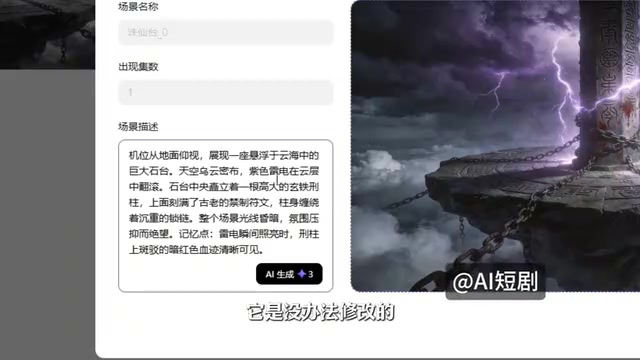
Another significant shortcoming is the lack of editing flexibility. When a generated image has only minor flaws, users can't make localized adjustments — they have to regenerate the entire image from scratch. The root cause of this limitation lies in the generation logic of current mainstream diffusion models: the image generation process is essentially an irreversible multi-step denoising procedure from random noise, and the model doesn't maintain an explicit mapping of "which pixel corresponds to which semantic element." While Inpainting (localized redrawing) theoretically enables partial edits, in complex character poses and lighting conditions, localized modifications often produce visible seam artifacts that degrade overall quality. This is fundamentally different from Adobe Photoshop's "layer" concept — AI-generated images are currently closer to an "already-exposed piece of film" than a layered, editable digital canvas. The industry is exploring breakthroughs through DiT architectures and 3D-aware generative models. Not only does this waste credits, it dramatically increases the cost of trial and error.
Visual Consistency Challenges
The most fundamental technical challenge is visual consistency. The same character and scene often fail to maintain consistent camera angles and spatial positioning across different clips — a character might be in the foreground in one clip and drift to the background in the next, with an obvious mismatch. The underlying issue is that video generation models lack persistent understanding of 3D space: each clip is an independent generation process, and the model cannot maintain a fixed "world coordinate system" the way a real camera does. While carefully crafted prompts (explicitly specifying camera direction and character positioning) can help mitigate this, the high cost of revisions makes this a persistent pain point. The research community is currently exploring video generation solutions based on NeRF (Neural Radiance Fields) and 3DGS (3D Gaussian Splatting), which may fundamentally resolve the cross-frame spatial consistency problem.
Conclusion: Usable, But Far From Fully Automatic
Overall, Short Drama Agents represent a clear trend in AI content production moving from "point tools" to "full-pipeline platforms." By integrating scriptwriting, character design, scene creation, storyboarding, and final video output into a single system, the efficiency gains for creators are real and tangible — for simpler content like cute-style short videos, the results can even rival paid productions.
That said, the field test is honest about the limitations: a true "one-click, fully automated" end-to-end production is still not realistic today, and human intervention for editing and adjustments remains necessary. High computational costs, the inherent editing constraints of diffusion model architectures, and visual consistency issues are three very real barriers creators face.
For creators looking to capture early traffic advantages, now is the window to learn and position yourself with these tools — mastering prompt engineering and asset management logic before the tools fully mature often provides a meaningful first-mover advantage. But it's important to be clear-eyed: AI short drama tools today are more like a highly efficient "semi-automated film crew" than a magic button that completely replaces human creative work.
Key Takeaways
Related articles
What Is Vibe Coding? The AI Programming Skill Every Developer Needs
What is Vibe Coding? Learn how AI programming is reshaping dev teams, why traditional programmers face displacement, and why Cursor & Claude Code matter.
Making Rocks Think: A Philosophical Exploration of Generative AI and Information Compression
From a viral Reddit post to deep AI theory: why compression equals understanding, the Library of Babel thought experiment, semantic compression, and the Hutter Prize.
Irregular Warns: Four AI Lab Security Breaches Traced to the Same Root Cause
Irregular reveals four AI lab security breaches share a single root cause, exposing systemic risks from technology stack homogeneity across the AI industry.